The outer blurb
and booklet notes make a big thing of the coupling on this disc:
“Pairing Mozart’s String Quartet K.464 and String Quintet K.593
amounts almost to a militant gesture: defending two relatively
little-known works ...” Little known works? by Mozart? Surely
not. Trawling through the catalogue however certainly reveals
a dearth of readily available recordings of the K.593 Quintet,
and K.464 appears most often in complete sets of the ’Haydn’
set. The point Antoine Mignon is making in his booklet notes
is that each of these works suffer in the shadow of more famous
close relatives, namely the ‘Dissonance’ Quartet K.465, and
the K.515-516 Quintets.
Whatever the thinking
behind presenting this programme, it certainly works well. Both
of these works fall into the ‘sunny’, more relaxed category
of Mozart’s output, which is not to say that the music is a
pushover to the serious listener. Filled with subtle twists
and turns, for instance in the extended variations of the Andante
third movement of K.464, Mozart revels in the purity of
expression the medium offers. The balance of apparently simple
melodic shapes and the intellectual demands of a highly developed
polyphony make this work as easy or as complex as a game of
chess, depending on how you approach it. Mozart himself, in
his dedication to Haydn, freely admitted that these ‘sons’ cost
him ‘the greatest fatigue, the most labour’ and with the compact
intensity of development from a minimum of means in the finale
I can well believe it.
The Brentano Quartet
performs with a great deal of subtle gradation of colour and
nuance. Theirs is a relatively romantic view both of these works,
employing all of the expressive resources of modern string quartet
technique while remaining sensitive to Mozart’s style and idiom,
much as they appear with recordings such as those of the Hagen
Quartet or the Lindseys. Arguably, there could be more
expression drawn from some parts of the music, but there is
a fine line to be drawn between intense involvement and mannered
over-reverence, and I sense that The Brentanos know exactly
where those boundaries lie.
The fuller ensemble
of the String Quintet K.593 provides quite a surprising contrast
with the quartet, and the balance of the instruments shifts
a little, the cello being pushed more to one side. The playing
is excellent however, not inhumanly perfect in all of those
runs, but utterly convincing – exciting and graceful, transparent
and sensitive, moving and eloquent. It’s one of those recordings
that, when you play it, you find yourself thinking, ‘I wouldn’t
mind if they played this at my funeral…’ Is it entirely perfect?
Not completely: First violin Mark Steinberg’s vibrato is just
a little too loose and slow on occasion for my taste, and the
odd mildly irritating grunt pops in from his position from time
to time. There are some acoustic reflections which give a mild
phasing effect at some sections later on in the Quintet which
suggests some kind change between sessions - possibly even just
a change in the weather. These are very minor gripes however,
and are only likely to crop up if you have to write a review
and find something negative to balance all of those superlatives.
With a gorgeous bloom of acoustic resonance from the venue and
plenty of air around the musicians, this beautifully engineered
package is one with which I shall be able to live happily for
a long time.
Dominy Clements












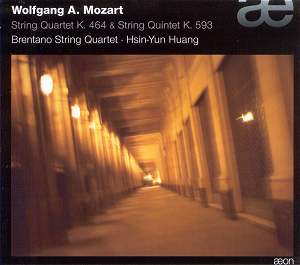

 Brentano String Quartet