Zinka Kunc was born
in Zagreb on 17 May 1906. Incidentally
both the back of the jewel case and
the heading of the tracklist have got
her birth and death years wrong, mixing
them up with the years for her Metropolitan
partner Jussi Björling. The biographical
notes in the booklet are correct, though.
She studied in her
home town as well as in Prague and Milan
and after her debut in 1927, singing
Leonora in Il trovatore, she
spent the next ten years at the Zagreb
opera with guest appearances in Hamburg,
Dresden and Prague, where Edward Johnson,
Manager of the Metropolitan Opera, heard
her and engaged her to the Met. She
made her debut there, again as Leonora,
on 17 December 1937, now as Zinka Milanov,
having adopted her husband’s name. She
went on singing in the house for 24
seasons in more than 420 performances.
Add to this guest appearances in Chicago,
San Francisco, Buenos Aires and in due
time also arrived at La Scala Milan
in 1950. In London she had sung a couple
of concerts with Toscanini before the
war. Covent Garden had to wait until
1956, when she sang Tosca, a role she
returned in the following year, singing
against the young Franco Corelli; a
recording of the performance on 1 July
1957 exists and was reviewed
not long ago. Tosca and Maddalena in
Andrea Chenier were two of her
great roles but she will probably be
best remembered as one of the pre-eminent
Verdi sopranos of the period. She continued
singing until 1966 and after that led
a quiet life in New York with her second
husband. She passed away in May 1989.
On this disc Nimbus
have collected scenes from four Verdi
operas, recorded during the first half
of the 1950s. Her voice was still in
fine fettle with a healthy ring on the
top notes, steady all through the register
and with her ability to float high pianissimo
tones intact. She had also lived with
these roles so long that she knew them
inside out and every phrase, every inflection
is so well considered, so at one with
the predicament of the character. What
can be seen as a drawback is the fact
that her voice sounds elderly, which
must not be interpreted as aged. She
was a mature singer at the time, in
her late 40s, and she sounds her age,
which jars with the characters, who
are supposed to be much younger women.
I shouldn’t make too much of this and
of course in the absurd world of opera
we seldom get opportunities to hear
singers of the leading roles who really
are their age.
And there are many
magic moments in this recital. With
the reliable Renato Cellini conducting
most of the excerpts she has an ideal
accompanist, sensitive, flexible and
unobtrusive. Aida is of course a role
for a dramatic soprano but it also requires
the ability to scale down a big voice
and sing softly and Milanov obliges
in both respects. She hurls the high
C in O patria mia up to the gallery
with tremendous power and then softens
it down to a beautiful pianissimo. Of
the two arias from Un ballo in maschera
especially Morrò, ma prima
in grazia is delivered with hushed
intensity and long phrases and an impressive
final note, while in Ecco l’orrido
she has her caustic moments. The duet
with Riccardo, which follows immediately
after the aria, is not wholly free from
a certain edge either and Mitropoulos
presses on too much, making it more
hectic than it needs to be. Jan Peerce
as Riccardo phrases well and he has
glow but his voice is on the dry side
and he shows signs of strain. There
is also some overloading in this number,
which continues with the scene when
Renato appears and doesn’t end until
Riccardo leaves. I would have liked
a couple of cue points in this almost
23-minute-long scene for example to
make the duet easily accessible. These
excerpts from Ballo are from
a highlights record, which also boasted
Marian Anderson as Ulrica.
The scenes from La
forza del destino finds Zinka Milanov
in superb form and her in La Vergine
degli Angeli is certainly angelic.
Both here and in Madre, pietosa Vergine
an un-credited chorus is present – and
a good one at that, probably the Robert
Shaw Chorale. In the final scene we
also hear Peerce, Leonard Warren – who
also sings Renato in the Ballo excerpt
– and bass Nicola Moscona, all three
frequent colleagues at the Met.
From Il trovatore
we get Leonora’s two arias, Tacea
la notte followed by the cabaletta
Di tale amor, where she lightens
the tone admirably and in D’amor
sull’ali rosee she also sports her
elegant trill. This is marvellous Verdi
singing by any standards. In Miserere,
again with splendid choral contribution,
Jan Peerce is a good Manrico. I was
a little perplexed by the recording
dates for these Trovatore excerpts,
since the booklet says February 1952,
which was also the period (21 February
to 16 March) when RCA recorded Trovatore
complete with Cellini and the RCA
Victor Orchestra and with Milanov as
Leonora. Why should they record her
twice? Or are these arias alternative
takes or even identical with the ones
from the complete opera? I have listened
closely several times to both versions
and they sound very similar but I can’t
swear that they are identical. At least
the short dialogue between Leonora and
Inez before the cabaletta in Tacea
la notte is not included but this
is of course easy to cut from the master
tapes. The Miserere is anyway
a separate recording, since on the complete
set Jussi Björling sang Manrico.
The transfers are excellently
done and Alan Bilgora’s liner-notes
are a good read. There are few Verdi
sopranos who can challenge Zinka Milanov
and these excerpts from four favourite
roles show her almost constantly in
the best possible light.
Göran Forsling
























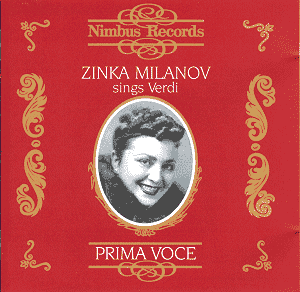
 Zinka Milanov (soprano)