This
volume follows on where volume
1 ended: in the middle of the recording session on 16 October
1937. In toto 18 titles were recorded on that occasion,
evidence of Lotte Lehmann’s extraordinary stamina. There is no
audible decline in her tone even in the last numbers. The highpoint
is Brahms’ Botschaft where she challenges Hans Hotter’s
famous reading from the mid-1950s. On the whole her Brahms is
superb. Mein Mädel hat einen Rosenmund is initially sung
with heavier accents than Elisabeth Schwarzkopf. The latter recorded
all 42 solo songs from Deutsche Volkslieder together with
Dietrich Fischer-Dieskau, a set that has been my touchstone recording
for forty years. Then Lehmann lightens the tone and is as delightful
as her heiress.
Tonerna
(literally “The tones”) was one of Jussi Björling’s favourite
songs, which he recorded several times, both with piano and -
in the late 1950s - with orchestra. It is a setting of Swedish
19th century poet and composer Erik Gustaf Geijer,
one of the central literary figures of that era. The music is
by Carl Sjöberg. As a composer he was mainly self-taught. He wrote
a piano quartet and quite a number of songs but Tonerna,
written in 1892 and not printed until the year after his death,
is the only composition of his that has survived. He was a doctor,
during the last six years of his life active in the little Swedish
town Hedemora, about 40 kilometres south of Borlänge, the Björling’s
birthplace. Lehmann sings it in an English translation and her
legato is admirable. She invests it with more drama than Björling
who, especially in his 1952 recording, is so magically inward
and pensive, more in line with the introspective text. I googled
in vain to get some information about Calcott to who Drink
to me only with thine eyes is attributed. I have always regarded
this as a traditional English folksong, although the words are
by Ben Jonson:
Drink to me only with
thine eyes
And I will
pledge with mine.
Or leave a
kiss within the cup
And I'll not
ask for wine.
she sings with warm tone and noble phrasing. I believe
though that after this long recording session she might have
wished to fortify herself with something stronger than a kiss.
During the next session, almost two years later, her
voice is marginally warmer and the piano tone less tinny. In
some songs, though, there is an edgy halo surrounding the voice.
This is especially noticeable on Nun lass uns Frieden schliessen,
where there is also some bacon frying in the studio; probably
the reason why it was never published on 78rpm. In general however
the recording catches the beauty of her voice better than on
the 1937 sides.
Among Elisabeth Schumann’s Lieder recordings from the
same period there was hardly one song that was technically perfect.
On the other hand everything was so alive that all criticism
was at once silenced. By contrast Lotte Lehmann is as close
to perfection as it is possible to get, without being lifeless.
She may be the more thoroughly calculating of the two but she
is not over-sophisticated. The whole Wolf section is marvellous.
Der Knabe und das Immlein is the song that lingers longest
in one’s memory. It is a thousand pities that her admirers in
the 1930s were never privileged to hear it, since it also remained
unissued until now.
Lotte Lehmann’s Feldmarschallin in Der Rosenkavalier,
as well as her Ariadne, placed her as the Strauss soprano
of her time. She was also a leading Wagnerian and in that field
she often appeared with the greatest Wagner tenor of all time,
Lauritz Melchior. Their first encounter was in 1926 and their
collaborations are memorably preserved for posterity on that
legendary complete act 1 of Die Walküre with Bruno Walter.
Here they are joined again, quite surprisingly, in five duets
by Robert Schumann. The orchestral sound is fairly scrawny,
the singing anything but. Melchior was no Lieder singer, even
though he recorded numerous songs, primarily Danish ones. He
also recorded some Schubert. Träume and Schmerzen
from Wagner’s Wesendonk-Lieder he set down twice. He
also recorded Sjöberg’s Tonerna. These Schumann duets
are in effect little scenas and both singers enjoy themselves
greatly, singing beautifully and softly in the folksong-like
So wahr die Sonne scheinet. They are in really high spirits
in Unterm Fenster.
The last session was devoted entirely to Schubert:
eleven songs from Winterreise. Intended for a male singer
the songs are still well suited to a female voice. Lehmann was
not the first woman to essay them on disc; Elena Gerhardt preceded
her. One of the most gripping recordings of this cycle is Brigitte
Fassbaender’s on EMI and though Lotte Lehmann’s soprano is lighter
than Fassbaender’s deep mezzo she still has an altoish roundness
in the lower regions of her voice that gives her reading a tragic
undertone. She takes Die Nebensonnen - the penultimate
song in the cycle - rather fast and though I prefer more measured
she still brings forth the spirit of resignation. Since all
the sides on these discs are presented in the recorded order
one gets a somewhat peculiar feeling when jumping back and forth
through the cycle, as when after Die Nebensonnen one
expects Der Leiermann one instead gets the lively Der
Post with the hooves trotting at rollicking speed. Forgetting
momentarily the intended progression of the cycle, each of the
songs is performed superbly. Lehmann’s insight sometimes makes
listening almost unbearable through the intensity of her readings.
Die Krähe had me grabbing the arm-rests of my chair due
to her hushed intensity. Her readings are certainly dramatic
but at the same time not overtly histrionic. In the main this
is a classically balanced reading where Rückblick is
so beautifully rendered that I momentarily forgot even Fischer-Dieskau’s
(with Gerald Moore on DG) and Olaf Bär’s hitherto unbeatable
versions.
This disc is a must for every lover of German Lieder
and the only possible hang-up is the quality of the recordings.
Mark Obert-Thorn has done what it is possible to achieve to
make them as listen-friendly as can be. In any event one soon
forgets such a peripheral detail won over by the all-conquering
singing.
Göran
Forsling
























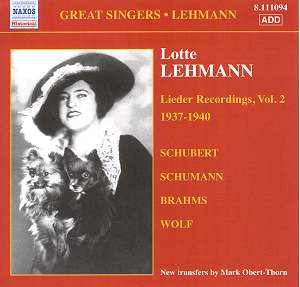
 Lotte Lehmann (soprano)