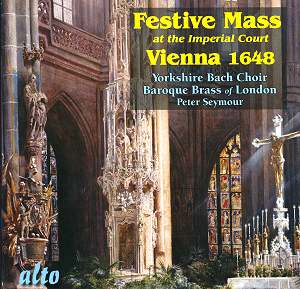
Here
we have a CD recorded in 1989 and already in its third incarnation.
What is interesting is that we hear not some warhorse but a
collection of pieces that might have constituted a Festival
Mass in Vienna to celebrate the Peace of Westphalia in 1648.
The sequence comprises a mass, three appropriate propers (if
one can say that), four brass works and several motets. Some
of the composers are better known than others, but none of them
is of the fame of a Gabrieli or Schutz and most of the music
here is unavailable elsewhere. However, it’s all interesting
and in the case of the Straus, quite impressive.
The
disc opens and closes with Imperial Sonatas by Girolamo Fantini,
perhaps the greatest trumpeter of the period. The Sonata No.
1 is well known and except for No. 2 and the Bertali works, the
only music available elsewhere (review).
It is only one of many such works that Fantini wrote for both
the Medici and the Hapsburgs, although these two pieces were probably
written for the coronation of the Holy Roman Emperor Ferdinand
II in 1619. As with No.1 the Second Imperial Sonata demonstrates
the Gabrieli style, which was then arriving in the German-speaking
countries. The second Sonata morphs into the first at the end.
The
Mass itself is by Christopher Straus, actually a native Viennese
and Kapellmeister to Emperor Mathias. At the accession of Ferdinand
II (see above) Straus was replaced by Priuli and “kicked upstairs”
to St. Stephen’s Cathedral. The Mass is a full-scale work and
has thematic connections between the sections as well as plenty
of reminders of the recent military events. The first section
of the Kyrie comprises an opening symphonia that is a
little disappointing after the Fantini mentioned above. This
goes directly into an elaborate kyrie eleison followed
by a simpler, more old-style christe eleison and then
back to the first kyrie eleison. The Gloria flows
thematically from the Kyrie. There are several beautiful
unaccompanied parts for the men, which they sing excellently.
Yvonne Seymour and especially Margaret Cable are even better
as they alternate with the male voices. The Credo is
less exciting than the first two movements of the mass, but
acts as a kind of slower interlude before Rauch’s Benedicite
and the triumphant Sanctus; in both of which Peter Seymour
gets a beautiful sound from the singers. The Benedictus
makes more use of the soloists, ending with interesting antiphonal
work. In the impressive Agnus Dei one must again mention
the singing of Margaret Cable, which stands out among a raft
of talented singers on this recording.
Of
the smaller elements of the service one must say that the two
Bertali Sonatas do not measure up to the two Fantini ones (review).
Similarly I found the first Rauch motet exciting but not as moving
as the Rauch Jubilate Deo. This may be due to fact that
the first is a political work and the second a liturgical one.
It may also be due to the performers agreeing with my opinion
since Atollite Portas gets the least committed performance
on the disc. Rauch’s Benedicite must count as the most
elaborate and rewarding work after the Straus Mass. It effectively
alternates solos and chorus, punctuated by intradas from brass
and drums. Peter Seymour handles the various forces with his accustomed
subtlety. The Rauch Pater Noster is a little lacklustre
after what goes before it, but the Cantate Domino is a
wonderful example of combined polychoralism and concertato work.
It’s a fine example of the various compositional winds that that
were blowing through the Holy Roman Empire from all musical directions
at this time. The Priuli works are also worthy of notice.
Although
this is a recording made almost twenty years ago the sound is
surprisingly clear of interference. The Chapel of Stet. Mary
and St. Evirilda is free from distortion and does not add “bounce”
or flutter as happens in some recordings of music of this period.
The only sonic complaint is that there is some flatness in the
chapel sound, but this is not a major complaint in a recording
made in 1989. It seems that the engineers at Alto have done
a fine job on this reissue.
Yvonne
Seymour and Margaret Cable have been mentioned above. The male
singers and the Yorkshire Bach Choir and Baroque Soloists are
also fine, but the real reason, to me, for releasing this disc
again is as an example of the excellent work that Peter Seymour
has done in his various capacities at York and its University
for three decades.
William Kreindler