Only very recently
I was reviewing
another Brilliant set of Brahms symphonies,
licensed from EMI and conducted by Wolfgang
Sawallisch. This cycle got a mixed reception
when it was new and that’s what it got
from me. While looking up my review
to make a link, however, I found a 2003
review on the site of this cycle in
its original EMI form by Rob Barnett
who took a more positive view.
The highlight for me was a powerfully
tragic fourth, the drawback a pedestrian
first – and a dreadfully humdrum Haydn
Variations. 2 and 3 were good without
matching my favourites, respectively
Boult
and Klemperer.
The whole situation simply reinforced
the old truism that no single conductor
can manage all four symphonies equally
successfully, and I suggested that the
cheapest way to make sure you have at
least one good performance of each is
to buy Janowski
– let down by a lack-lustre fourth –
and Sawallisch.
Brilliant’s response
was to send along this home-grown Dutch
set. Believe it or not, here at last
is a set that can be recommended all
through.
Jaap van Zweden was
born in 1960 and at the age of 19 became
the youngest concertmaster ever of the
Royal Concertgebouw Orchestra. He branched
into conducting in 1995 and in 2000
became Chief Conductor of the Hague
Residentie Orchestra.
More than any conductor
in this repertoire since Klemperer,
van Zweden brings the wind into democratic
equality with the strings. He also goes
for an almost organ-like equality of
balancing of the wind choir, rather
than "soloing-out" the instrument
which has the tune. So when, in the
slow movement of no. 4, the clarinets
take over the famous theme from the
horns, we also get to hear a bassoon
line that is usually damped down. At
several points in the symphonies I noted
a familiar passage taking on a new hue
with a burbling contrabassoon on the
bottom line which is more usually made
to mind its manners.
On the debit side,
both orchestras are good rather than
infallible over intonation and the textures
sometimes become clotted, but the performances
have sufficient rhythmic life to avoid
heaviness. This is an unfailingly warm-hearted,
full-blooded Brahmsian sound and seems
to represent a genuine attempt at redirecting
the modern symphony orchestra towards
the sort of sound-mix Brahms himself
is likely to have heard. Go to Sawallisch
in the third movement of no. 3 and you
will hear something totally different;
a great conductor apparently improvising
the most subtle refinements of phrasing
and balance from a great orchestra.
But Sawallisch and the LPO didn’t always
click like that and even in this movement
I find van Zweden’s straightforward
songfulness equally rewarding.
There are sign of Historically
Informed Practice in the phrasing, especially
in the first two symphonies. Van Zweden
often concentrates on tight little cells
rather than long lines, but structures
as deeply rooted as Brahms’s can take
care of themselves. Alongside the Historically
Informed there are also a few romantic
touches. In the coda of no. 1 the chorale
theme is broadened out in the old-fashioned
way, while the end of no. 2 there is
a marked accelerando. Second subject
territory relaxes somewhat in the first
movement of no. 2. Here I still prefer
the seamless way in which Boult unfolds
this movement – and the entire symphony
– but van Zweden knows how to relax
without losing the flow.
While lyrical passages
find van Zweden aptly flowing and aptly
sprung, he comes into his own with the
sheer gut conviction with which he infuses
the more dramatic moments. This results
in a no. 4 scherzo of daemonic power
– I don’t think I’ve ever enjoyed a
performance of it more – followed by
a finale of blazing conviction. In spite
of my praise for Sawallisch in this
symphony, I would not rank van Zweden
lower. I was also pleased to find van
Zweden countering the modern tendency
to stretch out the slow movements. At
10:42 he is closer here to swifter Brahmsians
such as Klemperer (10:19) and Boult
(10:00) than to the longueurs of
Colin Davis
(11:34), Sawallisch (12:12) and Janowski
(12:37).
This tendency towards
flowing slow movements is also present
in the third symphony, where his 08:26
is midway between Boult’s 08:35 and
Klemperer’s 08:17. Surprisingly, this
time Janowski is among the brisker ones
(07:57), with Sawallisch (09:17) and
Davis (10:02) taking their time.
In the slow movement
of no. 1 van Zweden (08:33) is not far
from the swifter-flowing Boult (08:27).
Klemperer was in a heavy mood when he
set down this symphony and comes in
at 09:25, siding with the slower Janowski
(09:28) and Davis (09:59). Sawallisch
is this time among the more mobile (08:59)
but he was evidently having an off-day
and communicates very little.
Van Zweden seems to
have taken particular note of the fact
that only one slow movement in all four
symphonies is actually marked adagio,
albeit "Adagio non troppo":
that of no. 2. Here he takes a fairly
stately 09:52, close to Sawallisch (09:56)
and Janowski (10:02). Davis is less
expansive than usual (09:39). Klemperer
takes a brisker 09:18, while Boult’s
08:29 even shaves a couple of seconds
off Toscanini
(08:31). Taking Brahms’s markings at
face value, van Zweden would seem to
have good reason for siding with the
slower performances in this case.
Incidentally, these
timings are all from my computer. I
realized something was wrong when I
saw the slow movement of van Zweden’s
no. 1 timed at an incredible 12:03 –
and it certainly hadn’t seemed slow.
Thereafter I checked the timings of
all these six cycles and in every case
the printed timings were at variance
with reality, often by ten seconds or
more, though nothing else matched this
discrepancy of over 3 minutes. Just
what is the point of printing timings
at all if you don’t even try to get
them right?
I think this is the
first time I have reviewed a Brahms
cycle and not adopted a symphony-by-symphony
approach. This is a tribute to van Zweden’s
consistency – there is no need here
to separate the good from the bad. Furthermore,
I had the impression at the end that
van Zweden had played the entire cycle
of symphonies like one gigantic symphony
in four movements, an inexorable progress
towards the heroic but uncompromising
fourth.
Of course, there are
drawbacks. Near the beginning of no.1
I was disconcerted by a sudden drop
in dynamic level that I listened to
several times without deciding whether
it was a fussy piece of dynamic shading
or an accidental piece of knob-twiddling
by the engineers. I rather think the
latter. The first note of no. 2 seems
too short, as though the recording equipment
had been switched on a split second
too late. Those who applaud the decision
to give the repeat in the first movement
of no. 2 will presumably regret the
omission of those in nos. 1 and 3. I
don’t give up my allegiance to Boult
in no. 2 and Klemperer in no. 3, nor
would I be without Sawallisch in no.
4. But if you opt for only one Brahms
cycle then you can safely buy this,
which has no weak link in it.
You will also get a
rather unusual extra item. Brahms’s
final work was a series of chorale-preludes
for organ. This is not an instrument
with which he was much associated and
they have their problems. As a pianist,
he was used to touch-sensitive keyboards
and much of the writing seems to cry
out for the sort of direct expressiveness
which the organ cannot provide. Yet
playing them on the piano – as the Italian
pianist Mario Delli Ponti frequently
did – is not wholly satisfactory either.
You get the touch-sensitiveness, but
you realize Brahms had sustained sounds
in mind. An orchestration may seem the
answer. At least some were orchestrated
long ago by Erich Leinsdorf. I haven’t
heard these but I understand they evoke
the colours of the romantic organ. Henk
de Vlieger makes no attempt at this,
or at the sort of orchestration Brahms
himself might have made. Nor does he
make a riotous send-up of the music
as Schoenberg did in his transcription
of the Piano Quintet. He is closer to
Rubbra who took the Handel Variations
as an opportunity to investigate certain
aspects of his own style. "Schmücke
dich", for example, gets very intimate
treatment. So far nobody who has tried
orchestrating Brahms has succeeded in
adding a new work to the regular canon
and I don’t think de Vlieger will either,
but it makes for intriguing listening.
Tempi and phrasing are often very different
from what would be effective on the
organ, but are probably right for the
context.
If you’re building
a basic collection, this set will leave
you needing the Haydn Variations and
the two overtures. If still available,
there’s a useful 2-CD Boult compilation
which gives you all his Brahms except
the symphonies – the two serenades,
the two overtures, the variations and
the celebrated Alto Rhapsody with Dame
Janet Baker. Boult’s liking for swift
slow movements reached controversial
extremes in the serenades, but at least
he’s not dull and these two sets will
together give you all of Brahms’s orchestral
music except the concertos – and the
few Hungarian Dances he orchestrated
himself – without any duplications.
Christopher Howell
























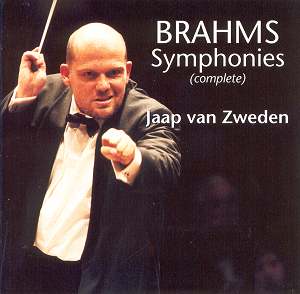
 for details
 Netherlands Philharmonic Orchestra, Amsterdam/Jaap
van Zweden
Netherlands Philharmonic Orchestra, Amsterdam/Jaap
van Zweden