It’s interesting
that the major effort of writing such a huge 1st
quartet meant that Bloch may well have felt that he had nothing
further to say on the subject. The 2nd Quartet dates
from 1945, some twenty-nine years later. Again, it’s a war-time
piece, but after that the remaining quartets were composed quickly
with his last, the fifth, from 1953. Laurel’s booklet notes
by John Erling state that this 1st quartet is probably
Bloch’s finest. I have not heard the others but it would difficult
to imagine that they are finer. On my two or so playings, I
can say immediately that this is surely a major work and one
that is dramatically gripping. I also found the Quintet a fine
work too; if anything even more gripping. It’s worth remembering
that as he was writing it Bloch was becoming increasingly aware
of his own mortality due to illness. Yet the work is full of
passion and energy.
But what do you
expect when you listen to Bloch’s music? Perhaps you have heard
the wonderful ‘Israel Symphony’ of 1914 or ‘Schelomo’ the Hebraic
Rhapsody for cello and orchestra of 1923 or the even earlier
and rather romantic ‘Three Jewish Poems’ of 1913. Then there’s
‘From Jewish life’ for cello and piano of 1925. These are hardly
standard repertoire works and are rarely played in the UK. They
are in fact just a few of Bloch’s more nationalistic utterances.
He had another side and we can hear that in these two chamber
works.
I found myself wondering,
and perhaps this is not too fanciful, if Bloch was a little
like Elgar. His public face being the above pieces with ‘nationalist’
Jewish titles. Then there was the private face: the chamber
works including the violin sonatas, the Concertino for viola,
flute and strings, the more popular, neo-classical concerto
grossos for strings and piano, and many other pieces. I leave
to you to consider this point further, but let’s look at these
two works.
In the case of the
1st Quartet Bloch admitted that it was an openly
autobiographical work written at “at a period of a double crises,
the crises of the world and a crisis in my own life - the expatriation
from my native country, Switzerland”. It opens with an expansive
movement of over thirteen minutes duration .Before long you
understand what the booklet annotator John Erling means when
he writes that the music “is devised to magnify the sound of
the four instruments”. You can imagine it would work well for
a string orchestra. And although he specifically mentions this
in relation to the ferocious second movement (marked allegro
frenetico) I do think that it applies also to the passionate
sections of this opening movement. This is a classical movement
in form, however Bloch himself is quoted as saying “it may appear
very free at times, melodically, modally, rhythmically, but
it’s certainly neither rhapsodical, nor free”. The second movement
is angry and rhythmically challenging and fits in with the comments
of Bloch quoted above. The 3rd movement in conciliatory.
It is the same length as the first and certainly has its ‘angst’
especially in the central climax, but it is marked ‘Pastoral’
and that is mostly its mood.
At this point I
must say a word about the recording. Firstly we are not given
enough information about its antecedents but it is rather brittle,
bright and I could say ‘in your face’. In addition my version
was faulty on track 1. This recorded sound works to a certain
extent with the opening movement and with the vivace finale,
the longest movement, but in the slow movement the effect can
be harsh, even if you jump up and turn down the treble. These
comments also apply to the Piano Quintet.
The Quintet falls
into three compact movements: Animato, Andante and
finally an Allegro which is the longest of the three.
It was premiered by the famous Juilliard Quartet and the end
of the third movement was described by Howard Taubman who was
at the time music critic for the New York Times as having a
“mood both inward looking and serene in its closing pages”.
I would add yes, but after much turbulence, tension and questioning.
The Sonata Allegro has an almost dodecaphonic first theme. I
thought of Alban Berg at least once and sometimes Hindemith.
The movement is full of fire and of conflict and represents
Bloch’s crowning achievement in chamber music.
I love the music
but not the recording and will look elsewhere for a more permanent
version of these pieces for my collection. However the performances
are truly fantastic and committed and if you can bear the recorded
sound then the Pro Arte Quartet and Howard Karp will impress
you. They really believe in this music and convince right from
the first bar. Their co-ordinated dynamics especially in challenging
passages are a revelation and their love of these scores shines
through.
So I’m in a bit
of a dichotomy really, I’m not sure what to recommend, but then
it was ever thus with CD collecting.
Gary Higginson
And another perspective from Rob Barnett
Bloch’s sequence
of five quartets began with the hour long Quatuor à Cordes.
The first three movements were written in Europe; the finale
was the first piece of music he completed in the USA. Europe
was deep in the Great War. His next quartet would not appear
until the final year of the next World War. His new homeland
offered him little financial reward and, at first, few friends.
Without bursting
the bounds of tonality the First Quartet is a work of
sustained intensity – even torment. The harshness verging on
brutality, abrasion and biting attack of the Pro Arte in the
first two movements is completely at one with the subject matter.
It registers the more strongly in this first stereo recording.
The Andante is more gentle; meditative but not utopian.
This is sorrowing music recollecting contentment - including
an innocent Swiss dance theme at 7:20 - but not conferring it.
Clouds darken the horizon. To a degree those clouds evaporate
for the finale which has its moments of delight and carillon
celebration amid the thrumming, guttural, rosin-rich attack.
If you are looking to experience a serious large-scale quartet
that faces the grim realities and claws from them something
of the supernal and the redemptive then this quartet - and this
recording - is for you.
The Griller's 1954
mono Decca
set of the first four quartets includes a hardly less fine reading
of the First Quartet but the stereo dimension offered by Laurel
adds valuably to the experience of this music. I have not heard
what I presume is the only other stereo version – the CD from
the Portland Quartet on Arabesque. It would be good to hear
from listeners who do know that disc.
The Piano Quintet
No. 2 was written within three years of the composer’s death
with his health in a parlous state due to cancer. The seclusion
of the Bloch house at Agate Beach, Oregon provided the locale.
A three movement work, it was premiered by the Juilliard Quartet
with Leonid Hambro in New York on 6 December 1957. The quintet
lacks little of the intensity of the First String Quartet but
to this is added a relentless rhythmic vitality. There is very
little of the piano as hero-soloist. More often the instrument
is primus inter pares with the string players. Especially
in the finale the piled-high intensity recalls that of the Martinů
Double Concerto for two string orchestras, piano and timpani.
This tempestuous writing fades into the sort of shimmering hard-won
contentment that is but rarely found in the First Quartet.
It is a pleasure to
report that this long awaited re-mastering of the Bloch First
String Quartet is now available again. The Second Piano Quintet
was formerly on Laurel LR-848CD,
which is now out of print.
Magnificent playing
that is more desperate than ardent from Karp and the Pro Arte.
Rob Barnett
























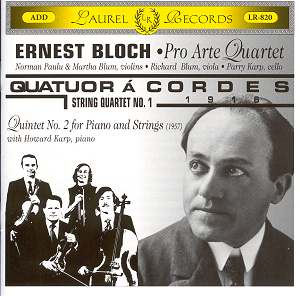

 Pro Arte Quartet:
(Norman Paulu, Martha Blum (violins); Richard Blum (viola); Parry
Karp (cello)); Howard Karp (piano)
Pro Arte Quartet:
(Norman Paulu, Martha Blum (violins); Richard Blum (viola); Parry
Karp (cello)); Howard Karp (piano)