Considering the name
of the record company and the period
covered by these operas I did some research
concerning Nellie Melba’s repertoire
and whether she sang any of these. I
drew a blank. Her repertoire was quite
small and she added no new roles after
the turn of the century; instead she
reduced the active roles to a mere dozen.
Moreover hers was a fairly light voice,
even though she essayed both Aida and
some Wagnerian roles – her Brünnhilde
in Siegfried was a disaster.
Most of the roles represented on this
recital require a lirico spinto voice.
However Melba was coached by Charles
Gounod when studying roles from his
operas – Marguérite and
Juliette – and she was a successful
Nedda in Leoncavallo’s Pagliacci.
All this is of course irrelevant, especially
since Elizabeth Whitehouse’s voice has
little similarity with Melba’s, but
since both sopranos were/are Australian
it was an interesting mission to find
some connections.
Melba’s voice was light
and nimble with fluent coloratura and
bell-like tone – ‘angelic’ is a word
often encountered when people describe
it. That of Ms Whitehouse is a vibrant,
fairly large-sized instrument with a
great deal of weight. Her biography
lists roles like Senta, Elsa, Fidelio,
Amelia, Marie (Wozzeck) and Maddalena
(Andrea Chenier). She doesn’t
(want to?) vary the tone colour very
much to differentiate the characters
but phrases intelligently and musically.
She has dramatic heft (Marion Delorme,
Andrea Chenier) and she can adopt
a silvery tone with exquisite nuances
(Amleto). Some listeners may
find her voice a mite too vibrant but
it is a steady voice – no wobbling!
– and she delivers honest, well considered
readings of these, in the main, unknown
arias from, in the main, little known
operas.
What about the quality
of the music? Maybe it is the familiarity
that makes the few ‘standard arias’
stand out as superior. I am talking
about La mamma morta from Andrea
Chenier and Io son l’umile ancella
from Adriana Lecouvreur where
especially the first-mentioned is so
much more many-facetted. It offers richer
characterization than many of the lesser
known pieces. This also applies to the
first aria, O ma lyre immortelle
from Gounod’s Sapho. The opera
is seldom performed today but the aria
is a lyric masterpiece, here given a
dreamy account. The well wrought orchestral
introduction amply demonstrates the
impressive sound quality and the surround
sound produces very realistic hall ambience
and depth. To fully appreciate Gounod
one needs to have a sweet tooth, but
all but the most saccharin-resistant
must enjoy the melodic flow of both
this aria and the following one from
La Reine de Saba. Also the Cinq
Mars aria has a typical Gounod melody.
That Franco Faccio
wrote a Hamlet opera was news to me,
even more so the fact that the libretto
was by Arrigo Boito, who more than twenty
years later wrote the masterful librettos
for Verdi’s Otello and Falstaff.
Faccio and Boito remained lifelong
friends and Faccio became musical director
of La Scala, where he premiered both
Otello and Ponchielli’s La
Gioconda. The latter opera was
Ponchielli’s only real success. His
last opera, Marion Delorme, which
is represented here, was based on a
play by Victor Hugo. The aria is powerful
and if the rest of the opera is on that
level it would be interesting to see
it revived. Saint-Saëns was also
a one-work composer when it comes to
opera – only Samson et Dalila
is performed today - but he wrote so
much else that has remained in the standard
repertoire. Like Gounod he was a skilled
tune-smith and the aria here is agreeable.
Someone memorably once called him ‘the
best composer who wasn’t a genius’.
An exotic bird on 19th
century operatic stages was Brazilian
Carlos Gomes. He was mainly active in
Italy and had at least six operas premiered
at La Scala. Even though he sometimes
used Brazilian folksongs as thematic
material his music is strongly influenced
by contemporary Italian opera. He isn’t
completely forgotten today; his possibly
best work, Il Guarany, was even
recorded by Sony a dozen years ago from
a performance in Bonn, with Verónica
Villarroel and Placido Domingo in leading
roles and Salvator
Rosa can be had on Regis.
And both Caruso and Gigli recorded arias
from Gomes’ operas. The aria from Salvator
Rosa is finely crafted and Elizabeth
Whitehouse characterises it well.
Some of the best things
come from Leoncavallo’s pen. Anyone
who has heard his version of La Bohème
knows that there is much more to this
composer than the raw primitivism of
Pagliacci. The short aria from
Chatterton is very fine and the
two excerpts from Zazà
offer dramatic writing in the highest
division. Another opera to suggest for
revival? Ah! Finalmente! from
Giordano’s Siberia has a melodic
appeal far beyond routine writing and
seems more inspired than anything I
have heard of this composer – a few
numbers from Andrea Chenier apart.
The two solos from
Cilea’s Gloria are attractive
and O mia cuna fiorita is beautifully
phrased with a fine pianissimo at the
end. Of the two concluding Mascagni
arias the one from Isabeau is
dark – the opera deals with Lady Godiva’s
thwarted love affair with Folco – whereas
in the operetta Sì he
challenges Lehár or Kalman with
a nicely lilting waltz.
Richard Bonynge, always
curious about unknown music, pilots
his forces through these rarities with
a safe hand and Patrick O’Connor is
a knowing guide to the works and the
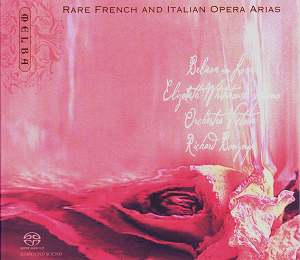
plots. The hardback disc + book package
is classy with photos of Ms Whitehouse
and Maestro Bonynge and we get full
song texts and translations, but we
never get to know which character sings
each aria.
Readers with an interest
in some operatic by-ways will find much
to enjoy here and the numbers are ordered
strictly chronologically, which is an
extra plus.
Göran Forsling






















 for details
 Elizabeth Whitehouse (soprano)
  MELBA
MR 301104 SACD [67:25]
MELBA
MR 301104 SACD [67:25]