Editorial Board
MusicWeb International
Founding Editor Rob Barnett Editor in Chief
John Quinn Contributing Editor Ralph Moore Webmaster
David Barker Postmaster
Jonathan Woolf MusicWeb Founder Len Mullenger
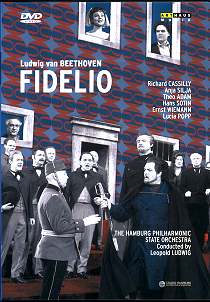
Ludwig van BEETHOVEN (1770-1827) Fidelio – opera in two acts (1814) Anja Silja
(soprano) - Leonore; Richard Cassilly (tenor) - Florestan;
Ernst Wiemann (bass) - Rocco; Theo Adam (bass-baritone)
- Don Pizarro; Hans Sotin (bass) - Don Fernando; Erwin Wohlfahrt
(tenor) - Jacquino; Lucia Popp (soprano) - Marzelline; Kurt
Marschner (tenor) - First Prisoner; William Workman (bass)
- Second Prisoner; Chorus of the Hamburg State Opera; Hamburg
Philharmonic State Orchestra/Leopold Ludwig.
rec. Studio Production, Hamburg State Opera, January 1968.
ADD ARTHAUS
101275 [115:00]
The
period colour, the sight of a fresh-faced and -voiced Lucia
Popp as the innocent Marzelline and the traditional sets
all act to give the viewer of this Fidelio a terminal
case of nostalgia. One of a series of made-for-television
operas that began in 1957 with Hocheit des Figaros,
this was the second to be issued. Alas there is an omission
from the opera, Rocco's 'Gold' aria, along with the curtailment
of much dialogue - the latter no real problem, surely. The
overture is played to a crystal-clear black-and-white shot
of the score's title. It is a good if not outstanding reading,
something which actually sums up Leopold Ludwig's conducting.
The
staging, by Rolf Liebermann, is traditional but effective.
This really is set in a prison, rather grey of wall and oppressive
of atmosphere. Prisoners really do emerge into the light.
There's even a token bit of greenery around. Notice also
how Leonore's asides are heard but not spoken, thanks to
the wonders of then-modern technology!
Lucia
Popp is in sterling voice as Marzelline. Her miming is not
absolutely spot-on and the static and close camera for her
Act 1 aria ('O wär ich schon') must have felt uncomfortable
for her. Yet she makes believe in her girlish crush on Fidelio/Leonore,
just as she genuinely appears transported as she initiates
the great Quartet with 'Mir ist so wunderbar'. She plays
the part of persuasive daughter well, as Fidelio fights to
be allowed to work with Rocco and the prisoners. Erwin Wohlfahrt
is almost as fresh of voice as Jacquino. Just a pity his
acting is rather wooden.
Anja
Silja is the model of determination - not only that, she
actually looks male in her disguise! You can see it in her
grit, in her every move, her every gesture. She is a woman
on a mission, and nothing will stop her!
Ernst
Wiemann, on the present showing, should have left a more
illustrious reputation behind him. He is a fine and deep-voiced
Rocco; he even looks benevolent yet wise. His pitching is
rock-steady: try 'Gut, Sönchen, gut'. Even his acting never
wavers for a moment. Theo Adam is dependably commanding as
Pizarro
The
facial close-up seems to be a favoured device here, and it
is mightily effective for Adam's 'Ha! Welsch' ein Augenblick!'
- sung at first in profile before he moves really uncomfortably
close to the camera. Not only is Adam's voice superbly focused,
he actually both looks and sounds evil, as he does in Act
2, for 'Er sterbe!'. The Pizarro/Rocco scene is stunning,
dramatically, principally because we can see and believe
in Rocco's reluctance to undertake his dark task. 'Stunning'
is the mot juste for Silja's 'Abscheulicher!' - accompanied
by some superb horn playing from the Hamburg Opera Orchestra'
s section - which works up to an 'Ich wanke nicht' of steely
resolution. If only Silja's miming skills were up to her
musical ones.
Act
2 begins with a shot of a closed door, fading into the dark,
subterranean locale of Florestan's prison. Cassilly, as unkempt
in dress as anyone you might find at London's Embankment,
provides a cry of 'Gott' that really does seem to reflect
his plight. His voice is open, fully able to negotiate the
upper reaches Beethoven demands. 'In des Lebens Frühlingstagen'
is taken rather briskly and superficially; luckily the vision
of the angel (Leonore) is appropriately transcendent.
Ludwig
paces the difficult and long Dungeon Scene expertly. Visually,
the only fly in the ointment is a Hammer House of Horror
zoom-in on Pizarro's face that some might even find amusing.
Balancing this is the pale yellow glow of Rocco's lamp symbolising
a flicker of hope in the gloom as the pair work to dig Leonore's
husband's grave.
The
moment of revelation is something else here. Silja goes from
boy to undisputed woman in one fell swoop as his/her hair – lots
of it – falls over the shoulders. Her 'Töt' erst sein Weib!'
has all the effect Beethoven surely intended. Ludwig manages
to pace 'Namenlose Freude' perfectly, giving it ample space
while being slightly fleeter than Klemperer in his famed
studio recording.
The
TV shot suddenly moves to the forecourt for the final scene,
where the people gather. Hans Sotin as Don Fernando is truly
noble of bearing and is in fine voice; Popp's 'Du prüfest'
is astonishingly heartfelt. I remain unconvinced about Pizarro's
openly stagy, almost pantomimic criminal when his crimes
are revealed; similarly the again uncomfortably close shot
of the triumphant pair in the very final bars grates a little.
Despite
some caveats, this is a version of Fidelio that every
lover of the opera should see. There are moments of great
depth to balance out the moments of delight and even the
unintentionally funny ones.
Colin
Clarke
Please support our advertisers below by clicking on the logos for further information.

























 Anja Silja
(soprano) - Leonore; Richard Cassilly (tenor) - Florestan;
Ernst Wiemann (bass) - Rocco; Theo Adam (bass-baritone)
- Don Pizarro; Hans Sotin (bass) - Don Fernando; Erwin Wohlfahrt
(tenor) - Jacquino; Lucia Popp (soprano) - Marzelline; Kurt
Marschner (tenor) - First Prisoner; William Workman (bass)
- Second Prisoner; Chorus of the Hamburg State Opera; Hamburg
Philharmonic State Orchestra/Leopold Ludwig.
Anja Silja
(soprano) - Leonore; Richard Cassilly (tenor) - Florestan;
Ernst Wiemann (bass) - Rocco; Theo Adam (bass-baritone)
- Don Pizarro; Hans Sotin (bass) - Don Fernando; Erwin Wohlfahrt
(tenor) - Jacquino; Lucia Popp (soprano) - Marzelline; Kurt
Marschner (tenor) - First Prisoner; William Workman (bass)
- Second Prisoner; Chorus of the Hamburg State Opera; Hamburg
Philharmonic State Orchestra/Leopold Ludwig.  [115:00]