Editorial Board
MusicWeb International
Founding Editor Rob Barnett Editor in Chief
John Quinn Contributing Editor Ralph Moore Webmaster
David Barker Postmaster
Jonathan Woolf MusicWeb Founder Len Mullenger
Béla
BARTÓK (1881-1945)
String Quartet No. 5 (1934) [28:49] Paul
HINDEMITH (1895-1963)
String Quartet No. 4, Op.22 (1921) [21:45] Zehetmair
Quartet: (Thomas Zehetmair (violin); Kuba Jakowicz (violin);
Ruth Killius (viola); Ursula Smith (cello))
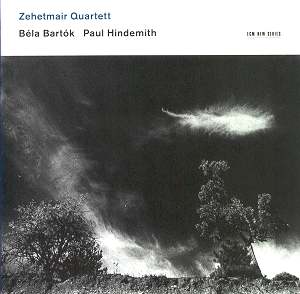
rec. June 2006, Kulturbuhne Ambach, Götzis, Austria. DDD ECM NEW SERIES 1874 [50:57]
It
is now over five years since the Zehetmair Quartet released
their successful ECM début disc of
Bartók’s String Quartet No. 4 and Hartmann’s String
Quartet No.1 and two years since garnering great acclaim
with their recording of Schumann’s String Quartets No.1 and No.
3. Now with a new line-up, they return to twentieth century
repertoire with two gems from the intense turmoil
of the inter-war years.
The
Zehetmairs’ 1999 recording of the of
the Bartók String Quartet No. 4 and Hartmann’s String
Quartet No.1 was their ECM debut release. A winner
of the quarterly German Record Critics’ Prize, it is available
on ECM New Series 1727. Their 2004 release of Schumann String Quartets
No.1 and No. 3 on ECM 1793 was highly acclaimed
receiving Gramophone’s Record of the Year Award, the Diapason
d’Or, the Edison Classical Music Award (Netherlands), and
two Belgian awards: the Caecilia Prize and the Klara Prize
for the year’s best international release. Since their Schumann
disc the Zehetmairs have undergone personnel changes with
the second violinist Kuba Jakowicz and cellist Ursula Smith
joining the group in 2005. In rehearsal and recital the Zehetmairs
play the music from memory asserting, “agreater
freedom and a different quality of communication”. It “allows
us to create an even larger overview of the whole piece.”
Bartók
and Hindemith were undoubtedly two of the finest and most
significant composers of the twentieth century. Both were,
in fact, concert soloists and chamber musicians. Bartók has
retained a most enthusiastic set of admirers with numerous
recordings of his work available, whilst the music of Hindemith
has had less success and seems to be out of vogue.
Bartók’s String
Quartet No. 5,composed
in 1934 as the result of a commission from the Elizabeth
Sprague Coolidge Foundation,
was duly premièred by the Kolisch Quartet the next year
in Washington D.C. Cast in five movements it is the longest
of his string quartets, marking Bartók’s return to a generally more consistent tonality.
The score is designed in an arch form, set out symmetrically
around the central pivotal movement, marked Scherzo, Alla
bulgarese.
My
preferred version of the Fifth Quartet is the robust
and thrilling performance from the eminent Takács Quartet.
Recorded to demonstration standard in Germany in 1996 the
double set is available on Decca 445 297-2 (as part of the Bartók 6 String Quartets).
Hindemith’s String
Quartet No. 4, Op.22 is sometimes referred to
as his third Quartet. This is frequently confusing
and one reference book that I saw mixes up their critical
appraisals of the third and the fourth Quartets.
The Quartet No. 4 marks Hindemith’s development
between Expressionism and neo-Classicism. Cast
in five-movements, in an arch-like design, the first
movement merges with the second and also the fourth movement
with the fifth. It was premièred in 1922 at the
contemporary music haven of the Donaueschingen Festival
in Baden-Baden.
Quartet
leader and founder Thomas Zehetmair remarks that, “Hindemith’s
quartets are not really well-known, not even in Germany.” Last
year the Zehetmairs performed
the second movement of the Hindemith Fourth Quartet a couple
of times as an encore without announcing its identity. According
to Thomas Zehetmair no one guessed it was by Hindemith. Many
thought it was by Sándor Veress with others wondering if
it was another Bartók movement. Evidently Hindemith’s Fourth
Quartet was the showpiece of the legendary Amar Quartet
(aka the Amar-Hindemith Quartet in which Hindemith played
viola) who performed it in recital well over one hundred
times. It became their most frequently performed score.
I
am aware of, but have yet to hear, the 2006 release of Hindemith’s String Quartet No. 4 from
the Pacifica Quartet. Their disc is titled ‘Declarations: Music
Between the Wars on Cedille Records CDR 90000 092 (c/w
Janáček String Quartet No. 2, ‘Intimate letters’ and
Ruth Crawford Seeger String Quartet).
The
Zehetmair Quartet is in consistently fine form. Their security
of ensemble is of a generally high standard and it feels
as if the players are aiming for technical perfection yet
still managing to probe with assurance for additional insight.
In Bartók’s Fifth Quartet their interpretations
cannot match the additional energy, sheer strength and emotional
intensity of the Takács Quartet (Decca).
With
a meagre playing time of just over fifty minutes this ECM
disc could easily have been made more competitive by accommodating
another work, such as the Schulhoff String Quartet No.
1 (1924); the Weill String Quartet (1923) or maybe
another quartet from Bartók or
Hindemith.
The
sound quality from the ECM engineers is excellent but I didn’t
care too much for the demanding essay in the booklet. It
left me wanting more information about the actual scores.
These
examples of twentieth century chamber repertoire from Bartók and
Hindemith are not heard often enough. Many will find this
pioneering music reasonably challenging but the rewards will
more than compensate with repeated hearings.
Reviews
from previous months Join the mailing list and receive a hyperlinked weekly update on the
discs reviewed. details We welcome feedback on our reviews. Please use the Bulletin
Board
Please paste in the first line of your comments the URL of the review to
which you refer.













 Zehetmair
Quartet: (Thomas Zehetmair (violin); Kuba Jakowicz (violin);
Ruth Killius (viola); Ursula Smith (cello))
Zehetmair
Quartet: (Thomas Zehetmair (violin); Kuba Jakowicz (violin);
Ruth Killius (viola); Ursula Smith (cello))