Atterberg’s Cello Concerto had a long gestation
but was eventually premiered in 1923 in Berlin. The soloist,
Hans Bottermund, who was prominent in the city and who made
some 78s, had decided to compose his own cadenza which, according
to the astonished composer who was conducting, was “hideously
long.” At the premiere the cadenza was again unveiled and the
concerto relatively well received. Another German performance
was given before Atterberg, doubtless exasperated by Bottermund’s
liberties, bought a new cello – he was a good player – and played
it himself at the Swedish premiere in March.
The Concerto is
late Romantic in orientation with a hankering for a vein of
melancholy nobility. It’s cast in three conventional sized and
organised movements and cleaves close to expected channels of
expression. There are some heroic brass calls in the opening
andante cantabile section of the first movement and also
a sense of powerful sweep from around 4:15. The ensuing attaca
is skittish and takes the cello high – Bottermund and indeed
Atterberg himself must have had (or desired to have) a fine
sense of pitching at such Alpine heights. Contrasts of high-lying
and guttural colours enliven the movement still further. The
yearning lyricism of the central movement almost prefigures
Finzi and especially touching is the way the solo cello muses
and entwines around the horn melody – a reflection of Atterberg’s
ear for decorative melodic strands but more importantly for
gauging the emotional temper of passages. His forte is always
tristesse. There are pensive Bachian moments in the finale,
with a sideways look at the way in which Dvořák lightened
orchestration and gave prominence to wind lines. The sense of
introspection however is evident even here, as is the sense
that for Atterberg directness and clarity of orchestration are
paramount. Mørk needless to say suffers no intonational battles
in his command of the work’s technical problems. His tone retains
allure at all moments and he is adeptly supported by the fifty-strong
orchestra whose small complement is in no sense a liability
under Kristjan Järvi.
In 1939 Atterberg
decided to publish his string orchestra arrangement of Brahms’s
String Sextet in G major. In his interesting sleeve note Tomas
Block suggests that the composer may have been spurred to arrange
the sextet after having written a number of polemical essays.
But he was in any case concurrently working on his opera Aladdin
so maybe it cleansed the compositional palette as
well. The arrangement conforms in its own way to everything
we know of Atterberg – clear, clean, and responding most warmly
to traditional models. Textures therefore remain light and avoid
any sense of clogging.
As I’ve noted the
playing is excellent and BIS’s recording very much up to its
accustomed standard. The sextet arrangement sheds little real
light on Atterberg beyond confirming much that we knew and the
prize here is the concerto. It’s not a CD premiere because Werner
Thomas-Mifune has recorded it for Koch-Schwann 315852, a disc
I’ve not heard. For Atterberg admirers though this new disc
packs a sizeable and sizeably sensitive punch.
Jonathan Woolf
























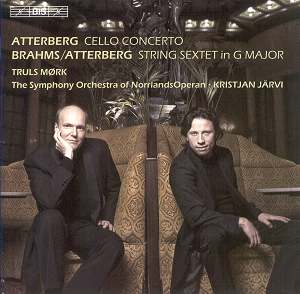

 Truls Mørk (cello)