Falstaff was
the culmination of Verdi’s long career as an opera composer. He
had talked of retirement after the premiere of Un Ballo in
Maschera in 1858 and really did believe he had laid down his
compositional pen after Aida in 1871. But nearly a decade
later, persuaded by his publisher, he embarked on a rewriting
of Simon Boccanegra which had been premiered in 1857. This
involved his working with Arrigo Boito, an accomplished librettist
and also a composer; it was an association Verdi came to relish.
The revised Boccanegra was a success at La Scala in 1881
and showed that even at the age of 68 Verdi’s inner genius was
alive and well. Ricordi and Boito subtly pointed Verdi towards
Shakespeare’s Otello. Verdi loved and revered Shakespeare
above any other poet. Slowly, via constant personal contact and
communication Otello was written. It was premiered at La
Scala, six years after the revised Boccanegra. Verdi was
then 74 years of age and really did think he had finished operatic
composition. But he had not allowed for Boito. Three years after
the premiere of Otello Verdi wrote to a friend What
can I tell you? I’ve wanted to write a comic opera for forty years,
and I’ve known ‘The Merry Wives of Windsor’ for fifty… however,
the usual buts and I don’t know if I will ever finish it…I am
enjoying myself. Boito’s vital contribution in enabling Verdi
to match Shakespeare was in his capacity for drawing out a taut
libretto from the plays concerned. He had reduced Otello by
six-sevenths and in Falstaff reduces the 23 characters
in The Merry Wives of Windsor to just ten in the opera.
Verdi wrote Falstaff for his own enjoyment. Inevitably
during its composition his mind must have wandered back to the
tragic domestic circumstances of the death of his wife and children
that surrounded the failure of his only other comic opera, Il
Giorno di Regno, at La Scala in 1840. With Falstaff
the outcome was utterly different. Verdi’s 28th and final opera,
‘my little enjoyment’ as he called it, was all he could have hoped
for. It was a triumph at its premiere at La Scala on 9 February
1893. The greatest Italian composer ever was 80 years of age.
It was a magnificent operatic culmination to a great career as
an opera composer.
Verdi’s
orchestration in Falstaff, with
its final fugue, represents a challenge
to even the best of the conductors with
a natural feel for the Verdian melodic
line and idiom. None has been considered
to have had this feel more than Arturo
Toscanini. His presence in the orchestra
of La Scala at the premiere of Otello,
gave him many privileged insights, albeit
his tendency in his later years to over-drive
the tempi detracted from them. But as
with the famous 1956 audio recording
of Falstaff conducted by Karajan
the man on the rostrum can make or break
a performance. That Karajan performance
scintillated and was recorded at a time
when the conductor on this performance,
Carlo Maria Giulini, was dominating
the opera scene at La Scala. Much of
his work in that theatre was in association
with the Luchino Visconti in charge
of the production side as was the case
in the memorable performances of Don
Carlo at Covent Garden in 1958.
Recollecting those cooperative occasions
Giulini recounted how conductor and
producer would attend all the rehearsals
of the other. In that way a dramatically
cohesive whole ended up on stage; many
memorable performances of that level
of cooperation are still remembered
and recounted by those privileged to
have been present. By the end of the
nineteen-sixties opera production and
producers had changed as had singers’
attitudes and Giulini, a man of deep
feelings and belief, found himself out
of sympathy with the developments. In
consequence he withdrew his significant
insights into the conducting of opera,
and particularly Verdi, from staged
performances and also the recording
studio. With promises of full commitment
of all concerned his record company
tempted him back into the recording
studio for Verdi’s Rigoletto with
Domingo, Cappuccilli and Cotrubas (DG
Originals 457 753-2). With that hurdle
surmounted negotiations for him to conduct
a staged production of Falstaff shared
between Los Angeles, Covent Garden and
Florence in 1982-83 were successful.
A live audio recording was made in Los
Angeles and issued by DG with the staged
performance at Covent Garden being recorded
for TV transmission by Brian Large.
How far Giulini was able to stipulate
a traditional production has been debated.
What is certain is that Hayden Griffin’s
sets, Michael Stennett’s costumes and
Ronald Eyre’s production would have
been recognised by Verdi as well as
pleasing Giulini. Only the first scene
at the Garter Inn was rather cramped
for the action that ensues.
Giulini’s conducting
of Falstaff is affectionate without being cloying. He is
fleet as the wives do their plotting (CH 4) and the lovers serenade
each other (CH 6) and appropriately serious and violent as Ford,
in his jealousy, searches his house for the would-be seducer (CHs
12-13). Overall Giulini treats Falstaff with an element of seriousness
that I consider to be in the plot and the music. Falstaff is not
a buffa opera and the humiliations of Falstaff have a bitter flavour,
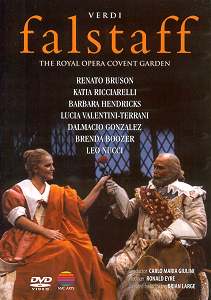
which the conductor catches. In the name part Renato Bruson gives
a commanding performance vocally and histrionically. His burnished
baritone is full of colour, his legato and enunciation of the
text full of nuance. Add the twinkling eyes of a benevolent professor
and this assumption is not of an egotistical seducer. He is portly
without an over-excessive belly and when he dresses up to visit
the ladies and sings a mezza voce ‘when I was a page’ it
is easy to imagine him fancying his chances (CH 9). Bruson’s is
a consummate portrayal fully realised. As Falstaff goes off to
put on his finery Ford, fearing he is being cuckolded has his
monologue. Nucci is more convincing here than in many of his Verdi
portrayals although I find other audio and video recorded interpretations
far superior. Katia Ricciarelli as Alice looks lovely and fines
down her big voice to give a portrayal that is vocally as well
as visually convincing (CH 4). Brenda Boozer as Meg is required
to make less of a contribution than her colleagues and whilst
looking significantly younger does her part justice. Lucia Valentina-Terrani
is a traditional Quickly, her bustle making her look oversized.
She is not as convincing an actress as her colleagues. Vocally
she has all the notes and her facial expressions add to the sonority
of those evocative reverenzas with which she approaches
Falstaff (CH 7). Barbara Hendricks as Nannetta cannot quite match
the sincerity of her acting with the ideal lightness of floated
phrase although in the final scene under the over-large Hermes
oak she is vocally most appealing (CH 20). Dalmacio Gonzales both
looks the part of her ardent lover and sings with honeyed tone
(CH 18). The character parts of Bardolph and Dr Caius are in the
capable hand of Covent Garden stalwarts Francis Egerton and John
Dobson.
Many people watching
this recording will wonder why operas such as Falstaff are
not seen nowadays in such traditional productions any more. Well,
Giulini may have had the answer in that the producer now reigns
not the music let alone the conductor. Graham Vick’s over-coloured
and overactive Covent Garden production with Bryn Terfel (BBC
Pioneer 1025) is typical of the more modern approach, as is that
by Luca Ronconi conducted by Mehta (Review).
The 2001 performance in 16:9 format from the Teatro Verdi in Busseto
conducted by Muti, given to mark the centenary of Verdi’s death
is a serious rival to this traditional staging. It replicates
the staging of that performed in the same theatre in 1913 conducted
by Toscanini. The vocal size of Ambrogio Maestri’s Falstaff matches
his physical dimensions, not that the later inhibits his acting
or movements or the nuance and variety of colour of his singing.
The wives are well matched and with Roberto Frontali is a strong
Ford. And Inva Mula and Juan Diego Florez are vocally mellifluous
lovers. The impact of the production can only be faulted in the
restricted stage size of the small Busseto theatre (TDK DV-OPFAL).
Robert J Farr


























 [137:00]