Smetana's two-act opera
The Kiss has retained the affection
of its native country, but it remains
likely that the only way non-Czech listeners
will hear it is on disc. After its first
performance, it quickly became the composer's
second most popular opera in Prague
(the first being Bartered Bride).
The booklet to the present release refers
to the figure of 180 separate productions
in total in the Czech Republic. The
piece is based on a short story by Karolina
Světlá (1830-1899), a writer who
frequently took rustic themes as the
basis for her stories. They were, specifically,
based on the comings
and goings in the Ještěd area.
The theme here, a refused kiss, is allegedly
true, its source being a local historian;
the story was published in the Enlightenment
magazine in 1871. The librettist was
Eliška Krásnohorská (1847-1926),
who herself suggested the subject to
Smetana who had just finished Libuše.
Although Smetana next turned his attention
to The Two Widows, he returned
to The Kiss in 1875.
This is not a comic
opera – Smetana himself referred to
it as a 'simple folk' opera. The setting
of a Czech village and the simplicity
of the characters obviously struck a
chord with him. The premiere, in November
1876 at the Provisional Theatre under
Adolf Čech,
was a success.
A refused kiss may
not seem such a big deal these days,
of course, but back in the latter stages
of the nineteenth century it was a completely
different matter. Lukáš, a young
widower, arrives in a village with his
brother-in-law Tomeš to negotiate the
hand in marriage of Vendulka. He has,
prior to this, been forced by his parents
to marry another; yet this wife died
and he is now free to declare his feelings.
Father Paloucký agrees, but is
more than aware of the lovers' hard-headedness.
Vendulka refuses to give Lukáš
a kiss until they are married. Martinka,
Vendulka's aunt, tries to persuade her
and supports her, while secretly also
helping smugglers in the wood. These
smugglers, who we meet in Act 2, are
headed by Matouš. A scene between Lukáš
and Tomeš means Lukáš agrees
to go and find Vendulka, but the conversation
is overheard by Matouš. Lukáš
feels guilt because of his late wife
... and to compound matters there was
a child by the relationship, too. In
the second part of Act 2 Lukáš
has to eat humble pie big style, having
to beg forgiveness off first Vendulka's
father, then Vendulka herself. She tries
to kiss him, but Lukáš insists
that first she has to forgive him in
front of everybody. Only then can there
be a happy ending ... and there is.
Such a sweet and harmless
plot is hardly the material of Ring
cycles, but it is the generative force
in the present instance behind a piece
of the utmost charm. The presence of
an indigenous cast, conductor and orchestra
means that the music's rusticity sounds
absolutely convincing and not in the
least hackneyed.
Zdeněk
Chalabala (1899-1962) had an impeccable
pedigree. He studied at the Brno Conservatoire
from 1919 to 1926 with František Neumann
and Janáček. Thereafter, he was
mainly associated with the Prague National
Theatre despite a time at Ostrava. His
opera recordings include Fibich
(Sarka), Foerster (Eva)
and Dvořák (Rusalka).
That he was a born man of the theatre
is immediately evident from the opera's
Prelude. The orchestra plays with what
I can only describe as an organic rusticity
– truly with roots firmly in the Czech
soil. The recording is good for its
time, although there is some eminently
understandable loss of body. Chalabala
paces the Prelude perfectly, as he seems
to everywhere. Although he is able to
convey the opera's light basis to a
tee, he is unafraid of bending the tempo
when he feels it is right; his feeling
for the idiom is beyond criticism.
Voices fare exceptionally
well in recorded terms. Marta Krásová's
firm contralto is the first voice heard,
as Martinka. Her voice is not heavy,
though, so
her brief ditty, 'S přteli byltĕ
dnes zármutek zapít' ('He went with
his friends today to drown his sorrows')
has all the requisite agility. Karel
Kalaš, a well-respected bass who included
King Philip (Verdi's Don Carlos)
in his repertoire, that takes the
role of the father, while Přemysl
Kočí as Tomeš sings with great,
open-throated gusto. Although this is
a high-lying role, apparently Kočí's
range was so wide that he elsewhere
took on Boris Godunov!
It is not until Scene
4 that the two lovers, Vendulka and
Lukáš, get a chance to blossom
vocally. And blossom they do. Their
voices work together in the freshest
of ways, emphasising the open-air, innocent
essence of the opera as a while, but
the actual duetting is fairly minimal
here. We have to wait until Scene 5
before they can stretch their lungs
in a tender love duet during which Vendulka
vows to take on the child and essentially
thanks Lukáš's wife for dying!
But when the duet comes, it really comes:
this whole exchange, centring around
the famous kiss, lasts for nigh on half-an-hour.
It makes for delicious listening, though,
only ending when Lukáš leaves
rather petulantly, having been denied
his kiss.
It is worth noting
that Chalabala's accompaniments are
of the very first rank. He has drilled
his orchestra to be responsive to the
nth degree.
Each act, conveniently,
fits on one CD. Act 2 begins with an
Overture (as opposed to the first act‘s
Prelude). The title is well chosen,
as it is more serious in intent than
its predecessor – its purpose is to
invoke
the thick forest that hides the smugglers,
led by Matouš. Vladimir Jedenáctík,
a native of Brno, takes the role; Jedenáctík's
mother, apparently, was a pupil of Janáček's.
His vocal articulation in the opening
scene of this act is exemplary as is
the
evenness of tone over his large range.
The chorus's reactions to his lines
reveal them to be a particularly well-drilled
lot. Lukáš's outburst of grief is potent
in his aria, 'Já nešfasník!' ('Woe is
me!'). Luckily, Kočí is his vocal
equal in the ensuing duet so
there is no drop in dramatic tension
immediately thereafter.
Probably Chalabala's
greatest interpretative achievement
is to stop the scene of Martinka and
Vendulka in the dark forest degenerating
into direst melodrama. Having heard
badly performed Czech opera (no names),
I can report that one really should
hear these scores presented by a master
of Chalabala's ilk. The trio of Martinka,
Vendulka and Matouš is pure magic. Later
in the act, the encounter with the Frontier
Guard brings an opportunity to admire
the talents of Karel Hruška, a specialist
in characterful minor roles; he hams
it up wonderfully! The fact is that
there is not a single weak link in the
casting. This is, as the final pages
prove, the work of a true ensemble that
includes some marvellous singers.
Pre-Janáček
Czech opera outside of Rusalka
and Bartered Bride really needs
a push. There is so much to enjoy, and
this radiant, laughing performance makes
the best possible case for the magnificently
crafted music of The Kiss. I
have not heard Supraphon's later
Brno recording of this work, conducted
by Vajnař. I would love to, but
I somehow cannot imagine it eclipsing
this magnificent, star-studded reading.
Colin Clarke
























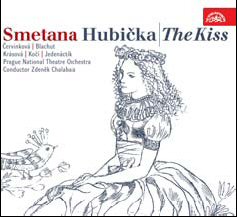
 for details
 Prague National Theatre Chorus and Orchestra/Zdenĕk
Chalabala.
Prague National Theatre Chorus and Orchestra/Zdenĕk
Chalabala.