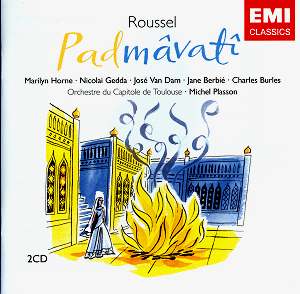
Padmâvatî
is part of EMI’s mid-price Opera Series. At first glance that
series doesn’t look too promising, with the possible exception
of the Callas Gioconda and Karajan’s Aida, but
in this case EMI has no competition as Roussel’s opera-ballet
isn’t easily available elsewhere (there is a live London Coliseum
recording under Jean Martinon from July 1969 on Gala GL100573).
Also it has the apparent advantage of a very strong cast. So
far so good, but is this operatic oddity really worth reviving?
The work has an
interesting history. Roussel’s ballet The Spider’s Banquet
had been a great success at the Théâtre des Arts in Paris so
its director Jacques Rouché, appointed director of the Opéra
in October 1913, asked him for a new lyric work. Roussel had
visited India in 1909 and chose the Padmâvatî story as the subject
for his opera-ballet. He was working on it when the war intervened
and completed the score in November 1918. Not surprisingly money
for the arts was tight in the post-war years, so Padmâvatî
was only premiered on 1 June 1923.
The two-act opera-ballet
to a libretto by Louis Laloy is set in the 13th-century
Indian city of Chitoor, the home of Prince Ratan-Sen and his
beautiful wife Padmâvatî. The prince and Alaouddin, the Mogul
ruler of Delhi whose army is camped outside the city, are about
to conclude a peace treaty. Ratan-Sen entertains his guests
with a warrior dance and a dance of slave girls, but it soon
becomes clear Alaouddin is more interested in Padmâvatî. The
Brahmin assures the reluctant Ratan-Sen that his master has
been converted to Hinduism so it’s safe for him to see Padmâvatî
unveiled.
Alaouddin is captivated
by Padmâvatî and demands her for himself or the treaty will
not be concluded. Ratan-Sen refuses and war looms. As Act I
draws to a close the Brahmin is killed by the crowds and a fearful
Padmâvatî sings of her fears for the future.
In Act II Padmâvatî
and the priests are in the temple of Siva, where it soon becomes
clear that sacrifices will be demanded. Ratan-Sen, wounded in
battle, staggers into the temple with the news that all is lost.
But, he says, they can all be saved if Padmâvatî surrenders
herself to Alaouddin. Overcome with horror Padmâvatî stabs and
kills her husband and rather than give herself to the Mogul
king chooses to join Ratan-Sen on his funeral pyre.
As an opera-ballet
Padmâvatî is essentially a set of dances linked by short
arias. These lavish set-pieces made a good impression on opening
night and listening to the opera on disc one senses the visual
element is crucial to its success. As for the music it is surprisingly
austere, with the oriental effects sparingly used. The singers
have no standout arias and the vocal style, though lyrical,
inclines towards the declamatory. There is little of the febrile
intensity of Pelléas, say, but the lush harmonies on
the harp do look back to Debussy and earlier musical impressionists.
The prelude to Act
I introduces a harmonic restlessness that pervades the whole
opera. The first set-piece, the warrior dance, may suggest something
of Stravinsky’s Le Sacre du Printemps (premiered
in 1913) but the dance of the slave girls is more in the vein
of Borodin’s Polovtsian Dances from Prince Igor.
The opera’s first substantial aria is sung by the Brahmin (Charles
Burles); he is suitably transported as he describes Padmâvatî’s
legendary beauty.
As the protagonists
Gedda and van Dam sing well enough but neither role is particularly
demanding vocally or in terms of characterisation; the same is
true of Padmâvatî who, like Turandot, only appears late in the
day. She is not so much an ice queen as a latter-day Helen of
Troy, whose beauty has tragic consequences for all. In her grim
lament at the end of Act I she becomes something of a Cassandra
figure, looking to the future with foreboding. It is hardly a
taxing role for Horne but unfortunately her voice has a beat that
is particularly noticeable under pressure.
Act
II moves into night and the Temple of Siva. Again Roussel resorts
to that unsettled mood that characterises much of Act I and peaks
in a rare orchestral outburst as it becomes clear that sacrifices
will be required. Ratan-Sen’s duet with Padmâvatî, a few moments
of calm in this all-enveloping nightmare, culminates in the prince's
suggestion that she surrender herself to Alaouddin and save the
city. Even at this moment of high dramatic tension Roussel's scoring
remains curiously spare and unspectacular; indeed, one silently
urges him on to something more uninhibited but that is not his
way. In a defiant gesture Padmâvatî stabs her husband and sets
in train the events that lead to her own destruction.
At
this point one begins to doubt whether Roussel is up to the dramatic
demands of the story, so restrained is his musical temperament.
Certainly the recessed recording doesn't help matters, with the
chorus relegated to the very back of the soundstage. Even as Padmâvatî
prepares for death and the priests intone 'la mort' one simply
misses the shiver that one should surely feel at this awful moment.
The
ballet returns with a dance and pantomime as Ratan-Sen's pyre
is lit and several figures emerge from the smoke in search of
the body. Once again the oriental strangeness of this music is
underplayed, although the choral writing – the daughters of Siva’s
lament intertwined with the fervent prayers of the priests – is
remarkably complex and rather moving. But even as the funeral
procession winds to a climax and Padmâvatî vanishes into the smoke
Roussel continues to pull his punches. Alaouddin breaks into the
temple but it is too late and the orchestral postlude resolves,
quietly, into F major.
As
an opera-ballet Padmâvatî clearly has plenty of visual
potential but as a straight opera it fails to convince. There
is very little in the way of character development and/or vocal
distinction, with a single memorable aria in Act I and a rather
underwhelming duet between Padmâvatî and her husband in Act II.
There is precious little nobility, grandeur or pathos in this
score and Roussel must shoulder some of the blame for that. Some
must also be laid at Plasson’s door, for the orchestral playing
isn’t particularly distinguished and the DDD recording is too
backwardly balanced for the musicians and singers to make much
of an impact.
Oh,
and one more thing. The booklet contains good notes and a cued
synopsis by Roger Nichols but there is no libretto. Listeners
are invited to download the text from www.theoperaseries.com but
I Googled in vain. Finally I went on to the EMI Classics website
and found the necessary PDF file, only to discover the libretto
is in French only. Sorry EMI, but this just isn't good enough.
Of course they are not alone in this self-defeating act of parsimony
but it is a source of constant irritation when one has to go in
search of texts. Admittedly it's much less of a problem with works
one knows well but in this case, well, it’s unforgivable really.
A
rather disappointing experience, this. And given that it is roughly
contemporaneous with the likes of Wozzeck (1925) it seems
Padmâvatî is just a side street off the main highway of
20th-century opera. Worth a brief diversion, perhaps, but no more
than that.
Dan Morgan

























 Marilyn Horne
– Padmâvatî
Marilyn Horne
– Padmâvatî