Rossini first made
his mark in a highly competitive profession with a series of
five
farsi presented at Venice’s small San Moise theatre. He
came to the notice of the city’s premiere theatre, La Fenice,
who commissioned him to write an opera seria. His Tancredi,
based on Voltaire’s tragedy, but given a happy ending, following
on 6 February 1813 and was a resounding success. Rossini reverted
to Voltaire’s tragic ending in a revival at Ferrara a few weeks
later. This north Italian audience, also used to happy endings,
was less enthusiastic than that at Venice. This version was
given at Pesaro in 2005 (DVD
review).
After the revised
Tancredi, Rossini returned to Venice to write a comic
opera, at short notice, for the Teatro San Benedetto who were
in a hole after another composer had failed to deliver. Faced
with a timetable of less than a month, Rossini later claimed
to have composed the work in a mere eighteen days and short
cuts were inevitable. First it was decided to recycle, with
some revisions the libretto of an existing opera, Luigi Mosca’s
L’Italiana in Algeri of 1808. Rossini outsourced the
recitatives and also Haly’s short aria in act 2 La femmine
d’Italia. Premiered on 22 May 1813, Rossini’s version
of L’Italiana in Algeri, his eleventh opera, was
received with almost constant wild, general applause
according to a contemporary review. It is the earliest of the
composer’s truly great full-length comedies. It has speed as
well as felicitous melodies. Although it fell from the repertoire
for a period early in the 20th century it was revived for the
Spanish coloratura Conchita Supervia in 1925. It is one of the
few Rossini operas to have had a presence in the catalogue since
the early days of LP.
The plot concerns
the feisty eponymous heroine Isabella. She has been sailing
in the Mediterranean, accompanied by an elderly admirer Taddeo,
in search of her lover Lindoro. After her ship is wrecked, Mustafa,
the Bey of Algiers, finds her the ideal replacement for his
neglected wife who he intends to marry off to a captured slave,
who happens to be Lindoro. After complicated situations involving
Taddeo being awarded the honour of Kaimakan and Mustafa in turn
becoming a Pappataci, a spoof award invented by Isabella to
keep him obeying her strict instructions, all ends well in a
rousing finale with the Italians escaping from the clutches
of the Bey.
The planning for
the 2006 Pesaro Rossini Festival from which this live recording
derives was complicated by the closure for refurbishment of
some of the town’s major venues including the Palafestival.
Works were presented in two out-of-town makeshift venues within
a sports arena, a situation that will continue until at least
2009. As a consequence of this situation the normal festival
programme of new productions was severely curtailed. Of the
stage works presented, this recording is taken from performances
in the BPA Palais of staged performances of Dario Fo’s 1994
hyper-activity production that featured the bravura American
mezzo Jennifer Larmore in the eponymous role. I stress the hyper-activity.
Fo’s productions do not do things by half measures. If it is
possible to have movement or extraneous stage activity or props,
then Fo will include it. As I indicate in my review
of his recent Pesaro production of Rossini’s La Gazzetta,
filmed when reprised at Barcelona in July 2005, it was easy
to become confused by all the comings and goings of singers
and extras.
What a critic, or
audience member, rarely gets are the reflections of the participant
singers to the production(s) in which they appear, or if they
do so at all it is at best many years after the event. Philip
Gossett, the renowned Rossini scholar and until recently responsible
for the Critical Editions of the composer’s works performed
at Pesaro, tells a few secrets in his recent book, Divas
and Scholars, Chicago 2006. Revelations include the
fact that he had to advise Jennifer Larmore to be circumspect
about her decoration of the vocal line in her arias in the original
production because of the physical activity demanded of her.
I mentioned this in my review of the Dynamic CD from this series
of Pesaro performances (review)
and wondered if Fo’s production impacted on the sung performance.
This DVD, presented in High Definition and superb sound is perfect
for me to find out.
Each act is presented
on one DVD. This generosity of presentation facilitates not
only the sound but also the clarity of the picture enabling
the multitudinous goings-on of the production to be seen in
all their glory. As I infer, Fo has an extraordinary, if idiosyncratic,
imagination and he lets it manifest itself in his opera productions.
This production is a scenic spectacular populated by mock jungle
animals, ships, imaginative representation of waves on the sea,
a dancing mannequin who floats up and down and around, flags
and dancers as well as a multitude of other effects and activity.
Add the elaborate and many costume changes for the chorus as
well as the principals and the result is a visual spectacular.
At the end of the opera, apart from being overwhelmed, my thought
was that the cost would have kept an average cash strapped provincial
Italian or British opera company in new productions for a year.
Very rarely is a singer allowed the luxury of a stand-and-deliver
for an aria or in a scene.
Fo, as might be
expected, makes much of the investment of Taddeo as Kaimakan
(Disc 2 CH 3) and the Papatacci plot and its realisation (Disc
2 CH 7). In the first of those situations the singing and acting
of Bruno De Simone is not overwhelmed by the goings-on and portrays
Taddeo’s confusions and frustrations with aplomb. Barbara Bargnesi
as Elvira, the Bey’s long-suffering wife, and Alex Esposito
act and sing well in their roles. Marianna Pizzaloto’s Isabella
looks good but her acting could be better. Her mezzo is excellent
in the lower register, a little less so in her middle voice
where she cannot always hold the vocal line, whilst her decorations
do have a tendency to sharpness. This vocal unevenness is more
evident in her rendering of Isabella’s act 2 Per lui che
adoro (Disc 2 CH 4)) than in her act 1 Cruda sorte
(Disc 1 CH 4). As Lindoro the Russian Maxim Miranov, a favourite
at Pesaro, sings with an appealing tenore di grazia.
His singing is most appealing in the ensembles and in his act
2 Cocedi amor pietoso (Disc 2 CH 2) he does so with some
vocal elegance while managing not to be distracted by the dancing
mannequin with which he has to interact. I was recently greatly
impressed by both the singing and acting of Marco Vinco as Dandini
in the TDK video of the 2006 production of La Cenerentola
at Genoa (review).
In this performance, despite starting off sonorously and with
good characterisation, he seems to be aware that his lean bass
has not the innate sonority in the lower registers that an ideal
characterisation of Mustafa requires over the whole of the opera.
He tires towards the end of act 1 and this is noticeable in
the trio and act finale (CHs 10-11). In act 2 there are times
when his voice becoming less steady and loses intonation and
he fails to make much humour out of the act 2 Pappataci charade;
perhaps overwhelmed by the activity Fo involves him in (CD 2
trs. 14-21). The ensemble singing goes with more zip than some
other parts of the performance with the Prague Chamber Chorus
contributing vibrantly and entering fully into their parts in
the various escapades.
This production is
shared with the Teatro Communale, Bologna, whose orchestra play
superbly under the direction of Donato Renzetti who conveys a
natural feel for the idiom. One virtue of a DVD recording, as
against a live performance, is the ability to go back and see,
and enjoy, what one missed the first time round. This is never
truer than with this production of one of Rossini’s most comic
creations. If you can get round the more questionable bits of
husbands dumping their wives to pursue a flighty bit of Italian,
then this spectacular with its many visual effects and staging,
can be an ideal introduction for children as well as an enjoyment
for parents and any other adults. It is certainly a contrast from
the rather wacky update from Paris’s Palais Garnier in 1998 with
Jennifer Larmore and Simon Alaimo rather more into their roles
than their counterparts here (review).
Robert J Farr
























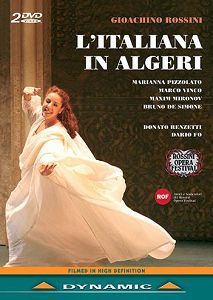

 Mustafa, Bey
of Algiers - Marco Vinco (bass); Elvira, Mustafa’s wife - Barbara
Bargnesi (soprano); Haly, captain of the Algerian pirates - Alex Esposito
(bass); Lindoro, a young Italian and Mustafa’s favourite slave - Maxim
Miranov (tenor); Isabella, an Italian lady - Marianna Pizzaloto (mezzo);
Taddeo, Isabella’s companion - Bruno De Simone (buffa baritone)
Mustafa, Bey
of Algiers - Marco Vinco (bass); Elvira, Mustafa’s wife - Barbara
Bargnesi (soprano); Haly, captain of the Algerian pirates - Alex Esposito
(bass); Lindoro, a young Italian and Mustafa’s favourite slave - Maxim
Miranov (tenor); Isabella, an Italian lady - Marianna Pizzaloto (mezzo);
Taddeo, Isabella’s companion - Bruno De Simone (buffa baritone)  [2 DVDs: 150:00]