This is my latest
encounter with Pristine Audio’s new XR technology - a claimed
miracle of the transfer engineer’s art. Go to www.pristineclassical.com
for specifics. They claim that pre-1945 78s now have their audible
upper frequency range increased from between 5-6 kHz to somewhere
between 11-13 kHz actually going further, boldly announcing
that these transfers render “all previous transfers and restorations
… entirely obsolete.” Since the firm has been embarking on a
wide programme of XR restorations this is a defiant claim. A
modern recording of the work in question is taken and utilised
it as a reference file – as was the case in the bass-stiffening
and percussion-enhancing in the famous Heward Moeran Symphony
recording released on Divine Art. I’ve reviewed his XR work
on Kathleen Long’s post-war, 78-based, Fauré Deccas (see review)
which I liked, was disappointed by the Thibaud-Cortot Kreutzer
sonata (see review),
remained solidly ambivalent about the Weingartner Eroica
and noted the interventionist implications of the piano work
in Hüsch’s Schubert – though here the sonic improvements in
immediacy were certainly apparent.
Unfortunately I
don’t have the commercial 78 set of the symphony with which
to do some back-to-basics comparison work - nor the EMI CD transfer.
There’s a Pearl transfer but it’s not directly relevant in the
context of comparisons. So I worked with the EMI LP on ED 2902581,
which included both scherzi and Jean Pougnet’s A Lark Ascending.
This is rather strange one to choose for XR work as one
can think of a raft of recordings that would sound more immediately
startling given XR treatment. The 1949 VW 6 was extremely well
recorded for the time and the visceral immediacy of the sound
has always been a big point in its favour. In a sense then this
opening salvo of XR issues has somewhat soft-pedalled by choosing
the Weingartner and this Boult though I note that next - and
last - on my listening duties is the Schnabel-Sargent Emperor
Concerto, which has clearly involved hard work from the information
provided on the site. Even the Thibaud-Cortot Kreutzer
was not badly recorded. A much stiffer test would have been
the slightly earlier Sammons-Murdoch Kreutzer, which
was not brilliantly recorded and is crying out for its first
CD restoration. This VW actually doesn’t represent anything
like so difficult a consideration.
The EMI LP scores
over the XR in the second movement in openness of sound. It
sounds like the XR bass has been subtly reinforced and maybe
the percussion section has been spatially enhanced as well,
by virtue of reference to a modern recording. In the Epilogue
I actually find that it’s the XR’s turn to have a more open
treble. Pristine has retained much more surface noise throughout,
and it’s most audible here of course, but the benefit is that
the ear adjusts to the whiskery hiss and takes advantage of
preserved higher frequencies. There’s really very little in
it as regards the LP/XR test.
I’m not quite sure
what this has proved. The XR is a good piece of work but it
doesn’t really displace the EMI – it sits alongside it as a
viable transfer alternative. Not having heard the CD transfer
I can’t offer an absolute judgement but on the basis of the
LP work the provisional conclusion must be that the XR is highly
effective but not necessarily outstanding.
Jonathan Woolf
























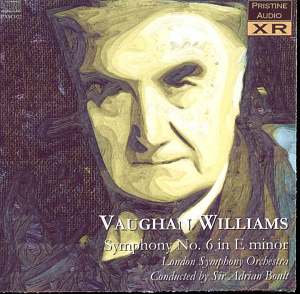

 London Symphony Orchestra/Adrian
Boult
London Symphony Orchestra/Adrian
Boult