Agrippina was
Handel’s second opera written for Italy. In fact it was one of
the last works he wrote before leaving Italy. It opera was written
for the San Giovanni Crisostomo theatre in Venice for the 1709/10
carnival season. One of Handel’s first popular triumphs, it was
performed some 27 times.
Handel did not write
many operas in Italy, mainly because he spent much of his time
in Rome where the theatres were closed. Instead he produced
a spectacular series of chamber cantatas, often for the same
singers that he would later encounter in opera houses. These
formed a remarkable training ground on which he could hone his
talent.
Agrippina was
the setting of a libretto by Cardinal Vincenzo Grimani, whose
family owned the theatre where the opera was premiered. The libretto
would seem to be one of the few which were specifically written
for Handel. Though it deals with historical characters, it treats
them very much in the manner of 17th century Venetian
opera with a mixture of comic and serious situations.
This style of libretto
would remain a life-long favourite of Handel’s. In London though,
when turning to 17th century Venetian librettos -
such as the one used for Serse - the libretto was subject
to considerable change to align it closer to contemporary tastes
in heroic opera.
But Agrippina
has fewer such adjustments; it is constructed of many short arias
mostly rather lightly scored. Few of its characters are admirable
and none is treated heroically. The music generally does not touch
the sublime grandeur that some of his later operas do. Instead
we get a quicksilver score which reacts to the characters’ changes
of mood and nefarious shenanigans.
The title role was
written for Margherita Durastantini, a soprano with whom Handel
worked frequently, first in Italy and later in London. She sang
in a number of Handel’s Italian cantatas as well as creating
the part of Maria Magdalene in La Resurrezione in Rome
earlier on in Handel’s Italian visit.
Durastantini was
not a high soprano and the part of Agrippina is nowadays often
sung by mezzo-sopranos, though this does mean that the work
is slightly over-burdened with contralto/mezzo-soprano/counter-tenor
type voices. On this disc, with Nerone sung by counter-tenor
Derek Lee Ragin, we have three counter-tenors, one mezzo-soprano
and one soprano.
Della Jones is a
highly experienced Handel singer and her performance of the
title role is a tour-de-force. There were odd moment when I
would have liked a lighter, soprano tone but she brings a vocal
warmth to the role which softens some of Agrippina’s less likeable
traits. Jones dominates Acts 1 and 2 as Agrippina’s scheming
articulates the plot. She is adept at both the lighter, shorter
number as well as the more powerful ones which Handel allows
her, such as Pensieri, voi mi tormentato her Act 2 aria
sung when she thinks her schemes are coming unstuck.
As her son, Nerone,
Derek Lee Ragin sings a part written for a soprano castrato.
Nerone is still young in this opera and Handel uses the part’s
high vocal range as part of the characterisation. Understandably,
the role is generally sung on stage by women but Ragin displays
a remarkably extension to the usual counter-tenor range. He
is by turns thoughtful, sensitive and virtuoso, his changes
of mood mirroring those of his mother. Ragin’s performance is
remarkable. There are moments of understandable strain in the
high-lying passages but he never compromises on the expressivity
and characterisation. Rarely have I heard a high counter-tenor
singing so well. The disadvantage is, of course, that the tone
sounds rather more mature and less boyish than a lighter soprano
but that is a small price to pay for fine artistry.
Nerone’s love interest,
Poppea, is the first of what Winton Dean describes as Handel’s
‘sex kitten’ roles. She lives for the gratification of the senses.
Handel would return to such a character with Cleopatra and with
Semele. Donna Brown copes very well with the considerable virtuoso
requirements of the role and creates an appealing character.
But I could not help feeling that her voice is sometimes a little
stressed at the top and her runs are a little heavy. Though
Brown does not let that side down in what is a very strong cast,
I have frankly heard better, lighter-voiced Poppeas.
Ottone, who is also
in love with Poppea, is the only character in the opera who
is not in some way despicable. Michael Chance brings to the
role some of the most perfect singing on the set. He is on fine
form in all his arias and certainly wins our sympathy and support.
Ottone can come over as a bit of a drip, but when sung as well
as this there is no chance of him losing our sympathy.
George Mosely and
Jonathan Peter Kenny are Pallante and Narciso, two conspirators
who Agrippina inveigles into her plotting. Handel nicely differentiates
their characters - one a baritone, the other an alto. Mosely
and Kenny respond well to their material and provide nicely
characterised performances.
Alastair Miles is
Claudio, Agrippina’s husband the Emperor. Miles makes Claudio’s
bluster and idiocy all the more amusing for taking it seriously.
Amongst the smaller
roles, Anne Sofie von Otter crops up at the end as the Goddess
Juno and Julian Clarkson contributes a neat turn as the servant
Lesbo.
John Eliot Gardiner
has not committed many Handel operas to disc, but his control
of the work is impressive. He keeps the tempos flowing without
seeming rushed. This is especially true of the recitative, of
which there is a considerable amount. He is ably supported by
the fine playing of the English Baroque Soloists.
My only real complaint
is that the whole recording comes over as slightly serious.
If you listened without any understanding of the plot, you might
miss its satirical nature. This is more easily brought out in
performance, when the stage picture can help focus how the audience
perceives the music. But here on disc I would have liked a little
more smile in the music.
That said, this
is a superbly sung and performed account of one of Handel’s
first masterpieces - a highly enjoyable recording that can be
recommended to experienced Handel opera fans and newcomers alike.
Robert Hugill
























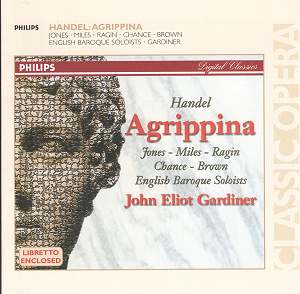

 Agrippina – Della Jones (mezzo)