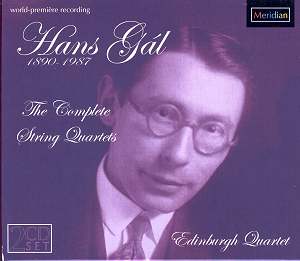
Meridian present across
two volumes, the Complete String Quartets
of Hans Gál. I noted that the
slip-case that holds the two discs states
‘world première recording’.
A 2002 musicweb-international
review
by Jürgen Schaarwächter of
Gál’s disc of ‘Music for and
with mandolin’ stated that, "Hans
Gál is receiving somewhat of
a revival." I have not detected
any significant sea-change of attention
being given to Gál’s music; it
remains in the doldrums. As far as the
record catalogues are concerned there
appear to have been only a minor resurgence
of interest with a trickle of all-Gál
recordings. Perhaps the Gál recording
most likely to be encountered is the
3-disc set from Leon McCawley of the
‘Complete Works for Piano Solo’, on
Avie
AV2064. A quick check has revealed
that there are listed around thirty
or so recordings that include a Gál
work or two in their programme. Everything
has to start somewhere and I remember
the old adage, "Mighty oaks
from little acorns grow." It
is to be hoped that this excellently
performed and recorded disc of the complete
string quartets from the Edinburgh Quartet
will serve as a catalyst for a revival
of interest in the music of Hans Gál.
Hans Gál, although
not a completely new name to me, is
a composer that I knew little about
before receiving this Meridian release.
The excellent Hans
Gál website contains a wealth
of information that I have drawn on
extensively for this review. I have
learned that Gál wrote 174 scores
in a wide range of genres of which some
110 were published. It seems that over
a fifty year association with Scotland
more than half of Gál’s scores
were composed in his adopted country.
Born in Brunn, near
Vienna, Gál studied at the New
Vienna Conservatory and completed his
doctorate there in 1913. In 1915 he
won the Austrian State Prize for composition
and was then drafted into the Austrian
army the same year, serving in Serbia
and the Polish Carpathians. His golden
period from the end of the Great War
to the early 1930s saw Gál develop
as a composer with an increasing reputation
in Viennese music circles and in other
central European cities. In 1919 he
was the recipient of the Rothschild
Prize and secured a teaching post at
Vienna University. Incidentally, this
was the same post that had once been
held by Anton Bruckner. The première
of the comic opera Der Arzt der Sobeide
(Sobeide's Doctor) in the
Prussian city of Breslau in 1919 gave
Gál considerable recognition.
Increasingly he appeared as a pianist,
especially in chamber music recitals
and he would on occasion travel outside
Vienna to promote his works.
Gál’s breakthrough
came with the acclaim given to his second
opera, Die Heilige Ente (The
Sacred Duck). Premièred under
Georg Szell at Düsseldorf in 1923,
the comic opera was soon staged in many
European cities. The triumph of Die
Heilige Ente was augmented by his
third opera Das Lied der Nacht
(The Song of the Night), a romantic
drama that was premièred in 1926
in Breslau. Although operas brought
Gál his initial success he was
active in many other genres, with vocal
music playing an essential role, as
also that of chamber music and solo
piano works. He founded a Madrigal Society
in 1927 which at that time was unique
in Vienna for performing a capella
compositions.
Gál’s orchestral
works also provided him with success
notably with his Overture to a Puppet
Play (1923). This popular orchestral
work soon achieved over a hundred performances
in many European cities under the directorship
of various eminent conductors: Szell,
Furtwängler, Keilberth, Busch and
Weingartner. Further compositional acclaim
came in 1926 with the Vienna Art Prize
award. Gál’s Symphony in D
major, Op. 30 (1927) was awarded
second place by the Columbia Broadcasting
Corporation in 1928 to mark the centenary
of Schubert's death. Incidentally, the
Third Symphony of Franz Schmidt
won the First Prize.
In Vienna Gál
cultivated a number of influential friendships
with leading musicians of the day, including
Alexander Wunderer the oboist, conductors
Georg Szell, Erich Kleiber, Carl Prohaska
and the composers Julius Bittner, Egon
Kornauth and Karl Weigl. Despite having
very different opinions to the avant-garde
affiliates of the Second Viennese School,
Gál had agreeable relationships
with its principal protagonists, Webern
and Berg. Gál also had associations
with Erich Wolfgang Korngold, Joseph
Marx, Ernst Toch and Alexander Zemlinsky;
all composers active on the Austro-German
music scene and with links to Vienna.
In 1929, against competition
from well over a hundred candidates,
he obtained the prestigious directorship
of the extensive Mainz Conservatory
on the Rhine. It is indicative of Gál’s
reputation that for the Mainz appointment
he gained heavyweight advocacy from
Fritz Busch (director and conductor
of the Dresden Opera) and Wilhelm Furtwängler
(conductor of the Berlin Philharmonic
Orchestra). It is thought that backing
also came from the renowned composer
Richard Strauss.
Hitler’s accession
to power in 1933 as German Chancellor
brought Gál’s career to a sudden
end and his hometown of Mainz was seized
by the Nazis. In spite of the fact that
Gál had fought for the German
allies in the Great War his Jewish origins
ensured that he was ostracised; losing
his job, with performances and publication
of his music prohibited. The extreme
pressure and abuse that Gál and
his family were experiencing and the
impending danger ensured that in 1933
he was forced to flee to the Black Forest
in south-western Germany for a few months.
Finding it hard to break away from Vienna,
his cultural home, Gál took the
dangerous decision to return.
When Hitler’s Third
Reich invaded and annexed Austria in
1938 it became obvious that Gál
and his family would have to flee overseas.
They managed to escape to London with
the objective of settling in the USA.
Following a fortunate encounter with
the composer Sir Donald Tovey, Gál
was invited to Edinburgh in Scotland,
where Tovey was University Professor
of Music. Employed with the task of
cataloguing the Reid Music Library the
promise of a teaching engagement disappeared
after Tovey’s death and Gál returned
to London. After the outbreak of war
in 1939 Gál moved back to Edinburgh
into the home of Sir Herbert Grierson
who had been English Professor at the
University.
Gál was categorised
as an alien by the British authorities
and as a ‘security risk’ he was subsequently
arrested in May 1940. Together with
all other Edinburgh refugees he was
sent to an internment camp at Huyton,
Liverpool, then a short time later transported
to the Isle of Man for detention. In
1940, the British Government’s policy
of internment changed and Gál
was given his liberty, and decided to
return to Edinburgh.
Gál’s fortunes
improved considerably following the
conclusion of the Second World War and
he secured a permanent position as a
music teacher at Edinburgh University.
Maintaining his involvement at the University
after retirement age, he resided in
Edinburgh until his death, in 1987,
aged 97.
The multi-talented
Gál had gained an excellent reputation
in Edinburgh’s music circles, as a composer,
performer, teacher and the author of
biographies on Brahms; Schubert; Wagner
and Verdi. Together with Rudolf Bing,
the Vienna-born opera impresario, Gál
was a founder member of the Edinburgh
International Festival. Although the
recipient of several prestigious honours
both in Britain and abroad, and remaining
active as a composer up to his death,
Gál was never able to re-establish
the success of his pre-war career.
Once acclaimed by the
members of the central European music
establishment, Gál’s music had
become unfashionable. Taste in music
had rapidly changed in the first half
of the twentieth century and the late-Romantics
of Gál’s generation became marginalised
having to compete with the growing enthusiasm
for influential modernists such as:
Bartók, Stravinsky, Schoenberg
and Berg. Gál was a victim of
the new vogue as he was still composing
in the manner of a bygone generation
and consequently his music moved into
virtual obscurity. However, in the last
year of his life, the music experienced
increased public attention with the
first British radio broadcast of his
cycle of four string quartets and the
cantata: De Profundis, Op. 50
(1936-37).
For those readers interested
in exploring these complete works for
string quartet I can report that Gál
has a style in the Austro-German late-Romantic
tradition. At times I was reminded of
the music of Max Reger with certain
echoes of Paul Hindemith and also Cyril
Scott; composers who both trained at
the Hoch Conservatory at Frankfurt-on-Main.
The emotional tension, violent rhythms
and frequent dissonance of the six quartets
of Béla Bartók, Gál’s
older contemporary, are some considerable
distance away.
The four movement String
Quartet No. 1 in F minor, Op. 16
was written in 1916. The Hans Gál
website claims the score was premièred
by the Rosé-Quartett in Vienna
in 1916, however, the Meridian booklet
notes state that it was dedicated to
Adolf Busch and first performed by the
Busch Quartet.
Erwin Kroll described
the score as "Schubertian"
and Wilhelm Altmann as, "somewhat
in the style of Brahms, it is also indebted
to Schubert and to the general musical
milieu of 19th century Vienna."
The comparisons of Gál’s music
to Schubert and Brahms given by Kroll
and Altmann are not sound-worlds with
which I can readily identify. I experienced
Gál’s score as rather idiosyncratic,
bereft of Schubertian bitter-sweetness
and although well-crafted and highly
attractive, without the melodic and
stylistic memorability of those great
Viennese masters.
The opening movement
Moderato, ma con passione contains
a Dvořákian
nostalgic yearning and I enjoyed the
urgency of the impishly scurrying Scherzo.
The extended Adagio is unrelentingly
tense with a mysterious atmosphere bordering
on the sinister. Clearly the product
of a fertile imagination, the multi-faceted
finale, marked Allegro energico,
un poco sostenuto provides a
temperamental if not an especially memorable
conclusion.
From 1929, the String
Quartet No. 2 in A minor, Op. 35
is cast in five movements and was
given its first performance in Vienna
in 1930 by the Rosé-Quartett.
In the opening Preludio the increased
use of more, "astringent harmonies
occasionally bordering on the atonal"
is apparent. A Scherzo-like second
movement Toccata is snappy and
outgoing in character with rapidly changing
textures. Tense and uneasy at times
the Canzone suggests searching
for a calm resolution and the short,
dance-like Intermezzo contrasts
a sense of aimless wandering with the
thrill of the chase. The final movement
is an agitated Rondo and the
work concludes in a composed manner
providing a welcome relief from the
anxieties that had gone before.
In four movements the
String Quartet No. 3 in B minor,
Op. 95 composed in 1969 was premièred
in Edinburgh in 1970 by the Edinburgh
Quartet. Marked Energico the
lively, extended opening movement is
just bursting with nervous energy and
the appealing Scherzando has
considerable poise that evokes the Viennese
Ländler. A searching, moody
and airless Cantabile - Adagio could
easily depict Gál reminiscing
over a lost love and the finale marked
Con umore - Allegretto is concentrated,
yet impressive with considerable emotional
tension.
Composed in 1970, the
four movement String Quartet No.
4 in B flat major, Op. 99 was
given its first performance by the Edinburgh
Quartet in Edinburgh in1972. Compared
to the first quartet, written some fifty-four
years earlier, one is aware of Gál’s
liberal use of chromatics and harmonics
of a greater complexity. I found the
lengthy opening movement Legend
marked Adagio-Allegro reminiscent
at times of a Britten quartet with a
strong sense of undergoing a continual
searching process. The capricious, short
Burlesque feels evocative of
a merry-go-round at a fairground and
the genial Elegy contains a soothing
lyricism as from a bygone Viennese age.
Concluding the quartet is a rather puzzling
hybrid movement with an agitated Fugue
and a hard to define Capriccio.
The Improvisation,
Variations and Finale on a theme by
Mozart for string quartet, Op.60b
is an arrangement from the original
score for mandolin, violin, viola, lute
or cello, Op.60 from 1934. It seems
that Gál also made an arrangement
for mandolin orchestra. The score for
string quartet is happy-go-lucky, full
of jaunty and fast-moving episodes.
I especially enjoyed the charming and
pastoral opening piece, Improvisation,
that could have been written by Vaughan
Williams or Finzi.
The Five Intermezzi
for string quartet, Op.10 was
composed in 1914, premièred in
Vienna in 1916 and is his earliest published
work for string quartet. Evidently there
is also a small orchestra arrangement
by Beece of movements 1 and 2. The Five
Intermezzi is an attractive and
genial Serenade, and one notices
the folk-like melodies that suffuse
the score.
The Edinburgh Quartet
displays secure ensemble and an agreeable
timbre. Playing with considerable conviction,
their convincing empathy for the music
conveys a sense of eavesdropping on
a private recital. In particular, one
feels that the chosen tempi permit
Gál’s intentions to register
with maximum effect. The recorded sound
is clear and well balanced. Although
not mentioned in the accompanying annotation
Meridian have informed me that the recordings
were made at Broughton St Mary's Parish
Church in Edinburgh in November 2003
(Vol. 1) and September 2004 (Vol. 2).
The set has the additional benefit of
exemplary booklet notes by Roger Bevan
Williams.
These are satisfying
and accessible string quartets in the
Austro-German late-Romantic tradition.
Lovers of rare chamber music will be
in their element with this splendid
set.
Michael Cookson

























 The Edinburgh Quartet: (Charles Mutter
(violin); Philip Burrin (violin); Michael
Beeston (viola); Mark Bailey (cello))
The Edinburgh Quartet: (Charles Mutter
(violin); Philip Burrin (violin); Michael
Beeston (viola); Mark Bailey (cello))