Back in 2002, Naxos
bundled together a very handy 5 CD box
of Elgar's orchestral music, which Rob
Barnett praised in these
pages. Now, in the composer's sesquicentenary
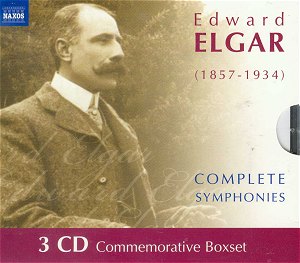
year, Naxos is offering this slimmer
commemorative box set of just the symphonies.
Both of them? All three. The individual
discs appear exactly as they do when
purchased separately, with the three
standard jewel cases housed in a cardboard
slipcase that features a wistful looking
Elgar behind his trademark moustache.
All three performances are highly recommendable.
George Hurst gets proceedings
started with a sprightly rendition of
the Imperial March, not quite
as pacy as Menuhin's traversal, but
with plenty of pluck. The recording
of the First Symphony that follows
is better still. Although a Boult or
Barbirolli approach might be expected
from a conductor of Hurst's pedigree
and vintage, there is plenty of forward
momentum and excitement in his performance
at tempi that come close to Elgar's
own. There is a fine nobilmente to
the opening tune, and triumph in its
return amid the fireworks at the symphony's
close. The scherzo is sprightly and
the adagio flows. It is a straightforward
performance, but none the worse for
that. If in the final analysis Hurst's
is not as distinctive an account and
Handley's
on Classics for Pleasure, Previn's swaggering
recording on Philips or Solti's
propulsive reading on Decca – though
Hurst comes close to Solti – it is still
well worth hearing and an excellent
recommendation for new initiates. The
BBC Philharmonic is in fine form throughout.
Sir Edward Downes'
recording of the Second Symphony
has always been one of my favourites.
His pacing is superb, bringing a Barbirolli-like
breadth and affection to the first movement
and a finale of rare coherence. In fact,
Downes is at his most impressive in
this final movement, which can so often
lose tension and become slack so that
by the time you reach the final afterglow
you have lost sight of the movement's
structure. Not so here. Downes makes
each climax count and shapes the opening
tune of the finale with a swagger that
prepares you for the main theme in all
of its rising optimism. If there is
a weak spot in this performance, it
is that the rondo is a little lightweight,
and lacks the punch that a Solti or
Handley brings to it. Solti's
performance remains the closest to the
composer's
own in propulsive pace, with Menuhin's
not far behind. Handley's
account is also superb. However, Downes'
recording is just as satisfying in its
own way and deserves a place in every
Elgarian's collection. The BBC Philharmonic
plays just as well for Downes as it
did for Hurst a year earlier, though
the perspective of the recording is
a little distant this time around.
It is a little odd
to include Anthony Payne's elaboration
of Elgar's sketches for his Third
Symphony as if it was fully one
of Elgar's. It has become common to
include Mahler's 10th with
his complete symphonies, but to do the
same here is something altogether different.
While Mahler's symphony was all but
complete in short score and already
partially orchestrated, Elgar's scraps
were much less fully developed at the
time of his death in 1934. The story
of how Payne came to develop Elgar's
sketches into a full symphony, drawing
on other scraps for the light and balletic
scherzo and composing much of the finale
and slow movement himself in Elgar's
idiom, is now well known. If you don't
know it, you can read all about it in
Robin Golding's detailed liner-notes.
While it is hard to be anything but
complimentary about Payne's efforts
and the final product stands up well
enough as a symphony in its own right,
I am not fully convinced that it should
be treated as a symphony of Elgar's.
Nonetheless, it remains compulsory listening
for those who love Elgar's music for
those lovely scraps of Elgarian inspiration
like the lilting second subject of the
first movement, that linger in the memory
and could not have been written by anyone
else.
There may be uncertainties
about whether the third can really be
classed as an Elgar symphony. There
are no uncertainties about Paul Daniel's
performance with the Bournemouth Symphony
Orchestra. They make the best case for
the symphony that I have heard, certainly
superior to the premiere recording made
by Sir Andrew Davis and the BBC Symphony
Orchestra. Daniel's feel for Elgarian
rubato is natural and unaffected and
he inspires the orchestra to great things.
The BSO is a plucky band, and when a
Berglund, a Rattle (that pioneering
Mahler 10!) or, in Elgar, a Silvestri
is on the podium, they play for dear
life. Their commitment and verve more
than compensating for any lack of sumptuousness
in the strings. In their hands, the
salt spray swing of the first movement
comes off very well, and the slow movement
has a forward momentum and sense of
mystery that is quite winning. Even
the finale is impressive, and only the
scherzo fails to convince entirely,
more a function of the material than
of the performance.
If you want all three
of these symphonies – Elgar's two and
the one by Payne using Elgar's material
– this is probably the easiest and cheapest
way to get them in performances that
will wear well. Naxos' box is not unchallenged.
In Britain it has to contend with Sir
Colin Davis' cycle of the three works
on the LSO
Live label at the same price point
(here in Australia, the LSO set costs
considerably more than the Naxos box).
I have not heard Davis' rendition of
the Elgar/Payne third, but I prefer
Hurst and Downes over Davis in symphonies
1 and 2. While some critics have found
Davis' readings revelatory, I find their
stop-start nature and Davis' tendency
to obsess over details distracting,
whereas the Naxos accounts are delightfully
free from mannerism and ideal for repeat
listening. The Naxos discs also have
a more natural soundscape, though as
noted above you will need to turn the
volume up for the second symphony, and
none of them suffer from the distracting
vocalising from the podium that mars
the Davis accounts. Add in Keith Anderson's
helpful liner notes for symphonies 1
and 2 and Robin Golding's for number
3, and you have an attractive package
indeed.
Tim Perry
























 BBC Philharmonic Orchestra/George Hurst