This fine CD of world premiere recordings (apart
from the Corigliano quartet) proves an interesting and educational
experience. Not only do we sample Corigliano’s style in relatively
light mood in the first two miniatures contrasted against the
dark and complex language of his remarkable String Quartet but
we also get to hear an accomplished work by one of Corigliano’s
pupils, Jefferson Friedman.
Corigliano is arguably the best known and most
feted composer of his generation. Honours include a Grawemeyer
Award for his haunting, terrifying and now widely performed
First Symphony, a Pulitzer Prize for the Second Symphony and
an Academy Award for his score for François Girard’s film The
Red Violin. Corigliano’s music is often uncompromising
and complex but always somehow transparent and directly communicative.
It is hard not to have an immediate emotional response to his
major works – even if that experience is sometimes a little
uncomfortable in its intensity.
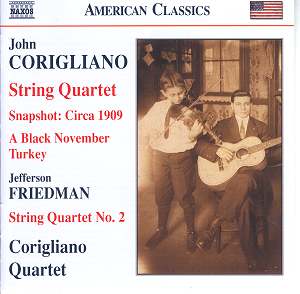
The first two works on this CD show the composer
in nostalgic and playful lights respectively. Snapshot: Circa
1909 was written as result of a request from the Elements
Quartet for a piece inspired by a photograph. Corigliano chose
a family heirloom which had always been dear to his heart –
a picture of his father and uncle playing a violin and guitar
duet in about 1909. Corigliano’s father was only about 8 years
old in the photograph but went on to become concertmaster of
the New York Philharmonic for nearly thirty years, playing under
Toscanini and Bernstein and acting as soloist in many concerto
performances. Snapshot opens with the second violin playing
a wistful melody accompanied by the other instruments pizzicato,
in imitation of his uncle’s guitar. The whole piece is infused
with a dreamlike quality and it is easy to sense the affection
the composer obviously felt for his subject matter. The photograph
in question is thoughtfully reproduced on the front cover of
the CD booklet. A nice touch.
A Black November Turkey started life as long ago
as 1972 as an a cappella setting of a strange poem by
Richard Wilbur; a bitter and savage farmyard allegory which
does not have a happy ending.
The String Quartet of 1995 must count as one of
Corigliano’s greatest achievements. Cast in five movements,
it takes the listener on a roller-coaster of the emotions, none
of them wholly happy. Corigliano must have thought highly of
this work as, when asked in 2000 by the Boston Symphony Orchestra
for a piece to commemorate the 100th anniversary
of the orchestra’s residence in Symphony Hall, he decided to
re-cast the Quartet, re-writing, expanding and scoring for string
orchestra. In its original form the Quartet is one of the toughest
in the repertoire. It was written for the Cleveland Quartet
for its farewell tour before disbanding and in it Corigliano
fully explored the wealth of compositional and musical possibilities
that writing for such an intimate ensemble allows. Binding the
Quartet together is a motto of even repetitions of a single
note, a series of broken-up minor thirds and concentration on
four pitch centres, as well as an arch-like architecture that
it shares with Bartók’s Fourth Quartet; first and last, second
and fourth movements related, with the third Nocturne (Bartók’s
‘night music’) acting as a central lynch-pin. To my ears, Bartók’s
ghost was invoked many times during this masterfully-conceived
quartet. This is evident from the outset with the interior arch-like
form of the eerie first movement, recalling Bartók’s movements
of this kind. This is followed by a wild, dissonant, rhythmically-complex
Scherzo and an almost static but endlessly riveting Nocturne.
Corigliano has always been fascinated by counterpoint and, in
particular, the fugue. This fugal fourth movement (marked ‘severe’)
shares much of the vehemence of the earlier Scherzo.
The composer adds to his contrapuntal task, however (and that
of the four players), by having the various fugal entries enter
in different tempos, the whole effect being a strange combination
of contrapuntal order and organised chaos. This constant battle
between coherence and apparent disintegration is almost a metaphor
for this Quartet as a whole. Not surprisingly, this fierce fugue
eventually burns itself out and dissolves into the final Postlude
which unwinds almost as a mirror-image of the opening Prelude,
therefore completing the arch.
It is interesting to hear Jefferson Friedman’s
Second Quartet immediately after that of his former teacher.
Friedman seems hardly less accomplished and certainly no less
lauded – born only in 1974, he has already been awarded the
2001 ASCAP Morton Gould Young Composer Award, the 2001 Palmer
Dixson Prize, and the 2001 Juilliard Orchestra Competition.
He is also the recipient of the 2004 Rome Prize Fellowship in
Musical Composition from the American Academy in Rome. The Second
Quartet won the ASCAP Leo Kaplan award and the BMI Student Composer
Award in 2000.
Friedman’s brief programme note declares that much
of his music is programmatic and describes the Second Quartet
as a ‘diary entry’. He does not expand on this any more than
to say he wrote the work during his studies with John Corigliano,
without whose guidance, Friedman says, the composition of this
Quartet would not have been possible. One is immediately struck
from the outset by the energy surging through this music. It
shows a similar intensity to Corigliano’s music and the spectre
of Bartók is still very evident – down the ‘snap’ pizzicatos
which abound near the beginning of the opening movement. Yet,
this is a new and individual voice – and one which knows how
to communicate clearly. As well as the influences of Bartók
and Corigliano, I also detected faint echoes of Debussy and
Ravel, a little in the restless slow second movement but especially
in the third movement finale. There is also an aching lyricism
in the music that reminded me that this young composer was Corigliano’s
pupil.
These works for string quartet could hardly wish
for better advocates than the Corigliano Quartet. It was formed
in 1996 to concentrate largely on new music and has won its
own share of plaudits and awards in its short career. The intense
musical and technical prowess of the Corigliano Quartet’s playing
is rewarded here with a very natural-sounding recording in which
every nuance is captured beautifully without there ever being
any artificial spotlighting or over-close placement of microphones.
In so many ways this CD of first-class string quartets
by American composers, teacher and pupil, yields many rewards,
especially on repeated listening. I urge lovers of the medium
to be brave and sample this wonderful disc, especially at Naxos’s
giveaway price.
Derek
Warby