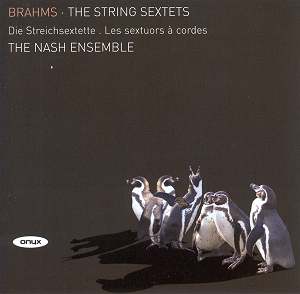
Why are there penguins
on the front cover, inside the case
and on the label? Presumably for the
same reason that there is a row of seats
on the cover of the Nash Ensemble’s
version of the Mendelssohn Piano Trios
(ONYX 4011). Three seats for the trios,
six penguins – the male members of the
Nash Ensemble in their ‘penguin suits’?
– for the sextets; not exactly the most
subtle of visual puns. This may seem
a trivial criticism but I can easily
imagine looking at the cover of this
disc in a shop and putting it down as
not a serious contender.
My next problem was
that the sound is rather recessed at
the outset, with the ensemble a little
too distant. This is better than too
forward a sound and the ear soon adjusts.
Partly it is of the nature of these
sextets that with two cellos the sound
is warm rather than bright – indeed,
it is a cello theme which opens the
First Sextet – but I do think that the
recording slightly over-favours the
lower end of the sound spectrum. Perhaps,
too, the recording engineers were trying
to avoid the slight blaring in forte
passages which Michael Cookson noted
in his review of the Mendelssohn Trios
on this site in November 2006. Otherwise
he found the recording, made at the
same venue, decently balanced and reasonably
clear.
In the booklet Joanna
Wyld makes the case for linking both
works to Brahms’s tangled relationships
with Agathe von Siebold, his first love,
and Clara Schumann, whose husband had
died three years before the first Sextet;
Brahms had adopted the role of Clara’s
protector and their relationship had
begun to assume the on-off nature which
characterised it thereafter.
Having urged the case
recently for a connection between Schubert’s
final illness and the mood of his String
Quintet, it may seem perverse to minimise
this element of the Sextets but more
important for me is the crisis in Brahms’s
creative life. The notes mention this,
but do not pursue it. His Piano Concerto
No.1 had not made the impression he
had hoped for and it was to be some
time before he returned to the concerto
form. For the time being he seems to
have been afraid to compose in any format
that could be interpreted as an attempt
to emulate the great musical successes
of his predecessors, especially Beethoven
and his late friend Schumann. When he
did finally commit himself to the First
Symphony, the big tune of the finale
caused it to be dubbed ‘Beethoven’s
tenth’, raising the very comparison
that Brahms had tried to avoid; his
attempt to pass the matter off with
a joke – that any ass could see the
similarity – may well have hidden his
true feelings.
He avoided for the
time being the chamber music forms associated
with Haydn, Mozart, Beethoven, Schubert
or Schumann, but none of his great predecessors
had attempted a Sextet. The First Sextet
is similar in its range of moods, and
in its employment of a second cello,
to the Schubert String Quintet, which
had received its posthumous first public
performance in 1850, but neither Brahms’s
andante ma moderato second movement
nor the poco adagio of the Second
Sextet matches the intensity of the
adagio of the Schubert.
The Nash Ensemble face
strong competition in these works, with
an excellent version from the Raphael
Ensemble, fine performances from the
ASMF Chamber Ensemble, the augmented
Lindsay Quartet and Hausmusik, and a
recommendable bargain version from Menuhin
et al. Setting aside my reservations
about the sound, the new disc offers
very fine performances, but it is not
quite ideal.
Most of the members
of the Nash Ensemble are well-known
soloists but here the keynote is smoothness
and integration – six instruments playing
as one. This is, of course, a virtue,
but I could have welcomed a little more
individuality. The beginning of the
First Sextet is a case in point: the
opening cello theme is answered by the
first violin and first viola but the
impression that the Nash Ensemble give
is of a corporate entity answering itself,
rather than an interplay of individuals.
The credits in the booklet and on the
rear cover emphasise the role of the
Nash Ensemble’s Artistic Director, Amelia
Freedman, CBE, FRAM; perhaps there has
been a little too much external direction
in this case. One hardly imagines Joachim,
the leader at the first performance
in 1860, integrating himself in quite
this way. Of course, the tension between
the rich overall sound and the individual
contributions is bound always to be
a consideration but the effect of homogeneity
from the Nash Ensemble is enhanced by
the failure of the recording to locate
the individual instruments as clearly
as most modern chamber-music recordings.
Even listening on headphones, which
usually produces exaggerated separation
in listening to chamber music, does
not entirely focus the sound sonically
or spatially.
The Ensemble resist
the temptation to wring too much emotion
out of the andante ma moderato
of the First Sextet or the poco adagio
of the Second Sextet. In both these
movements they are slightly brisker
than the Raphael Ensemble (9:40 against
9:58 and 8:50 against 9:24) but there
was no sense of hurry in either movement;
indeed, throughout, the tempi which
they adopt seem well-justified.
There is much to admire
and to enjoy in these performances but,
for me, admiration rather than enjoyment
is the keynote. The technical excellence
of the Nash Ensemble can be taken for
granted and they capture the varying
moods of these two works very well.
I feel that I should respond more positively
to both the performances and the recording
– I know that others have called both
exemplary and I cannot imagine anyone
being seriously disappointed – yet I
cannot recommend this as the best available
version. Perhaps part of the problem
is that these are not my favourite Brahms
chamber works. I fully concur with those
who point to the elegant, effortless
and dignified playing, but I also feel
the slight lack of individuality to
which I have referred and I attach more
significance to the lack of differentiation
in the recording than do those who note
it but consider it comparatively unimportant.
In all fairness I should add that these
more positive reactions to the performance
and recording can be found on the Onyx
website.
To end on a positive
note, the finale of the Second Sextet
closes the CD in just the right way.
The Nash Ensemble really capture the
carefree, skittish yet graceful air
of the movement – they seem more willing
to take chances than in the earlier
movements – and the recording captures
their most delicate nuances. If the
whole disc had been of this quality,
it might have been an outright winner.
With repeated hearings
my reservations about the Nash Ensemble
performance and recording diminished,
especially when I stopped scoring points
and sat back just to listen, but the
Raphael Ensemble (Hyperion CDA66276)
seem a safer recommendation – and their
cover artwork, depicting the lake of
Thun, certainly wins the day over those
penguins. The cover of the Menuhin version,
with its bisected and fragmented painting
is almost as quirky as the Onyx: EMI
Encore 5 74957 2. With all repeats observed,
the Onyx is a well-filled CD, but so
is the Hyperion. Try the RealPlayer
sample of the Raphaels’ scherzo
of Sextet No.1. For those who prefer
period instruments, Colin Clarke on
this site in April 2004 found the Hausmusik
performances (Signum SIGCD013) more
satisfying than the London Concertante
version of the Second Sextet which he
was reviewing.
Brian Wilson























 The Nash Ensemble (Marianne Thorsen (violin);
Malin Broman (violin); Lawrence Power
(viola); Philip Dukes (viola); Paul Watkins
(cello); Tim Hugh (cello))
The Nash Ensemble (Marianne Thorsen (violin);
Malin Broman (violin); Lawrence Power
(viola); Philip Dukes (viola); Paul Watkins
(cello); Tim Hugh (cello))