RECORDING OF THE MONTH


RECORDING OF THE MONTH

BARGAIN OF THE MONTH

VAUGHAN WILLIAMS
A London Symphony
Oboe Concerto
£11 post free World-wide


RACHMANINOV Elegy, Preludes, Piano concerto 3
£12 post free World-wide

CHAUSSON, DEBUSSY
RACHMANINOV
TRios
2CDs £16 post free World-wide

Search
What's New
Classical CD Reviews
Live Reviews
Jazz CD Reviews
Composers
Resources
Contact Us

Every Day we post 10 new Classical CD and DVD reviews. A free weekly summary is available by e-mail. MusicWeb is not a subscription site and it is our advertisers that pay for it. Please visit their sites regularly to see if anything might interest you. Purchasing from them keeps MusicWeb free.
  Classical Editor: Rob Barnett  
Founder Len Mullenger   


CD REVIEW


EXPLORE
Musicweb - CLICK

------------------
Message Board
Announcements
Twitter @MusicWebINt
------------------


Schubert complete symphonies
Bamberger Symphoniker
Jonathan Nott


Only complete set on the Market
35CDs £67


RECORDING OF THE MONTH

Momentous!

BARGAIN OF THE MONTH

Italian Cello Concertos and Sonatas
3CDS £10.95


Brahms Symphonies Zinman
£26.85


RECORDING OF THE MONTH

Beethoven Symphonies
Thielmann


Magic Moments of Opera
10 Operas Arthaus £95


Brilliant Classics 40CDs


Brilliant Classics 60CDs


9 Symphonies Chailly
£31.90


9 Symphonies C Davis
£18.70

BARGAIN OF THE MONTH

Absolutely marvellous!
£5.99 post free


Bruch VC1 Gluzman
Quite the finest performance of the Bruch concerto I have ever heard.


The best opera DVD of the year so far [ST]


Mahler Song Cycles
Katarina Karnéus

Available again

The Raga Guide
4CDs + 196 page book
£33 post-free world-wide
15,000 copies sold


Would you like a hyperlinked weekly summary of the CDs we have reviewed?

Click for further details

Sample: See what you will get

Editorial Board
Classical Editor
   
Rob Barnett
Seen & Heard
Editor Emeritus
   Bill Kenny
Editor in Chief
   Stan Metzger
MusicWeb Webmaster
   Len Mullenger
Assistant Webmaster
   David Barker


Buy through MusicWeb from £12.00 postage paid World-Wide.

Sale or Return if you do not like it

Musicweb Purchase button

Johann Sebastian BACH (1685-1750)
Sonatas

CD 1

Sonata for harpsichord and violin in b minor (BWV 1014) [12:36]
Sonata for harpsichord and violin in A (BWV 1015) [13:41]
Sonata for harpsichord and violin in E (BWV 1016) [15:01]
Trio Sonata for violin and bc in C (after Trio Sonata for organ in C, BWV 228) [12:48]
CD 2

Sonata for harpsichord and violin in c minor (BWV 1017) [16:56]
Sonata for harpsichord and violin in f minor (BWV 1018) [18:07]
Sonata for harpsichord and violin in G (BWV 1019) [15:49]
Sonata for violin and bc in G (BWV 1021) [08:28]
Ottavio Dantone (harpsichord, organ*), Viktoria Mullova (violin), Vittorio Ghielmi (viola da gamba)*, Luca Pianca (lute)*
rec. 16–19 March 2007, Alte Grieser Pfarrkirche, Bolzano, Italy. DDD
ONYX CLASSICS ONYX 4020 [54:05 + 59:22]


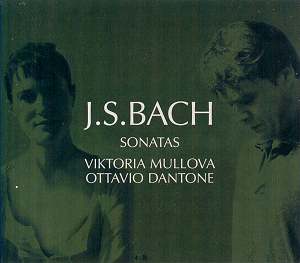
The six sonatas for harpsichord and violin are amongst the most popular pieces of chamber music by Johann Sebastian Bach. This is reflected by the number of recordings of these works. Recently no less than three new recordings were released, one of which by the famous Russian-born violinist Viktoria Mullova and the Italian harpsichordist Ottavio Dantone. It is not by coincidence that I mention them in this order: this is the hierarchy on the cover.

As these sonatas are very well-known there is no need to say that much about them. What is important here is to refer to the title of the sonatas: Sei Suonate a Cembalo certato è Violino Solo, col Basso per Viola da Gamba accompagnato se piace. Although the violin doesn't play a subservient role, it is clear from this title that the harpsichord has the lead in the partnership. The suggestion to use a viola da gamba to support the bass part - played by the left hand on the harpsichord - is very seldom followed. Here the viola da gamba is only used in two additional sonatas, as the track-list shows.

The clear indication of the title-page notwithstanding, it is the violin which attracts most of the attention here. The fact that the violin tends to dominate more often than not isn't just a matter of artistic decision. It is also a result of the recording technique. I am disappointed by the recorded sound, which is much too distant. I miss the intimacy that repertoire like this requires. The fact that the recording has taken place in a church is partly responsible for this. In particular at the end of a movement one hears a far too long reverberation.

There is another factor here. I wonder whether Mullova is playing a real baroque violin. According to the booklet she uses a Guadagnini from 1750. But its sound is quite different from other baroque violins I have heard on disc, among them those on two other recent recordings of the same repertoire. I suspect it has been re-engineered at some time to meet the demands of 19th century repertoire. Ms Mullova uses gut strings, but these don't turn a modernised violin into a baroque violin. In particular when Ottavio Dantone uses only one 8' register the harpsichord is no match for the violin.

Viktoria Mullova is a product of the Russian violin school, which concentrates on technical brilliance and the interpretation of romantic repertoire. After she defected to the West she discovered historical performance practice. She has worked with prominent representatives of this approach, among them John Eliot Gardiner and Il Giardino Armonico, often with wonderful results. But I have to say that her interpretation of these sonatas is disappointing.

In most movements there is too little differentiation between the notes and too much legato. As a result the adagio of the Sonata in f minor (BWV 1018), for instance, where the violin part is dominated by double-stopping, lacks contrast and is simply boring. I wonder why in some movements there are dynamic accents – like in the allegro of the same Sonata in f minor or the opening movement of the Trio Sonata BWV 525 – whereas they are very rare elsewhere. This is just one example of the lack of consistency in this interpretation.

Another issue with these performances is the fluctuation in the tempi of several movements. I don't think there is anything fundamentally wrong with that, and it can be used to increase the tension of a piece, on the basis of a thorough knowledge of baroque rhetorics and 'affetti'. The performances and recordings of the ensemble Musica ad Rhenum, for instance, show that tempo fluctuations can be used to great effect. But it shouldn't be exaggerated and should not be applied at random. Yet that seems to be the case here. The 'dolce' from the Sonata in A (BWV 1015) is the worst: the rhythm is hardly recognisable, and one would think the piece lacks measures. Towards the end it almost comes to a standstill. The 'adagio' of BWV 1014 begins in a tempo which is too fast for an adagio but then the tempo slows down. The reasoning behind it escapes me, and instead of increasing the tension it is plain annoying and way over the top. There is certainly no reason to increase the speed – which is generally too slow anyway – in the middle movement (for harpsichord solo) of the Sonata in G (BWV 1019).

In some movements the partnership between Dantone and Mullova does not work very well. 'Playing apart together' seems to be a suitable description of how some movements sound. In the opening movement of the Sonata for violin and bc in G (BWV 1021) Mullova, all of a sudden, uses more vibrato than elsewhere and certainly more than is justified by the needs of ornamentation.

There is very little in this recording which makes it recommendable. The Trio Sonata in C - originally written for organ solo - is played rather well, and so is the last movement of the Sonata in c minor (BWV 1017). Apart from the vibrato in the opening movement the Sonata BWV 1021 is one of the most satisfying items in this set.

But this is just not enough. This interpretation adds nothing useful to the catalogue.

Johan van Veen

 

Advertising Rates
Visitor stats
MusicWeb International
has over 40,000 Classical CD reviews on offer

Discs received

Having a problem Donating?


Gerard Hoffnung Concerts &
The Bricklayer Story

MusicWeb can now offer you discs from the following catalogues:
Prices include postage

There will be NO VAT Rises

[Acte Préalable £13.50]
[Arcodiva £12.00]
[Avie from £6.25]
[British Music Society £12.00]
[CDACCORD from £13.50 ]
[ClassicO £12.50]
[Hallé from £11]
[Heritage £10]
[Hortus £14.99 ]

[Lyrita ONLY £11.75 ]
[Nimbus Special prices]
[Northern Flowers £13.50]

[REDCLIFFE £11 ]
[Sheva £11]
[Tactus £11.50 ]
[Talent from £12.00 ]
[Toccata Classics £10.50 ]

Musicweb
Special Offers

Monthly Best Buys


Naxos Classical


New Releases

Hyperion


New Releases


MusicWeb sells the Polish
catalogue CDAccord
£10.50 post free W-W


MusicWeb sells the
Arcodiva catalogue
£12.00 post free W-W


£11.75
post-free
world- wide


Google Ads - for information about privacy matters, click here
Amazon Musicweb International is a participant in the Amazon EU Associates Programme, an affiliate advertising programme designed to provide a means for sites to earn advertising fees by advertising and linking to Amazon.co.uk and Amazon.com


EXPLORE MUSICWEB INTERNATIONAL

Making a Donation to MusicWeb

Writing CD reviews for MWI

About MWI
Who we are, where we have come from and how we do it.

Site Map

How to find a review

How to find articles on MusicWeb
Listed in date order

Review Indexes
   By Label
      Select a label and all reviews are listed in Catalogue order
   By Masterwork
            Links from composer names (eg Sibelius) are to resource pages with links to the review indexes for the individual works as well as other resources.

Themed Review pages

Jazz reviews


Discographies
   Composer
      Composer surveys
   National
      Unique to MusicWeb -
a comprehensive listing of all LP and CD recordings of given works
.
Prepared by Michael Herman

Book Reviews

Complete Books
We have a number of out of print complete books on-line

Interviews
With Composers, Conductors, Singers, Instumentalists and others
Includes those on the Seen and Heard site

Nostalgia

Nostalgia CD reviews

Records Of The Year
Each reviewer is given the opportunity to select the best of the releases

Monthly Best Buys
Recordings of the Month and Bargains of the Month

Comment
Arthur Butterworth Writes

An occasional column

Phil Scowcroft's Garlands
British Light Music articles

Classical blogs
A listing of Classical Music Blogs external to MusicWeb International

Reviewers Logs
What they have been listening to for pleasure

Announcements


Community
Bulletin Board

Give your opinions or seek answers

Reviewers
Pat and present

Helpers invited!

Resources
How Did I Miss That?

Currently suspended but there are a lot there with sound clips


Composer Resources

British Composers

British Light Music Composers

Other composers

Film Music (Archive)
Film Music on the Web (Closed in December 2006)

Programme Notes
For concert organizers

External sites
British Music Society
The BBC Proms
Orchestra Sites
Recording Companies & Retailers
Online Music
Agents & Marketing
Publishers
Other links
Newsgroups
Web News sites etc

PotPourri
A pot-pourri of articles

MW Listening Room
MW Office

Advice to Windows Vista users  
Questionnaire    
Site History  
What they say about us
What we say about us!
Where to get help on the Internet
CD orders By Special Request
Graphics archive
Currency Converter
Dictionary
Magazines
Newsfeed  
Web Ring
Translation Service

Rules for potential reviewers :-)
Do Not Go Here!
April Fools


Return to Review Index

Untitled Document


Reviews from previous months
Join the mailing list and receive a hyperlinked weekly update on the discs reviewed. details
We welcome feedback on our reviews. Please use the Bulletin Board
Please paste in the first line of your comments the URL of the review to which you refer.