Editorial Board
MusicWeb International
Founding Editor Rob Barnett Editor in Chief
John Quinn Contributing Editor Ralph Moore Webmaster
David Barker Postmaster
Jonathan Woolf MusicWeb Founder Len Mullenger
Arleen Augér(soprano) Robert SCHUMANN (1810–1856) 1. Widmung, Op. 25, No. 1 [2:29]
2. Röselein, Röselein!, Op. 89, No. 6 [2:44]
3. Er ist’s, Op. 79, No. 24 [1:29]
4. Des Sennen Abschied, Op. 79, No. 23 [1:46]
5. Mignon (“Kennst du das Land”), Op. 79,
No. 29 [4:07]
6. Singet nicht in Trauertönen, Op. 98a,
No. 7 [2:16]
Franz SCHUBERT (1797–1828) 7. Frühlingsglaube, D686 [3:25]
8. Der Schmetterling, D633 [1:27]
9. Nacht und Träume, D827 [4:05]
10. Ariette: Liebe schwärmt auf allen Wegen,
D239, No. 6 (From the unfinished Singspiel “Claudine von Villa Bella”)[1:23]
11. Erster Verlust, D226 [2:01] 12. Gretchen am Spinnrade, D118 [3:58]
Arnold SCHÖNBERG (1874–1951) Vier Lieder, Op. 2
13. No. 4: Waldsonne [3:48]
14. No. 1: Erwartung [3:53]
15. No. 2: Schenk mir deinen goldenen
Kamm [3:55] 16. No. 3: Erhebung [1:13]
Richard STRAUSS (1864–1949) 17. Das Rosenband, Op. 36, No. 1 [3:08]
18. Mohnblumen, Op. 10, No. 7 [1:28]
19. Die Zeitlose, Op. 10, No. 7 [2:12]
20. Efeu, Op. 22, No. 3 [3:52]
21. Freundliche Vision, Op. 48, No. 1 [2:58]
22. Herr Lenz, Op. 37, No. 5 [1:20]
Encores Franz SCHUBERT 23. Heidenröslein, D257 [2:14]
Lee HOIBY (b.
1926) 24. The Serpent [4:17]
Arleen Augér
(soprano), Dalton Baldwin (piano)
rec. live, BBC Studios, Pebble Mill, Birmingham,
2 January 1987
BBC LEGENDS BBCL
4214-2 [66:01]
Arleen
Augér’s recorded legacy is extensive, to say the least, and
in a very wide repertoire. My first encounter with her voice
was, I believe, when she sang a mermaid in the DG recording
of Oberon, with Birgit Nilsson and Placido Domingo, among
others. That was in the early 170s and her crystal clear and
still warm lyric soprano greatly impressed me and made me hope
to hear more of her. My prayer was granted. She will probably
be best remembered for her Mozart but she sang so much else;
one of my favourite recordings with her is Cimarosa’s Il
matrimonio segreto, where she is a wonderful Carolina, having
the same agility and face as Alda Noni on the old Cetra set
but much more warmth.
Warmth,
beauty of tone and ravishing pianissimo singing are also characteristics
that distinguish her Lieder singing but besides these she possessed
that harder-to-define quality that can be termed insight or
communication, the ability to probe beneath the notes and convey
not just the words but the deeper meaning of them. Early on
while listening to this live recital I scribbled down ‘Seefried’
on my pad and it was gratifying to see Mike Ashman in his liner
notes quoting the soubriquet ‘the true successor of Irmgard
Seefried’. It isn’t so much a question of similarities of voices
– at least not when comparing Seefried at roughly the same age
as Arleen Augér here (48). Seefried, even in her early thirties,
had a shorter range and when approaching her forties she could
be sorely strained in the upper regions, but she had a unique
way of making every song her own, to make an audience listen,
accentuate a phrase or a word, saying: ‘Listen! This is important!
This is something special!’, without overstating and distorting
the text or the tone. Arleen Augér communicates in the same
way on this well composed recital, often discreetly, even recessed,
singing so to speak inwards, as a dialogue with the individual,
not the whole audience as a collective.
The
opening song, Schumann’s Widmung, at once tells us that
this is going to be an intimate hour: soft, unaffected but with
concentration and acuity. Röselein, Röselein! is ethereal
and extremely beautiful, while the seldom heard Goethe setting
Singet nicht in Trauertönen is light and springy, the
piano accompaniment played with infectious bounciness by the
excellent Dalton Baldwin. It is also good to have the three
songs from Liederalbum für die Jugend, of which Mignon
is especially impressive. It seems though that the track list
has got the opus numbers wrong: Mignon is allotted Op.
79 No. 28, whereas it should be Op. 79 No 29 and the other two
songs have both had the numbers displaced one step ahead. A
bagatelle, but just to put the record straight. The correct
numbers are shown in the heading to this review.
The
Schubert songs are all superb and especially here Irmgard Seefried
comes before my inner ear. Schönberg’s early (1899) Vier
Lieder Op. 2, late romantic and mostly inward and soft,
are also superbly done. They are not sung in the published order
but the one indicated in the heading, which means that No. 3:
Erhebung comes last, which is good for the applause since
this is the only lively song. BBC have advised me that the correct
sung order will be given on a sticker.
Everything
superb so far, the Richard Strauss group is even better and
it is extra valuable since there are a couple of songs rarely
heard. The pick of the crop is probably Die Zeitlose,
sung with silvery tone so perfectly attuned to Strauss’ music
and the story is told intimately and with restraint. But Freundliche
Vision, beautiful and inward, is also something for the
desert island and – in total contrast – the lively, joyous Herr
Lenz is like a refreshing Spring rain.
The
well behaved audience crave encores and Arleen Augér satisfies
with a simple an fresh-as-dew Heidenröslein and Lee Hoiby’s
jazz influenced The serpent, rounding off one of the most
satisfying song recitals I have heard for a long time. This disc
will, I am sure, figure high on my list of favourite recordings
of 2007.
Göran Forsling
Please support our advertisers below by clicking on the logos for further information.
























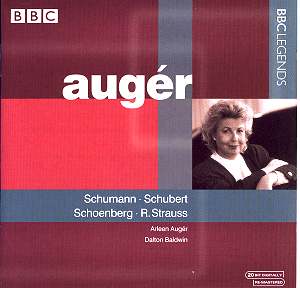

 Arleen Augér
(soprano), Dalton Baldwin (piano)
Arleen Augér
(soprano), Dalton Baldwin (piano)