Comparative reviews
http://www.musicweb-international.com/classrev/2003/Jan03/debussy_ravel_martinon_emi.htm
http://www.musicweb-international.com/classrev/2005/Nov05/Debussy_Brilliant_92765.htm
I'm never quite sure what goes through record
companies' minds when they lease or license material but EMI has
clearly seen good sense in reissuing these recordings very soon
after licensing them to Brilliant Classics, who issued them in a
four CD boxed set (Brilliant Classics 92765). EMI had itself
issued a big eight CD set of Debussy and Ravel - four discs to
each composer - on CZS 5755262. The recycling and leasing of
material at least goes to show one indisputable fact. Whereas not
every recording here is going to be the most imaginatively played
or the most evocatively nuanced, they have all stood the test of
time and the accountants'
scythe. Recorded over thirty years ago
they have proved durable and important
recordings, fully worthy of a rejigging
in EMI's Gemini series.
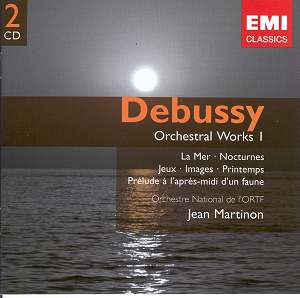
The new format is two
twofers. The first starts as it means
to go on, with a no-nonsense La Mer.
Martinon had at his command a notoriously
recalcitrant orchestral beast in the
shape of the Orchestre National de l'ORTF
but it's a measure of his convincing control that they play so
consistently well for him. He encourages from them a clarity, a
distinct "separation of the powers" when it comes to sectional
discipline - no lazy bleaching
of sonorities - and very little overtly
gaudy expression. In pianistic terms
his approach reminds me of George Copeland,
not Walter Gieseking; if the orchestra
was a piano its feet would be off the
pedal. It means of course that there's
ultimately a want of sheer sheen and
colour but to compensate there's no
rhythmic flaccidity. Everything keeps
moving nicely. But Martinon certainly
encourages some vivid wind playing in
the Jeux de vagues; this
is a bracing, forward-moving La Mer.
The Trois Nocturnes
feature something of a reprise -
attractively and athletically lean sonorities
conjoined with a decisive sense of tempo
relationships. It's undoubtedly the
case that many will miss say, Ormandy's sense of glamour and
vitality - his
evocative surface painting - in Fêtes.
And if one is objective Prélude
à l'Après-Midi d'un Faune
will stand more as a corrective
to overtly romanticised languor rather
than as a necessarily recommendable
recording in its own right. There's
little of Beecham's famously erotic
glamour.
But one of Martinon's
greatest strengths in this repertoire
was the immediate establishment of a
firm rhythm. This is coupled with real
atmosphere in Jeux. One senses
however that in Images Martinon
is not given quite the free rein he
seeks, that he is hindered by an orchestra
that can't quite give him the free spiritedness he is asking for
- especially in Iberia. Still there is vitality - and a
nice big fat trumpet - in Par les rues
et par les chemins. If criticisms
need to be established about this cycle
they will centre on a lack of explicit
string tone and weight in these readings.
For all the intimacy of Les parfums
de la nuit the strings lack the
last ounce of evocative lusciousness
that they ideally need here. I should
add as a rider that Martinon would doubtless
argue that this is not quite what he
wanted.
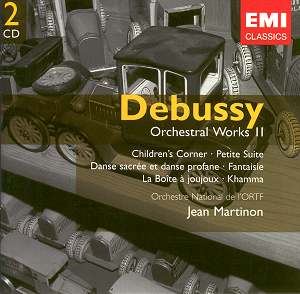
The second twofer features
a raft of soloists and orchestrations.
Lest I give the impression that Martinon's
deft clear sightedness is impervious
to charm one could do worse than listen
to Children's Corner. Wind playing,
sectional balance and rhythmic pointing
are all a delight. En bateau
from the Petite Suite is of a piece - a reading that eschews extraneous
gesture in favour of the essence. And
if there's not much sign of Stokowski's
voluptuous approach in Danse sacrée
et danse profane Martinon's solutions
are, if less voluble and exciting, always
clean-limbed, analytical and superbly
thought through.
Ciccolini impresses
in the Fantasie where his articulation
is deft and the orchestral support suitably
robust when required. John Leach bring
some cimbalom spice to Le plus que
lente but Guy Dangain impresses
even more in the Première
Rapsodie with his very personalised
tonal qualities and athletic fingering.
Jean-Marie Loneix's very French, rather
woolly, saxophone tone is on display
in the Rapsodie and there's an
exciting generation of rhythmic intensity
here. There are other bits and pieces
that you will need for a complete and
representative Debussy orchestral collection
and they're very well played if not
always tremendously interesting.
If you seek swathes of colour and outsize
personality in your Debussy you may find that Martinon
under-characterises. If however you are satisfied with
performances that are lucid, imaginative, thoughtful and
unselfconscious then you will be very happy with Martinon. He has
a special understanding of this - and allied -
repertoire and his clarity and care
in balance and dynamics are merely two
of his great virtues in Debussy conducting.
That's why these performances exist in multiple competing
editions - and
long may they continue to do so.
Jonathan Woolf
see also review
by Paul Shoemaker December
BARGAIN OF THE
MONTH



 Orchestre National de l'ORTF/Jean Martinon