Editorial Board
MusicWeb International
Founding Editor Rob Barnett Editor in Chief
John Quinn Contributing Editor Ralph Moore Webmaster
David Barker Postmaster
Jonathan Woolf MusicWeb Founder Len Mullenger
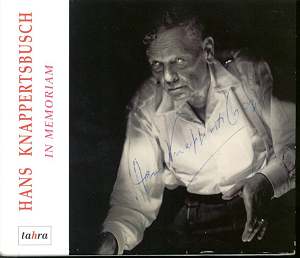
Hans Knappertsbusch - In Memoriam Richard WAGNER(1813-1883)
Siegfried Idyll [20:07] (rec. 8 May 1953) Johannes BRAHMS(1833-1897)
Symphony No.4 in E minor Op.98 (1885) [40:54] (rec. 8 May 1953) Ludwig van BEETHOVEN(1770-1827)
Symphony No. 5 in C minor Op.67 (1808) [36:49] (rec. 9 April 1956) Gustav MAHLER(1860-1911)
Kindertotenlieder (1901-04) [26:41] (rec. 9 April 1956) Anton BRUCKNER(1824-1896)
Rehearsal of Symphony No. 8 with Interview with Knappertsbusch [7:30] Ludwig van BEETHOVEN(1770-1827)
Piano Concerto No. 4 in G major (1806) [32:12] (rec. 17 January 1954) Robert SCHUMANN (1810-1856): Symphony No. 4 in D minor Op.120 (1851) [26:47] (rec. 4 November 1954) Richard WAGNER(1813-1883) Parsifal (selection) (1882) [61:29] (rec. 5 August 1954) Lucretia West
(mezzo) (Mahler)
Wolfgang Windgassen (tenor) (Wagner: Parsifal)
Martha Mödl (soprano) (Wagner: Parsifal)
Josef Greindl (bass) (Wagner: Parsifal)
Wilhelm Backhaus (piano) (Beethoven concerto)
Kölner Radio Symphony Orchestra (Wagner: Idyll; Brahms)
Berlin Philharmonic Orchestra (Beethoven: Symphony; Mahler)
Vienna Philharmonic Orchestra (Beethoven: Concerto)
Dresden Staatskapelle (Schumann)
Orchester of the Bayreuth Festspiele (Wagner: Parsifal)
Hans Knappertsbusch TAHRA TAH606-609 [4 CDs:
61:32 + 71:34 + 59:21 + 61:29]
This four CD boxed set from
Tahra is produced in memoriam though there’s never
a wrong time for intelligently selected examples of his
art. Most Kna collections have their up and down moments
and this is no exception but at its best it offers powerful
and moving testimony to his rugged greatness as an interpreter.
All the performances – bar the
rehearsal and interview - have made an appearance in some
form or other so a few words might be helpful here to enable
the collector to orientate the discography. The Siegfried
Idyll, a truly beautiful performance, has been on Music & Arts
CD-1014, which like this one was a four CD set; it was
also on King Records. The Brahms has seen a lot of service
on LP and CD; Arlecchino, Golden Melodram and Andromeda
ANDRCD5066 (see review) are amongst the best known. The
Beethoven Fifth has recently been released on ANDRCD5017
(see review)
with the Backhaus G major concerto and a raft of all-Beethoven
material.
The Dresden Schumann has seen issues on Hunt, Fonoteam
and King Records. The Mahler is a rare bird – though it
was once again on Hunt and King. The Parsifal extracts – a
whole CD’s worth – turned up on a Melodram LP set years
back; also on King KICC 2341/44 and Golden Melodram GM
1.0053 – where I believe the whole performance was preserved.
So this leaves the brief rehearsal
and interview – about seven minutes in total – as the only
material not previously commercially released, to the best
of my knowledge. The rehearsal proceeds much as one would
expect, with Kna’s comments transcribed in the booklet;
similarly with the interview in which Knappertsbusch’s
gruffly wry voice has been well preserved. It’s not an
especially revealing document though – a little about conducting
etiquette and endorsements of the Vienna Philharmonic.
Of
the performances the Brahms Fourth happens to be my favourite,
maybe for all the wrong reasons. Powerful, fluid, dramatic,
gruff, wilful - yes to all these. But also opening out like
lava flow in the second movement and running rapid accelerandi
to prefigure the finale’s crises. This is a very human Fourth,
at times overwhelmingly, dangerously so. Not a connoisseur’s
Fourth or maybe for most collectors or even auditors. But
something for once in a dramatic while – gaunt tragedy, unvarnished.
The
Beethoven Fifth isn’t as marmoreal as it was later to become
but it’s still heavy going. The Berlin horns are rather blustery
and things are heavily underlined. The highly emphatic performance
has some passingly lovely things – try the string curve at
4.40 in the slow movement – but this is in truth a dumpling
of a performance
The G major Piano Concerto
with frequent collaborator Backhaus is good. The sonics are
muffly and unhelpful, unfortunately, which mitigates pleasure
but through them one can still hear the soloist’s fluent
and thoughtful performance, the more so as he’s somewhat
over–recorded. The first movement cadenza really blazes and
the slow movement is expressive. This is a worthwhile addition
to the Kna-Backhaus discography, though admirers will already
have it on their shelves.
He certainly had to cede
to Furtwängler when it came to Schumann. Tahra have released
the latter’s live Lucerne 1953 performance and despite the
shrill recording and tense sonics this is a memorable and
moving traversal. Kna by contrast is faster all round with
a swishy sound – like a dished LP – and he lacks Furtwängler’s
organic power and sense of cumulative weight of expression.
The Mahler with Lucretia West sees him with a singer with
whom he was to make a commercial recording of the Brahms
Alto Rhapsody in May 1957. Kindertotenlieder is recorded
very close-up though the sound is otherwise clear – and there’s good spatial
separation between strings and horns. Even so the recording
gives West’s voice a slight edge and occasionally one might
feel she lacks sufficient colour to bring the greatest degree
of depth to the songs. Nevertheless this is the only Kna-Mahler
survival so far discovered and as such an important document
of Kna’s way with a composer he conducted very rarely.
Kna’s Parsifal by contrast is of course legendary. These 1954
extracts begin with a rather magnificent Prelude and include
the Klingsor Garden scene, the Good Friday music and the
finale of Act III. With a decent recording level and Windgassen,
Martha Mödl and Josef Greindl with him this is another
valuable souvenir of his 1950s Bayreuth appearances. It
was taped three years after the famous 1951 recording to
which it’s nearer in time than the equally esteemed 1962.
But it makes for compelling listening.
As for the comparative
business with regard to competing transfers; Andromeda’s
transfers are consistently at a higher, that’s to say louder
level. Tahra has also done some restorative work by, for
example, removing coughs. This is especially evident in the
G minor concerto performance where Backhaus has to battle
against a bronchial audience. One can hear the excision edits
though if one listens carefully. There is little meaningful
difference - beyond transfer levels - between the two Beethoven
Fifths. The Brahms is again transferred at a higher level
in the Andromeda but the Tahra is slightly clearer and far
better bass defined. Andromeda’s is by comparison crudely
over processed and opaque and Tahra’s enormously to be preferred.
Tahra also has two good
booklets. One is solely given over to photographs of the
conductor from childhood to old age, provided by the family,
and is a sumptuously produced affair – the kind of thing
this company does so well. And for Kna admirers there are
some important things in these four well-filled discs.
Jonathan Woolf
Please support our advertisers below by clicking on the logos for further information.

























 Lucretia West
(mezzo) (Mahler)
Lucretia West
(mezzo) (Mahler)