Site
Map
More
Reviews
How
to find a review
Classical CD Review Archive
Book
Reviews
Film
Music Reviews
Jazz
CD Reviews
Nostalgia
Comment
Norman
Lebrecht Weekly
Arthur
Butterworth Writes
Phil
Scowcroft's Garlands
Classical
blogs
Reviewers
Logs
Announcements
Don't
Go Here!
Community
Bulletin
Board
Web
Ring
Reviewers
Helpers
invited!
Resources
Quiz
British
Composers
British
Light Music Composers
Other
composers
Indexes
Label
Masterwork
Discographies
On-line
Music
[Download sites]
Themed
Review pages
Our
Classic Classics
Online
books
MWI
Classical
Encyclopaedia
Gilder
Dictionary of
Composers
MWI
Pop
Encyclopedia
Other
Complete
Books
Programme
Notes
British
Music Society
Performers
The
BBC Proms
Musical
WWW pages
Classical
Music Online
Recording
Companies and Retailers
Agents
and Marketing
Publishers
Non-Classical
Web pages
Orchestra
Web Sites
Newsgroups
Web
News sites etc
Editorial
Board
Classical Editor
Rob Barnett
Seen & Heard
Editor and Webmaster
Bill Kenny
MusicWeb Webmaster
Len Mullenger
Assistant Webmasters
Patrick Waller
David Barker
PotPourri
A
pot-pourri of articles
MW
Listening Room
MW
Office
Helping
MusicWeb
Advice
to Windows Vista users
Questionnaire
Site
History
What
they say about us
What
we say about us!
Where
to get help on the Internet
CD
orders By Special Request
Graphics
archive
Currency
Converter
Dictionary
Magazines
Newsfeed
Web Ring
Translation Service
Rules
for potential reviewers :-)
Do
Not Go Here!
April Fools
|
alternatively AmazonUK |
Wolfgang Amadeus
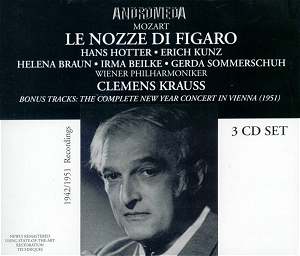
MOZART (1756-1791)
Le nozze di Figaro (The Marriage
of Figaro) K492. Sung in German.
Irma Beilke (soprano) - Susanna
Helena Braun (soprano) - Countess Almaviva
Res Fischer (soprano) - Marcellina
Liane Timm (soprano) - Barbarina
Gerda Sommerschuh (mezzo) - Cherubino
Josef Witt (tenor) - Don Basilio
William Wernigk (tenor) - Don Curzio
Hans Hotter (baritone) - Count Almaviva
Erich Kunz (bass) - Figaro
Gustav Neidlinger (bass) - Bartolo
Franz Normann (bass) - Antonio
Vienna State Opera Chorus and Vienna Philharmonic
Orchestra/Clemens Krauss
rec. Salzburg, 5 August 1942
The (Decca) New Year Concert
Johann STRAUSS
II (1825-1899)
Egyptischer Marsch, 'Egyptian March' Op. 335 [4:34]
Eljen a Magyar!, 'Hail to Hungary' Op. 332 [3:11]
G'schichten aus dem Wienerwald, 'Tales from the
Vienna Woods’ Op. 325 [11:54]
Im Krapfenwald Op. 336 [4:08]
Pizzicato Polka [3:21]
Vergnügungszug, 'Train' Op. 281- Die Fledermaus,
'The Bat' [2:54]
Josef STRAUSS
(1827-1870)
Jokey, 'Jockey' Op. 278 [1:56]
Die Libelle, 'The Dragonfly' Op. 204 [4:38]
Mein Lebenslauf ist Lieb und Lust 'The Course
Op. 263 [7:03]
Vienna Philharmonic Orchestra/Clemens Krauss
rec. Grosser Saal, Musikverein, Vienna, September
1951
ANDROMEDA ANDRCD 5075 [3 CDs: 76:38 + 53:38
+ 74:52] |
Advertising
Rates
Visitor
stats
MusicWeb
International
has over 21,000 Classical CD reviews on offer
Gerard
Hoffnung Concerts &
The
Bricklayer Story
New
Releases

New
Releases


MusicWeb
sells the Polish
catalogue CDAccord
£10.50 post free W-W

MusicWeb sells the
Arcodiva catalogue
£12.00 post free W-W

Price
Reduction: £11.00
post-free world-wide
Try
it and see - Sale or Return
MusicWeb
can now offer you discs from the following catalogues:
Prices include postage
MusicWeb
Recommended Recordings 2008
DISCS
OF THE YEAR 2007
|
There’s
nothing new to the catalogues here. The Figaro first appeared,
if memory serves, on Preiser 90203 in a two CD set. The Strauss
miscellany was last available on Decca 425 990-2DM2 where it
was harnessed to Krauss’s Die Fledermaus with its famous all-star
cast of Gueden, Lipp, Patzak, Dermota, Poell et al. Coupling
the Strauss items – Johann and Josef – to Mozart’s Figaro is
on the face of it an unlikely proposition. Doubtless Andromeda
has done it because the Mozart spills over to the third disc
and some kind of filler was required – even so, it makes for
rather patchwork listening. Collectors, those high-minded avians,
will be fuming at the inconsequentiality of the pairing, though
in mitigation I’m not aware that any other example of Krauss’s
way with a Mozart opera has emerged.
The
performance is splendid. It’s energetic, lithe, well-paced and
doesn’t stint emotive candour into the bargain. It’s sung, as
was customary, in German and there is a piano continuo for the
fluently taken and athletic recitatives. Perhaps it doesn’t
plumb the greatest of depths but it assuredly skirts the excesses,
musico-dramatic, that the opera sometimes received. It was given
at the 1942 Salzburg Festival. The sound is not quite as good
as many a wartime German broadcast – which is to say a whole
lot better than most others from this period. Spatial definition
and stage movement are both audible with clarity; no real complaints
on this score, especially not when given the rarity of the material
and the fact of its survival at all.
The
weight of cast excellence lies in the men. Kunz is Figaro and
he strikes a warmly chiselled dramatic presence. This is character
acting that transcends the medium with a voice that compels attention.
He takes no time at all to warm up – fortunately – and by Non
più andrai – or Nun vergiss leises Flehn as he sings
it – we are in the presence of a cherishable document highlighting
his Mozartian credentials. He is more than matched by the young
Hotter whose Count is in truly commanding and youthful voice.
No one would argue with his Cosa sento? and for an exhilarating
example of his compelling characterisation turn no further than
to Act II’s Esci ormai garzon malnato. He employs a suitably
rich array of vocal blandishments and proves a crowning glory
of the performance. The young Gustav
Neidlinger is a fine Bartolo -warmly vocalised and rich of compass,
albeit still a touch nasal higher up the range.
The
women are by no means disgraced but don’t quite operate at the
exalted level of Hotter and Kunz. Beilke’s Susanna certainly
has the top notes though hers is – maybe appropriately – quite
a lightweight assumption. Helena Braun is the Countess and she offers an interesting
study in the fluid use of portamento in Porgi amor. Res
Fischer’s Marcellina is inclined to be a touch shrill but Gerda
Sommerschuh as Cherubino offers plenty in the way of urgency
and personality.
The bonus consists of numbers from the Decca New Year concert,
recorded in anticipation in September 1951. Krauss had started
the concerts during the War and was to continue to do so until
his death. He is of course delectable in this repertoire. He
finds plenty of sauce for G'schichten aus dem Wienerwald.
There again he brings out the woodland Idyll of the seldom-heard Die
Libelle (The Dragonfly) and dispatches the whip-crackery
of the Parisian sounding Jokey with veritable élan.
No notes of any kind grace the box. But in conclusion and
for those who do not already posses these recordings elsewhere
this is a valuable historic document. Figaro captures
Kunz and Hotter in their primes and Krauss in rare repertoire
for him – pretty well recorded too. The Strauss family New Year
disc is self-recommending, thin strings and slightly papery quality
notwithstanding.
Jonathan Woolf
|