Editorial Board
MusicWeb International
Founding Editor Rob Barnett Editor in Chief
John Quinn Contributing Editor Ralph Moore Webmaster
David Barker Postmaster
Jonathan Woolf MusicWeb Founder Len Mullenger
Ludwig van BEETHOVEN (1770-1827)
Piano Concerto No. 4 in G, Op. 58 (1805/6) [33:10]
Piano Concerto No.5 in E flat, Op. 73, “Emperor” (1809) [39:16] Emil Gilels (piano)
Philharmonia Orchestra/Leopold Ludwig
rec. No. 1 Studio, Abbey Road, London, 26-27, 30 April, 1 May 1957.ADD EMI CLASSICS
GREAT RECORDINGS OF THE CENTURY 4768282 [72:35]
Classic accounts of Beethoven here, as Bryce Morrison's
overtly laudatory booklet note makes clear. There are many other
Gilels versions of both concertos, but none can boast the
resplendent orchestral playing that the Philharmonia delivers
nor the excellent - if somewhat beefy - sound provided by
Walter Legge and Robert Gooch.
Gilels' discography lists a number of other Fourths: Leningrad
with Sanderling (1957); Czech PO also with Sanderling (1958);
live from Naples with Pradella (1965); the famous Cleveland
cycle of 1968; USSRSO under Masur (1976) and a live Bavarian
performance with Sawallisch (1979). Personally I am most
familiar with the Szell Cleveland cycle - with which I was
brought up. There is significantly more humanity in these
readings of over a decade earlier.
The opening of the present Fourth is very serene and unhurried.
Originally issued on Columbia 33CX 1055, this is a magnificent
performance. The Fourth is in some ways the trickiest, finger-wise,
of the Beethovens. Not that anyone would guess it from Gilels'
finger strength at around 9:20 in the first movement. Only
some muddying in the orchestral textures detracts - as I
say, the orchestral recording can be a bit obscured at times.
Curiously the orchestra sounds rather dry at the opening
of the second movement, something one forgets immediately
at Gilels' hyper-placatory entrance. The end of Orpheus and
the Beasts is magical; the finale is full of drive; the strings
are nicely together at the opening. If the cadenza is perhaps
a touch heavy to begin with, it is small cause for complaint.
This is memorable music-making.
There are apparently eleven Gilels 'Emperors'. Of these I
would love to hear the live Chicago with Martinon of 1966.
With Ludwig, Gilels seems astonishingly at home, able to
unleash the largest fortissimi: the chords around 10'30 in
the first movement. His sovereign command is never in doubt
here, as he shines from first note to last. Fingerwork is
crystal throughout.
Ludwig, excellent in No. 4, if anything excels himself in
the 'Emperor'. The very opening E flat chord is absolutely
resplendent, while the opening of the Adagio un poco mosso is
unutterably tender, the perfect preparation for Gilels' magic
touch. Nice to hear the accompanying woodwind chords around
3'30, just a pity the oboes are not together at 3'34 - a
small point perhaps, but once you've heard it you start expecting
it on rehearings.
The finale is big-boned, a testament, perhaps, to the barn-storming,
revolutionary image of Beethoven, with Gilels' iron fingers
again making Beethoven's demands seem laughably easy. I should
report a pressing error on my copy just before the very end
(8'26).
These performances demand to be heard.
Colin
Clarke
























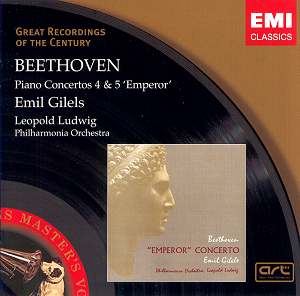

 Emil Gilels (piano)