Editorial Board
MusicWeb International
Founding Editor Rob Barnett Editor in Chief
John Quinn Contributing Editor Ralph Moore Webmaster
David Barker Postmaster
Jonathan Woolf MusicWeb Founder Len Mullenger
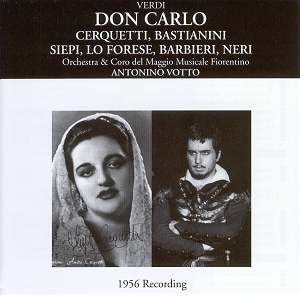
Giuseppe VERDI (1813-1901) Don Carlo - Opera in Four Acts, sung in Italian
(1884) Philip,
King of Spain - Cesare Siepi (bass); Don Carlo, Infante
of Spain - Angelo Lo Farese (ten); Rodrigo, Marquis of Posa
- Ettore Bastianini (bar); The Grand Inquisitor - Giulio
Neri (bass); Elisabeth de Valois, Philip's Queen - Anita
Cerquetti (sop); Princess Eboli, Elisabeth's lady-in-waiting
- Fedora Barbieri (mezzo); Tebaldo, Elisabeth's page - Liliana
Poli (sop); The Count of Lerma, A Royal Herald - Enzo Guagni
(ten); An Old Monk - Paolo Washington (bass); A Voice from
Heaven - Rena Gary Falachi (sop)
Orchestra and Chorus of the Maggio Musicale Fiorentino/Antonino
Votto
rec. live, Teatro Communale, Florence, 16 June 1956 Appendix: Ettore Bastianini as Rodrigo in Don
Carlo from the Met production, rec. 5 March 1955
with Richard Tucker as Carlo and Jerome Hines as Philip/Kurt
Adler [32.45] ANDROMEDA ANDRCD5064 [3CDs:
70.44 + 63.13 + 69.36]
The
original five-act form of Don Carlos,premiered
at the Paris Opéra on 11 March 1867, was only modestly received.
The premiere of the Italian translation as Don Carlo was
given at Bologna in September 1867 and then made its way
to Rome and along the remainder of the Italian peninsula.
It fared little better. Both the Italian public and theatre
managements found it over-long and they were slow to take
it to their hearts. It was not long before the act three
ballet and then the Fontainebleau act were dropped altogether.
The arrival in Italy of the shorter and grander Aida in
1871 added to the difficulty of the opera’s length. After
a failure in Naples in the same year Verdi made his first
alterations to the score for a revival under his own supervision.
Still its fortunes disappointed the composer and as early
as 1875 he began seriously to consider shortening the work
himself. With competing demands on his time he did not begin
serious work on this until 1882 concluding his revision as
a four act opera the following year. Its premiere had to
wait until 1884. The new shorter four-act revision involved
much rewording to explain the sequence of events and maintain
narrative coherence. Verdi’s own reworking also involved
the removal of the Fontainebleau act, the ballet and the
Inquisitors’ chorus in act five as well as other detailed
changes. The premiere of the new four act Don Carlo,
which has become known as the 1884 version, was a great success
at La Scala and featured the tenor Tamagno who created Otello
three years later.
At
the time of this recording in 1956 it was common practice
to perform the 1884 four-act version. This situation began
to change after the Covent Garden performances under Giulini
in 1958 (see review)
with a tendency to include the original Act 1 music. Performance
practice now often goes further with the inclusion of music
that Verdi reluctantly cut before the Paris premiere when
it became obvious that the length of what he had written
would cause Parisians to miss the last trains home if given
in full!
This
issue of a live performance of the 1884 version from Florence
in 1956 comes just as a Naxos remastering of the first studio
recording of the work in 1954 has appeared ((8.111132-34)
and which must be seen as a competitor. Whilst the virtues
of a live performance are often found in the creative tension
or frisson of the drama, the rather flaccid conducting of
Antonino Votto mitigates such benefits here. There are frequent
breaks for applause, often before the end of any orchestral
postlude, and the sound is rather muted with scrawny strings
and both the voices and orchestra being set too far distant
and lacking immediacy.
But
all is not bad news with two excellent performances not found
elsewhere on disc in the Philip of Cesare Siepi
(b.1923) and the Elisabeth of Anita Cerquetti, a considerable
soprano who is poorly represented on disc. Born in 1931 she
debuted as Aida in 1951 and quickly established a formidable
reputation in the lyrico spinto repertoire of Amelia (Ballo
in Maschera), Abigaille (Nabucco) and Norma. She
appeared at La Scala and in the USA, but with Tebaldi signed
for Decca, Callas for EMI and Milanov for RCA she didn’t
get the studio exposure her gifts deserved. After an operation
in 1958 her prowess declined swiftly. This performance of
Elisabeth indicates a singer of considerable vocal prowess
and capacity for characterisation. Her Tu che le vanita (CD
3 tr. 5) illustrates those skills very well indeed. Siepi
was more fortunate than his colleague in respect of studio
recordings although records of his singing of Verdi’s great
bass arias are thin on the ground. His Ella giammai m’amo (CD
2 tr. 5) really sounds like the prayer of a broken-hearted
man.
Of
the other soloists Barbieri as Eboli, just as on the 1958
Giulini recording, is stretched by the garden scene aria,
finding O don fatale (CD 2 tr. 9) more to her liking.
The Carlo of Angelo La Forese has little virtue whilst Ettore
Bastianini as Rodrigo is variable. The two fail to start
the famous friendship duet together. The appendices of Bastianini
as Rodrigo in excerpts from performances at the Met in 1956
show him in more disciplined and better vocal form (CD 3
trs. 9-11). These tracks are also better recorded with a
more detailed and forward sound. Bastianini’s Rodrigo is
also to be heard on DG’s 1961 stereo studio recording from
La Scala; it also features Christoff as Philip (not currently
available).
The
leaflet is of the sparsest giving only a track-listing and
cast details. In that respect the low cost has to be a factor.
An earlier Andromeda label live recording of Anita Cerquetti
as Matilde in Rossini’s Guglielmo Tell has appendices
of the soprano in Verdi arias from Nabucco, Les
Vêpres, Forza and Aida (ANDRCD 5045). Perhaps
the company will favour her with a disc collection of excerpts
and arias.
Robert J Farr
























 Philip,
King of Spain - Cesare Siepi (bass); Don Carlo, Infante
of Spain - Angelo Lo Farese (ten); Rodrigo, Marquis of Posa
- Ettore Bastianini (bar); The Grand Inquisitor - Giulio
Neri (bass); Elisabeth de Valois, Philip's Queen - Anita
Cerquetti (sop); Princess Eboli, Elisabeth's lady-in-waiting
- Fedora Barbieri (mezzo); Tebaldo, Elisabeth's page - Liliana
Poli (sop); The Count of Lerma, A Royal Herald - Enzo Guagni
(ten); An Old Monk - Paolo Washington (bass); A Voice from
Heaven - Rena Gary Falachi (sop)
Philip,
King of Spain - Cesare Siepi (bass); Don Carlo, Infante
of Spain - Angelo Lo Farese (ten); Rodrigo, Marquis of Posa
- Ettore Bastianini (bar); The Grand Inquisitor - Giulio
Neri (bass); Elisabeth de Valois, Philip's Queen - Anita
Cerquetti (sop); Princess Eboli, Elisabeth's lady-in-waiting
- Fedora Barbieri (mezzo); Tebaldo, Elisabeth's page - Liliana
Poli (sop); The Count of Lerma, A Royal Herald - Enzo Guagni
(ten); An Old Monk - Paolo Washington (bass); A Voice from
Heaven - Rena Gary Falachi (sop)