Editorial Board
MusicWeb International
Founding Editor Rob Barnett Editor in Chief
John Quinn Contributing Editor Ralph Moore Webmaster
David Barker Postmaster
Jonathan Woolf MusicWeb Founder Len Mullenger
Giuseppe VERDI
(1813-1901) Don Carlo - Opera in Four Acts, sung in Italian.
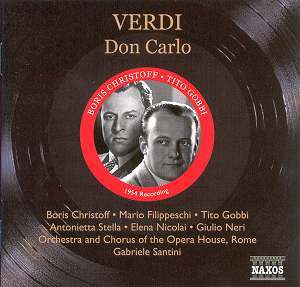
(1884) Philip, King of Spain,
Boris Christoff (bass); Don Carlo, Infante of Spain, Mario Filippeschi
(ten); Rodrigo, Marquis of Posa, Tito Gobbi (bar); The Grand Inquisitor,
Giulio Neri (bass); Elisabeth de Valois, Philip's Queen, Antoinetta
Stella (sop); Princess Eboli, Elisabeth's lady-in-waiting, Elena
Nicolai (mezzo); Tebaldo, Elisabeth's page, Loretta di Lelio (sop);
The Count of Lerma and A Royal Herald, Paolo Caroli (ten); An Old
Monk, Plino Clabassi (bass); A Voice from Heaven, Orietta Moscucci
(sop)
Orchestra and Chorus of the Opera House, Rome/Gabriele Santini
rec. Rome Opera House, October 1954. ADD Appendix. Historical recordings
of Don Carlo [41.34]
Restoration Engineer: Mark Obert-Thorn NAXOS
HISTORICAL GREAT OPERA RECORDINGS SERIES8.111132-34 [3 CDs: 77.29 + 71.26
+ 63.08]
This, performance,
or at least the highlights from it, was seminal in my operatic
education and tastes. Sometime in the late 1950s I returned
home from college to find that a new HMV LP of highlights from
the recording was the family pride and joy. I knew Traviata
and Rigoletto from the family LPs, the latter on
the Cetra
issue with Taddei and Tagliavini as the jester and Duke respectively.
But I recognised the music of Don Carlo as being of a
different breed to the composer’s middle period duo, and it
haunted me. The impact was most pronounced in listening to Boris
Christoff’s heart-rending singing of Philip’s great lonely soliloquy
Ella giammai m’amo (CD 2 tr. 8) and the portrayal of
Rodrigo by Tito Gobbi, whose account of the noble, selfless
soldier’s death has never been equalled on record (CD 2 trs.
19-20). As to the duet between the two, even in my then complete
operatic naivety, I recognised it as being a truly great performance
of great music (CD 1 trs. 13-16).
The premiere of
the original five-act form of Don Carlos at the Paris
Opéra on 11 March 1867 was only modestly received. The Italian
translation, as Don Carlo, premiered at Bologna in September
1867 and in Rome and the remainder if the Italian peninsula.
So far as critical reception was concerned it fared little better.
Both the Italian public and theatre managements found the opera
overlong and were slow to take it to their hearts. It was not
long before the act three ballet and then the Fontainebleau
act were dropped in performances. The arrival in Italy of the
shorter and grander Aida, in 1871, added to the difficulty
of the opera’s length. After a failure in Naples in the same
year Verdi made his first alterations to the score for a revival
under his own supervision. Still the fortunes of the opera disappointed
the composer; as early as 1875 he began seriously to consider
shortening the work himself. With other demands he did not begin
serious work on this until 1882 concluding his revision as a
four act opera the following year with the premiere having to
wait until 1884. The new shorter four-act revision involved
much reworking to explain the sequence of events and maintain
narrative coherence. Verdi’s revision also involved the removal
of the Fontainebleau act, the ballet and the Inquisitor’s chorus
in act five as well as other detailed changes. The premiere
of the new four act Don Carlo, which has become known
as the 1884 version, was a great success at La Scala and featured
the tenor Tamagno who created Otello three years later.
At the time of this
first studio recording in 1954 it was common practice to perform
the 1884 four-act version. This situation began to change after
the Covent
Garden performances under Giulini in 1958 with a tendency
to include the original Act 1 music. Performance practice now
often goes further with the inclusion of music that Verdi reluctantly
cut before the Paris premiere when it became obvious that the
length of what he had written would cause Parisians to miss
the last trains home if it was given in full! What is evident
in the original, and even more so in this 1884 version, is Verdi’s
more complex chromaticism compared to his great middle period
operas. Accommodation of this increased orchestral complexity
requires a sure and steady hand at the rostrum. In the period
since this recordings first appearance Gabriele Santini’s conducting
has received criticism from some quarters for its lack of drama
and dynamism. I first owned the complete recording when it made
its CD debut in the late eighties. With the rather boxed and
occluded sound I did not then appreciate the conductor’s dramatic
virtues and pacing of the work. Mark Obert-Thorn’s remastering
brings the whole sound-stage, and particularly the voices, into
a more forward focus and aural balance causing me to radically
change my view. I now find Santini sympathetic to both Verdi’s
complex lines and to the unfolding drama.
Of the other soloists
besides Gobbi and Christoff, Antoinetta Stella also benefits
from the added clarity of the recording. She is not a spinto
more a strong lyric soprano. There are moments of strain but
her Tu che la vanita (CD 3 tr. 2) is far superior to
that of Montserrat Caballé on the extensively eulogised Giulini
studio recording
of 1971. Mario Filippeschi sings with excessive stress as Carlo.
He has neither the tonal beauty nor vocal elegance evident in
Bergonzi’s interpretation on the 1965 recording conducted by
Solti (Decca) or the vocal virility of Domingo for Giulini,
both recordings of the five-act version. Likewise Giulio Neri
as the Inquisitor hasn’t the power of Talvela for Solti and
Talvela makes the confrontation with Ghiaurov’s King hair-raising.
The Bulgarian mezzo Elena Nicolai as Eboli is uneven in the
Turkish aria (CD 1 tr.7) and whilst finding O don
fatale (CD 2 tr.15) more to her liking, she fails to invest
much colour in her tone. She lacks the distinction or ease of
Agnes Baltsa in Karajan’s 1978 recording of the four-act version
(EMI). Quality renditions of Eboli’s diversely demanding music
are also given by Grace Bumbry for Solti, Shirley Verrett for
Giulini and Fiorenza Cossotto on Santini’s 1961 stereo recording
(DG) of the five act version that also features Christoff as
Philip and Antoinetta Stella as his queen.
The appendices include
over ten minutes of Björling and Merrill in the act 1 duet.
Recorded in the RCA studio in New York in December 1950 (CD
3 tr. 7) those sessions of duet recordings included other Verdi
as well as Puccini and the evergreen favourite duet from Bizet’s
Pearl Fishers. The date of the duet recording here is
given as 30 November 1950. Other sources say 3 January 1951.
Whichever, the sound and the singing are first class in this
remastering. Björling sang in the 1950 Met production of Don
Carlo mounted as the introduction to Rudolf Bing’s regime
at the theatre. It is a pity that he never recorded the role.
It is also to be regretted that no studio recording of Ezio
Pinza’s Philip exists either. His sonorous tone, steady legato
as well as plaintive expression of the emotions in his rendition
of Philip’s lonely soliloquy would have graced any recording
(CD 3 tr. 9). Marian Anderson’s 1934 O don fatale (CD
3 tr. 9) is more interesting than idiomatic (CD 3 tr.10, whilst
Mattia Battistini’s Felice ancor io son…Per me e giunto
and O Carlo ascolta (CD 3 trs. 11-12), from 1913, celebrate
a singer and Verdian style no longer found.
Robert J Farr
Please support our advertisers below by clicking on the logos for further information.

























 Philip, King of Spain,
Boris Christoff (bass); Don Carlo, Infante of Spain, Mario Filippeschi
(ten); Rodrigo, Marquis of Posa, Tito Gobbi (bar); The Grand Inquisitor,
Giulio Neri (bass); Elisabeth de Valois, Philip's Queen, Antoinetta
Stella (sop); Princess Eboli, Elisabeth's lady-in-waiting, Elena
Nicolai (mezzo); Tebaldo, Elisabeth's page, Loretta di Lelio (sop);
The Count of Lerma and A Royal Herald, Paolo Caroli (ten); An Old
Monk, Plino Clabassi (bass); A Voice from Heaven, Orietta Moscucci
(sop)
Philip, King of Spain,
Boris Christoff (bass); Don Carlo, Infante of Spain, Mario Filippeschi
(ten); Rodrigo, Marquis of Posa, Tito Gobbi (bar); The Grand Inquisitor,
Giulio Neri (bass); Elisabeth de Valois, Philip's Queen, Antoinetta
Stella (sop); Princess Eboli, Elisabeth's lady-in-waiting, Elena
Nicolai (mezzo); Tebaldo, Elisabeth's page, Loretta di Lelio (sop);
The Count of Lerma and A Royal Herald, Paolo Caroli (ten); An Old
Monk, Plino Clabassi (bass); A Voice from Heaven, Orietta Moscucci
(sop)