Editorial Board
MusicWeb International
Founding Editor Rob Barnett Editor in Chief
John Quinn Contributing Editor Ralph Moore Webmaster
David Barker Postmaster
Jonathan Woolf MusicWeb Founder Len Mullenger
Richard STRAUSS (1864–1949) Vier letzte Lieder (1949) [19:10]
1. Frühling (Hesse) [3:24];
2. September (Hesse) [4:07];
3. Beim Schlafengehn (Hesse) [4:27];
4. Im Abendrot (Eichendorff) [7:11]; Elisabeth Schwarzkopf (soprano)
Philharmonia Orchestra/Otto Ackermann
rec. 25-26 September 1953, Watford Town Hall Arabella (1933), highlights [57:41]
5. Ich danke, Fräulein [8:21];
6. Welko, das Bild! [13:11];
7. Mein Elemer! [7:55];
8. Sie wollen mich heiraten [8:49];
9. Und jetzt sag’ ich adieu [13:26];
10. Das war sehr gut, Mandryka [6:00];
Elisabeth Schwarzkopf (soprano) – Arabella;
Joseph Metternich (baritone) – Mandryka; Nicolai Gedda (tenor) – Matteo; Anny
Felbermayer (soprano) – Zdenka; Walter Berry (bass) – Count Lamoral; Harald Pröglhöf
(baritone) – Count Dominik; Murray Dickie (tenor) – Count Elemer; Waiter; Theodor
Schlott (bass) – Count Waldner
Philharmonia Orchestra/Lovro von Matacic
rec. 27–29 September, 6 October 1954, Kingsway Hall, London. ADD NAXOS 8.111145 [76:51]
Richard Strauss didn’t live long enough to hear the four last
songs performed. The premiere took place on 22 May 1950 in the
Royal Albert Hall, London with Kirsten Flagstad as soloist with
the Philharmonia Orchestra under Furtwängler. On that occasion
they were sung not in the later published order but beginning
with Beim Schlafengehn, followed by September, Frühling and Im
Abendrot. The order of composition differs further: Im
Abendrot (6 May 1948), Frühling (18 July 1948), Beim
Schlafengehen (4 August 1948) and September (20 September
1948). Most recorded versions stick to the published order, except
Lisa Della Casa/Karl Böhm and Felicity Lott/Neeme Järvi, who
follow the Flagstad order. Of all the versions I have collected
through the years some have become eternal favourites while others
tend to be overlooked when I want to play the songs. None of
them is without merit, however, and the list, though by no means
comprehensive, reads like a sopranos’ Who’s Who: Della
Casa, Schwarzkopf, Borkh, Söderström, Popp, Harper, Lott, Te
Kanawa, Studer and Isokoski. Della Casa was my first recording
and it still occupies a place of honour but Schwarzkopf has always
run it close and among latter day versions Soile Isokoski’s is
my favourite.
It is interesting to note that Della Casa and Schwarzkopf followed each other
closely on their Strauss path: Della Casa recorded the songs in June 1953 and
Schwarzkopf set down her set a mere three months later. In January 1953 and April
1954 Della Casa recorded three scenes from Arabella, partnered with Hilde
Güden as Zdenka and Paul Schöffler and Alfred Poell sharing the role of Mandryka;
the highlights LP with Schwarzkopf, which is reproduced here in its entirety,
was recorded in September 1954. Whereas Arabella was possibly Della Casa’s greatest
role, Schwarzkopf never sang it on stage and Della Casa’s interpretation can
be heard on two complete recordings, first on Decca in 1958 (with Güden and George
London) and then in 1963 (with Rothenberger and Fischer-Dieskau) for DG.
With Della Casa it is first and foremost the creamy beauty of tone and the unaffected
naturalness that catches the ear while Schwarzkopf enthrals with her myriad of
nuances and inflexions. Both ladies are ideally equipped to do full justice to
Strauss’s writing for the voice and if one at times feels that Schwarzkopf is
too “knowing”, too “interventionist” – a criticism that has also been directed
towards Dietrich Fischer-Dieskau – there are so many instances when she moulds
a phrase so memorably that one feels that this is the only way to do it. In this
early recording the balance between pure singing and insightful interpretation
is possibly at an ideal equilibrium whereas on her stereo remake with Szell thirteen
years later the pointing of details may dominate on behalf of the vocalism. It
goes without saying that the recording quality on that later effort wins hands
down but this mono recording is perfectly acceptable and the Philharmonia under
Ackermann give full justice to Strauss’s wonderfully autumnal orchestration.
Both Della Casa’s and Schwarzkopf’s recordings should be in every respectable
collection, preferably together with a further handful – why not some of those
on my list.
With Lovro von Matacic at the helm the Philharmonia also extracts all the beauty
from the Arabella score. Composed more than twenty years after Der
Rosenkavalier it hasn’t quite the exuberance of that music. It is a notch
more subdued and with hindsight one could say that it points forward to the even
more peeled-off last songs. Still it has a beauty all of its own. There are so
many memorable scenes: Arabella’s Er ist der Richtige nicht für mich (tr.
5), the long solo within the Arabella–Zdenka duet which develops into one of
Strauss’s most beautiful soprano duos – here Anny Felbermayer is a youthful Zdenka;
Arabella’s monologue that closes act 1 (tr. 7) and the Arabella–Mandryka scene
in act 2 (tr. 8) where near the end Und du wirst mein Gebieter sein offers
such magical singing of magical music. The string-dominated postlude is heavenly.
Another solo for Arabella, brings the opera to a fine conclusion. As with the Vier
letzte Lieder it is difficult to decide which Arabella I prefer but Schwarzkopf
is at least on the same level as Lisa Della Casa. She is surrounded by an exceptionally
fine cast, where Joseph Metternich’s sonorous and warm Mandryka is a great asset.
Actually he is almost too pleasant sounding for the boor he portrays. Theodor
Schlott is an expressive Count Waldner and among Arabella’s suitors we find young
rising stars like Murray Dickie, Nicolai Gedda and Walter Berry.
Seeing or hearing Arabella complete can sometimes be a bit frustrating.
Listening to these excerpts was a very satisfying experience and those who have
not yet made the acquaintance of Arabella are warmly recommended to grab
this opportunity. It might turn out to be a lifelong love story. I would have
wished for a more detailed synopsis – especially important for newcomers to the
score. Not everyone may have the texts to Vier letzte Lieder either. The
Arabella libretto can at least be found (http://www.impresario.ch/libretto/libstrara.htm).
Mark Obert-Thorn’s restoration work has to be admired and I do hope he will continue
his important task to preserve valuable recordings from by-gone days. This disc
is worthy of a place in any Strauss collection.
Göran Forsling
Please support our advertisers below by clicking on the logos for further information.
























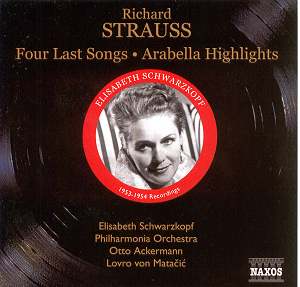

 Elisabeth Schwarzkopf (soprano)