Editorial Board
MusicWeb International
Founding Editor Rob Barnett Editor in Chief
John Quinn Contributing Editor Ralph Moore Webmaster
David Barker Postmaster
Jonathan Woolf MusicWeb Founder Len Mullenger
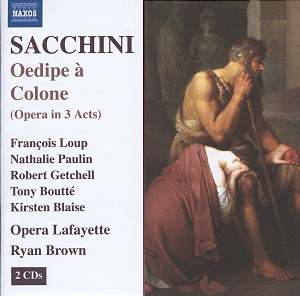
Antonio SACCHINI (1730–1786) Oedipe a Colonne – opera (1786) [112.07] Oedipe – Francois
Loup (baritone)
Antigone – Nathalie Paulin (mezzo)
Polinice – Robert Getchell (tenor)
Thésée - Tony Boutte (tenor)
Eriphile – Kirsten Blaise (soprano)
Opera Lafayette Orchestra and Chorus/Ryan Brown
rec. 13–15 May 2005, Clarice Smith Performing Arts Centre,
University of Maryland, USA NAXOS 8.660196-97 [67.54
+ 44.53]
You can’t help feeling a bit sorry for Antonio Sacchini.
Born in Florence, trained in Naples, he specialised in writing
opera seria; he spent 10 years in London where his initial
success was eventually marred by financial troubles. Fleeing
London in 1781 he moved to Paris. There he won the support
of Queen Marie Antoinette but got caught up in the warfare
between Gluck and Piccini. His opera, Dardanus,
was staged by the French court in 1785 and was a success
but the Queen failed to get Oedipe a Colonne staged
in 1786. This fact is said to have contributed to Sacchini’s
death. When Oedipe
a Colonne was
finally staged in 1787 - at the Paris Opera rather than at
the court theatre - it was a great success and was performed
regularly there until 1830.
This is not the first recording of the work; that palm
goes to Jean-Paul Penin and his Camerata Bourgogne. The Gramophone
review of that disc describes the performance as a bit rough
and ready and looks forward to one of the major early music
groups taking up the work. That has not happened; after all,
early music groups are hardly falling over themselves to
give us authentic performances of Gluck’s French works, so
we can hardly expect to hear many of Sacchini’s. Still, Ryan
Brown and group Opera Lafayette have now taken up the challenge.
The story is based on the
Sophocles play, but without the really gruesome bits. In
the play, blind Oedipus struggles to Colonnus supported by
his daughter Antigone. There Theseus, King of Athens agrees
to support him against Creon, Jocasta’s brother, who now
rules Athens. Oedipus’s son Polynices comes to gain his father’s
forgiveness. Oedipus curses Polynices, who is slain by Creon
and Oedipus is taken by the Gods.
So much for Sophocles. In Sacchini’s version Oedipe
- as he is called in the opera - is still blind and more
than a little intemperate but he is eventually reconciled
with his son and all ends happily. The opera opens with the
planned wedding celebrations for Polynice and Eriphile, Thésée’s
daughter. Thésée, King of Athens, is supporting Polynice
against his brother Eteocles, who currently rules Thebes.
Act 1 is taken up with setting the scene, the wedding preparations
(complete with dancing) and finally Thésée and Polynice’s
visit to the temple for Polynice’s act of expiation. The
act ends with the High Priest announcing that the gods have
rejected Polynice’s offerings.
Act 2 starts with Polynice lamenting his lot and deciding
that his father, who has cursed him, would surely forgive
him. At this moment Oedipe appears with Antigone and Polynice
flees. The remainder of the act is concerned with Oedipe’s
troubles and concludes with Thésée offering Oedipe his support.
Act 3 covers the attempts of Polynice, Antigone and
Thésée to reach a resolution with Oedipe. Though Oedipe calls
down curses on Polynice and Eteocles, he is finally reconciled
to his children, the High Priest announces that the anger
of the gods is calmed and that Polynice and Eriphile may
marry.
The construction of the libretto is not ideal. A large
chunk of act 1 is concerned with the marriage preparations
of Eriphile who barely re-appears in the opera. The two strongest
characters, Oedipe and Antigone, do not appear until Act
2.
What struck me, upon listening to the music, was how
much like Gluck it sounds, even down to the cast of some
of the melodies. Sacchini is very flexible in his use of
accompanied recitative, of which there is a great deal in
the opera. The overall feel is of freedom and expressive
mellifluousness. There are no really great melodies, though
some are memorable, more it is the flexibility of the drama
and the way the piece flows that stays with you.
A stronger composer could probably have made the extraneous
bits - like the dance movements in Act 1 - seem more germane,
but Sacchini is never less than poised and charming and sometimes
a lot more so.
French baritone Francois Loup plays troubled Oedipe.
His voice is a little rough at the edges but he still manages
to conjure up the requisite suavity of line and expression.
He creates a real character out of Oedipe. The other strong
portrayal on the disc is Nathalie Paulin as Antigone. Her
voice tends to spread a little under pressure, which is not
ideal in this music but she is moving in her expression.
She succeeds in bringing warmth to the character of someone
who seems annoyingly to like being permanently downtrodden.
This period of French opera comes with its own problems
of course, notably the requirement to cast high tenors; in
this case both Polynice and Thésée are tenors. Both Robert
Getchell and Tony Boutte manage the tessitura well and Getchell
impresses in Polynice’s Act 2 aria. Neither tenor is quite
ideal in that both are rather too light-voiced, but this
is to be preferred to an over-strained tenor voice in these
roles.
But this raises a more general issue of style in this
period of opera. The singers on this disc are all adept at
spinning out Sacchini’s flexible vocal lines and are undoubtedly
expressive. But none are quite able to imbue the vocal lines
with focused passion; Getchell and Boutte have a tendency
to sound a little too light-voiced in their big moments and
both Loup and Paulin have voices which spread under pressure.
This is not to deny that this disc has many vocal pleasures,
it is just that we seem to have lost the art of combining
vocal purity and focused passion. If you listen to singers
like Régine Crespin and Diana Montague singing Gluck then
you will understand what is needed.
The singers are ably supported by Ryan Brown and his
band, the recording is live, so there are the odd smudgy
bits, but overall they play with poise. Sacchini’s long lines
are given flexibility and generally made to seem suitably
effortless. The group don’t quite manage the style of some
of the best French groups in music of this period, but they
go a long way towards it.
As might be expected from an ensemble that includes
French and Canadian singers, the French diction is pretty
good and remarkably clear; the chorus also contribute in
this respect.
The CD booklet includes a detailed plot summary in English
and the complete libretto in French. An English translation
of the libretto is available to be downloaded from the Naxos
web site.
If you have never heard of Sacchini but enjoy Gluck’s
French operas then do try this disc, you will not be disappointed.
Robert Hugill
























 Oedipe – Francois
Loup (baritone)
Oedipe – Francois
Loup (baritone)