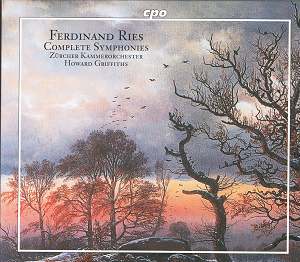
Born
in Bonn and a student of Beethoven’s in Vienna, it is no surprise to
find that the First Symphony of Ferdinand Ries is strong on fellow-feeling
with Beethoven’s early symphonies. It was premiered in Leipzig on 4
October 1812. Perhaps more surprising is the masterly classical manner
that reaches back to Mozart’s Jupiter. In the second movement
there are several moments that sound like Schumann’s Fourth. Be assured
though, this is no ragbag of cultural references. Nor does it creak
with flaccid plagiarism.
The Second
has much the same stylistic signature. In a performance that shivers
with excitement and momentary grandeur this goes very well indeed. This
was premiered by London’s Philharmonic Society where Ries had made a
grand splash with the affluent finance men who then regarded skill at
the piano as a mark of gentlemanly accomplishment. The most original
gestures come in the third movement which, amid the storms, has some
limpid and gracious solo wind writing. In fact there are quite a few
bel canto touches throughout not that this feature stops the
composer ending the symphony in a series of brusque brass-emphasised
gestures. Beethoven was the dedicatee.
The Fifth
Symphony can only have been written under the exaltation produced by
knowing Beethoven’s Fifth. That jerky pecking Fate motif grips
the first movement. In addition there are many other wholly delightful
touches: try the antiphonal bel canto dialogue at 2:03 onwards.
A ‘night-watch’ quick-march haunts the conspiratorial third movement
and prepares the ground for the tempestuous return of the Fate motif
in the finale. Rossini might well have been an influence too. As for
that Fate motif its legacy can also be heard in the finale of
the Third Symphony, in the Eighth Symphony and elsewhere. This work
was premiered in London on 14 February 1814.
A
London concert of the Philharmonic Society
was the scene of the premiere of Ries’s Third
Symphony on 15 May 1815. Cleverly calculated
tremulous tension-building effects can be
heard at the start as a scene–setter for the
forward rush of the main Allegro. The
andante reveals another Ries hallmark:
the relaxed use of wind solos to create a
blithe serenading contrast to offset his predilection
for Beethovenian romps and storms.
The Fourth
Symphony, like so many of the others, was written in London – where
he was warmly welcomed and valued. It was dedicated to Louis Spohr who
rated Ries’s symphonies highly. He continued to conduct performances
of them in Kassel well into the 1840s past the point at which they were
already plummeting into a neglect from which these recordings should
help to rescue them. This Symphony has a few Weber-like touches but
otherwise carries the usual fingerprints: a serious mien, skirling energy
strong on thrust and riposte, resounding Beethovenian energy - try the
Scherzo and the finale - and a leaning towards suave and touching
bel canto asides.
The Sixth
Symphony was performed again at London’s Philharmonic Society concert
series on 13 June 1822. While the voice of the immortal Ludwig is in
evidence again Ries also reaches again towards the Mozartian manner:
try 2:43 onwards in the first movement. Intriguingly the Menuetto
looks back to the baroque era – to Handel and perhaps Purcell. It’s
interesting to hear this and mentally compare the approach adopted by
Reger a century or so later in those of his works gripped by the music
of the same era. The seraphic Larghetto third movement prepares
the ground for the extremely effective ‘Jingling Johnny’ alla turca
drums and bells panoply of the finale. You will recall similar voices
from Beethoven’s Choral, a work that Ries held in the highest
esteem.
The Seventh
Symphony – chronologically his last - continues the Beethovenian style
with redolences drawn from the Seventh, the Pastoral and the
Eroica. There is a distinct Rossinian and Neapolitan feel about
the lively finale and the almost Lisztian start of the Scherzo is most
striking. The Eighth Symphony is again blithe and mercurial in spirit
with Schubert being a reasonable comparator for the effervescence of
the writing especially in the Scherzo. The finale looks to the more
animated parts of Beethoven’s Fourth and Eighth symphonies and to Mozart’s
Jupiter.
The first
three discs are standard CDs while the last is an SACD hybrid which
I heard in its CD format.
That
these fine, insinuatingly pleasurable symphonies are played with such
eager delight and thoughtful attention to flickering dynamics and antiphonal
effect serves Ries’s cause handsomely. The long silence between the
end of the first symphony on each disc and the start of the second speaks
of CPO’s usual cultured approach as also do the fine notes. These are
fortunately among the company’s better and less cerebral efforts.
There
you have it: eight compact symphonies; none longer than 34 minutes,
three under 30 minutes. All are in four movements. The writing follows
a Beethovenian primer but Ries’s inspiration is his own and does not
suffer the enervation of cloned productivity. I am quite sure you will
enjoy these symphonies if you have any liking for the comparator works
quoted above or for the slightly earlier symphonies of Spohr or those
of Méhul or Weber.
Rob Barnett
Links to reviews of individual
discs in the CPO Ries cycle:
Symphonies 1 and 2:
http://www.musicweb-international.com/classRev/2001/July01/Ries.htm
Symphonies 7 and 8:
http://www.musicweb-international.com/classrev/2004/Feb04/Ries78.htm
http://www.musicweb-international.com/classrev/2004/July04/Ries78.htm




 Zürcher Kammerorchester/Howard
Griffiths.
Zürcher Kammerorchester/Howard
Griffiths.