Editorial Board
MusicWeb International
Founding Editor Rob Barnett Editor in Chief
John Quinn Contributing Editor Ralph Moore Webmaster
David Barker Postmaster
Jonathan Woolf MusicWeb Founder Len Mullenger
Nicholas MAW (b.
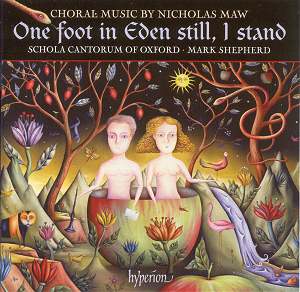
1935) Three Hymns (1989) [13.07] (1) Five Epigrams (1960) [6.40] The Angel Gabriel (1963) [2.24] Our Lady’s song (1961) [2.34] Balulalow (1964) [2.20] Corpus Christi Carol (1964) [3.25] (2) Swete Jesu (1992) [3.25] Five Irish Songs (1972) [15.13] One Foot in Eden still, I stand (1990) [7.52] Schola
Cantorum of Oxford/Mark Shepherd
Jeremy Filsell (organ) (1)
Simon Jones (piano) (2)
rec. Chapel of Exeter College, Oxford, 12-14 March 2000 HYPERION CDA67615 [58.04]
Nicholas
Maw was born the same year as Arvo Pärt, but Maw numbers
far fewer recordings in the catalogue than Pärt. In a way
this is strange because, like Pärt, Maw is a composer who
has tried to produce music which re-connects with 20th century
music before the fissure caused by post-war modernism. But
Maw’s way is not Pärt’s. Maw’s music has a depth and toughness
that is absent from the Estonian master’s mystically-inspired
minimalism.
Early influences on Maw were Richard Strauss, Berg, Tippett and Britten. On this
survey of Maw’s choral music, it is the voice of Britten’s choral music that
seems to haunt many of these pieces. Like Britten, Maw’s voice is essentially
melodic and lyrical but it is enshrined in a harmonic toughness that ensures
complexity and emotional depth without sacrificing comprehensibility. His harmony
exploits serial and tonal tensions; Maw is one of those composer’s who rely on
a sense of tonality and key to provide structure and tension with a work, though
Maw uses this in a highly individual and personal way.
His choral output is extensive but it is mostly small in scale, conceived for
amateur forces. Maw has said that it ‘is modest in size and scope. My aim
has usually been the entertainment of performers and audience alike.’ That
said there is something challenging in even the simplest piece; nothing included
here is merely entertaining. Constantly I kept coming back to that element
of toughness in Maw’s music that infuses even the most light-hearted of his works.
The first item on the disc, the rather unpromisingly named Three Hymns was
commissioned by the Lichfield Festival and first performed by the Choir of Lichfield
Cathedral in 1989. The texts all come from the Oxford Book of Christian Verse;
and are from the 17th century and thus provide a degree of textural
unity. This is a strong, big work and deserves to be far better known.
The setting of Joseph Beaumont’s Morning Hymn opens with brilliant colours
from the organ and choir. This is big- boned music; though part of the setting
reflects the text’s struggle to find the living light of Christ, the conclusion,
with its florid organ part - well played by Jeremy Filsell – is jubilant. John
Hall’s Pastoral Hymn is lighter and airy, by contrast but develops into
something bigger. Maw then surprises; in the concluding Evening Hymn (words
by Thomas Browne) we get rapt, lyrical intensity rather than jubilation and there
are some lovely, ethereal solos.
Maw’s Five Epigrams was written for amateur singers and dates from shortly
after the conclusion of his composition studies. The work was dedicated to Kenneth
Roberton and the London Scottish Choir who gave the premiere in 1961. The five
short pieces mix rhythmic liveliness with some jokiness, lyric beauty and austerity.
But these are pieces with a serious intent rather than jokey and must be a joy
to sing. The performance by the Schola Cantorum of Oxford evinces great enjoyment
in the pieces’ rhythmic, lyric and verbal felicities.
There follows a group of five carols. In the early 1960s Maw had the idea of
writing a carol each year. Whilst this did not quite happen, this group reflects
his interest in the genre and his ability to combine the lyric attractiveness
of the carol with something extra. The Angel Gabriel is a rich arrangement
of the well known Basque carol. Our Lady’s song presents the anonymous
medieval text in a strikingly austere setting. Balulalow uses a wonderfully
attractive melody that Maw then wraps in harmony and counterpoint to create a
striking fusion. The Corpus Christi Carol sets the traditional carol with
a piano that produces a commentary rather than an accompaniment. Finally, Swete
Jesu was commissioned for the 1992 Service of Nine Lessons and Carols at
King’s College Cambridge. All these carols display Maw’s skill at taking the
familiar and making it unfamiliar.
The Five Irish Songs were commissioned for the 1973
Cork International Choral Festival. Maw wanted to set Irish
texts and chose them from the Oxford Book of Irish Verse.
The first is an uncompromising setting of I shall not
die for thee, an English translation from the Irish by
Douglas Hyde. This is followed by the austere beauty of Dear
dark head, another translation, this time by Samuel Ferguson.
The lively Popular Song sets anonymous 19th century
words; Ringleted youth of my love sets another translation
by Douglas Hyde and displays great lyrical beauty. As a lively
light-hearted finale Maw sets Jig, a poem by C. Day
Lewis
The final piece on the disc is One foot in Eden still, I stand Maw’s 1990
motet setting a poem by Edwin Muir. Maw uses a solo quartet choir. At the opening
the solo quartet peacefully chant a beautiful setting of the words, answered
by the full choir in unison. The whole work develops from this alternation of
resources and the whole is both beautiful and profoundly satisfying.
It is given a thoughtful performance by the Schola Cantorum of Oxford, under
Mark Shepherd. The whole disc is well performed, but more than that the choir
seems to enjoy Maw’s idiom and relish both the felicity and trickiness of his
writing. And this is reflected in their performances.
It is good to have another disc of Maw’s music in the catalogue, particularly
in performances as fine as these. If you are interested in choral music or well
wrought contemporary music, then buy this disc. Robert Hugill
Please support our advertisers below by clicking on the logos for further information.

























 Schola
Cantorum of Oxford/Mark Shepherd
Schola
Cantorum of Oxford/Mark Shepherd