Editorial Board
MusicWeb International
Founding Editor Rob Barnett Editor in Chief
John Quinn Contributing Editor Ralph Moore Webmaster
David Barker Postmaster
Jonathan Woolf MusicWeb Founder Len Mullenger
Johann David
HEINICHEN (1683-1729) Concertos and Sonatas
Concerto a 4 for oboe, bassoon, cello and harpsichord in G [08:41]
Sonata a 3 for oboe, viola da gamba and bc in c minor [06:21]
Sonata a 2 for oboe and bassoon in c minor [10:53]
Concerto a 4 for violin, viola da gamba and bc in D [10:46]
Sonata a 3 for oboe, violin and bc in c minor [06:15]
Sonata a 2 for oboe and bc in g minor [08:26]
Sonata a 3 for violin, oboe and bassoon in B [07:50] Epoca Barocca (Alessandro Piqué (oboe);
Margarete Adorf (violin); Hartwig Groth (viola da gamba); Ilze Grudule (cello);
Sergio Azzolini (bassoon); Matthias Spaeter (archlute); Christoph Lehmann (harpsichord
(organ))
rec. November 2003, Studio of Deutschlandfunk, Cologne, Germany. DDD cpo 777
115-2 [59:42]
Composers
of the 18th century were practical people: they wrote music
for musicians in their environment, whose specific qualities
they knew and exploited. Their compositions therefore tell
us a lot about the features and level of music-making where
they were active. The compositions written for the court
chapel in Dresden - or music which was ordered elsewhere,
in particular in Italy - reflect the characteristics of music-making
at the court. The fact that many compositions performed in
Dresden contain virtuosic parts for the oboe suggests the
chapel had a brilliant oboist at hand. One of the composers
to take advantage of that was Johann David Heinichen.
Heinichen was born in Krössuln near Weissenfels. Like his father he entered the
Thomasschule in Leipzig where he received lessons at the keyboard from the then
Thomaskantor, Johann Kuhnau. He was so impressed by the qualities of his pupil
that he asked Heinichen to act as his assistant. Heinichen didn't plan a musical
career, though: he studied law at Leipzig University and moved to Weissenfels
to start a practice as lawyer. But Johann Philipp Krieger, then Kapellmeister
at the court of Duke Johann Georg, encouraged him to compose music for festive
occasions at the court. It was the beginning of a career in music: in 1709 he
returned to Leipzig, composed several operas and played in the Collegium Musicum
which was directed by Telemann. In 1710 Heinichen travelled to Venice, where
he came into contact with several famous masters, like Gasparini, Lotti and Vivaldi.
He also paid a visit to Rome, and in 1716 he returned to Germany. In 1717 he
was appointed as Kapellmeister at the court in Dresden, a position he held until
his death.
In Dresden Heinichen concentrated on sacred and secular vocal music - he composed
just one opera, which remained unfinished - and instrumental works. Many of these
are testimony to his Italian experiences. He has a special preference for unusual
combinations of instrumental colours (just like Telemann), as this disc shows
in the Sonata a 3 for oboe and viola da gamba, and more specific for a contrast
of high and low instruments, like violin and viola da gamba or oboe and bassoon.
Most pieces are written in the traditional four movements of the sonata da
chiesa. In the booklet Karl Böhmer sees a similarity with the sonatas by
his colleague Jan Dismas Zelenka who often replaced him as Kapellmeister, because
of Heinichens poor health. But the Sonata a 3 in c minor has only three movements
and shows the influence of Vivaldi's concertos. Unlike Zelenka Heinichen avoids
the 'learned style' and the use of chromaticism - he preferred the naturalness
of the galant style.
When Heinichen was working at the court in Dresden, the city was in the middle
of a period of cultural magnificence which was second to none in Germany. It
all started when Friedrich August I of Saxony became Elector in 1694. The Wettin
dynasty to which he belonged converted to Catholicism in 1697 so as to inherit
the Polish crown. In order to provide the Catholic services at court with appropriate
music the Churfürstlich Sächsische Capell- und Cammer-Musique was founded, which
developed into the most brilliant ensemble in Germany. Most members were musicians
of the highest level, due to the fact that they were handsomely paid and that
they could concentrate on playing just one instrument - rather unusual at the
time. One of the features of the court chapel was the inclusion of musicians
from all over Europe, in particular France and Italy. It was in particular the
Italian style which was preferred at the court, and Vivaldi belonged to its favourite
composers.
One of the oboists in the chapel was the Frenchman François Le Riche (1662 -
after 1733). Telemann met him in 1702, was impressed by his artistry and dedicated
his collection 'Kleine Cammer-Music' (published in 1716) to him and to his German
pupil, Johann Christian Richter (1689 - 1744). How much they were admired can
hardly be expressed better than by Telemann's words of dedication: "I venture
to dedicate the present Kleine Cammer-Music to you in the confidence that it
will be benevolently regarded, since I have had the honour of being acquainted
with numerous examples of your goodness and courtesy, which can never be praised
highly enough. Whether, however, this work will meet with your approbation remains
yet to be seen. Were this to be so, since your virtu is admired by half the world,
it would be no small matter."
There can't be any doubt that their skills must have inspired Heinichen to compose
the pieces performed on this disc. And for the interpretation of the parts for
the violin, the viola da gamba and the bassoon he had other equally famous players
in the chapel at his disposal: the violinists Johann Georg Pisendel and Jean-Baptiste
Volumier, the gambist Carl Friedrich Abel and the bassoonist Johann Gottfried
Böhme.
The ensemble Epoca Barocca has made a fine choice of pieces from the large repertoire
of instrumental music associated with the court in Dresden. As Heinichen was
a key figure at the court and his music belongs to the best of the time it is
only logical that the ensemble has concentrated on his oeuvre. The ensemble's
performances are vivid and dynamic, and all members are masters on their respective
instruments. I only wish they had been a little more generous in the addition
of ornamentation.
This disc gives an idea of the splendour of music-making at the court in Dresden
and I strongly recommend it.
Johan van Veen
Please support our advertisers below by clicking on the logos for further information.
























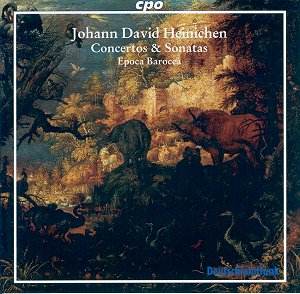

 Epoca Barocca (Alessandro Piqué (oboe);
Margarete Adorf (violin); Hartwig Groth (viola da gamba); Ilze Grudule (cello);
Sergio Azzolini (bassoon); Matthias Spaeter (archlute); Christoph Lehmann (harpsichord
(organ))
Epoca Barocca (Alessandro Piqué (oboe);
Margarete Adorf (violin); Hartwig Groth (viola da gamba); Ilze Grudule (cello);
Sergio Azzolini (bassoon); Matthias Spaeter (archlute); Christoph Lehmann (harpsichord
(organ))