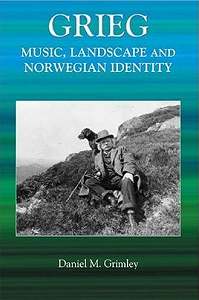
This is a remarkable
book. I’ve read it several times, yet
there’s so much in it that I keep going
back and still it provides more insights.
It really is that good. It is a book
that should be read by anyone interested
in "how" music comes about,
regardless of whether or not they are
interested in Grieg. It may seem obvious
that music doesn’t exist in a vacuum,
and is part of society, but it bears
repeating because it is fundamental
to the nature of composition, and to
the way music is received
Grimley deftly summarises
current theoretical thinking on national
identity. Far from being inherent, it’s
very much a construct developed when
communities redefine themselves in relation
to others, such as in the nineteenth
century. "Imagined communities",
to use Benedict Anderson’s terminology,
and "Invented tradition",
to use Svetlana Boym’s, may idealise
the past, but serve modernising purposes.
Grimley shows how nationalism in Norway
was "a form of national self improvement,
emancipatory and creative" for
it fuelled independence from Denmark,
and ignited interest in regional folklore.
Song was very much part of the nationalist
movement, as it linked to dialect. Waldemar
Thrane’s comic opera Fjeldeventyret,
(The Mountain’s Tale) from 1825, mixes
"European" and Norwegian elements
such as the kulokk (cow-herding
song). Ole Bull was trained as a classical
violinist, but as early as 1833 was
playing the hardingfele (Hardanger
fiddle) and folk melodies in formal
concerts in Paris. Nonetheless, traditional
music was not mummified. Grimley examines
pieces by Kjerulf and Bull to show that
they adapted folk form creatively. Using
Grieg’s op 17, he analyses how Grieg
in his turn, assimilated and developed
his own "compositional state of
mind"; his own creative voice.
Landscape played a
fundamental role in European Romanticism
because it was used as a metaphor for
human values. Grieg wrote to a young
urban composer "You need an inoculation
of mountain stuff into your work".
For Grieg, the pure air and physicality
of mountain living inspired a deep emotional
response. He wrote about the "youthful
combativeness" of Norway, "like
the music of harsh triads compared with
all the sugary seventh chords "
in Denmark. In Norway, he said "the
conflict concerns spiritual existence"
while in the urban south it was "just
a matter of trivialities". Analysing
Gangar op 54/2. Grimley demonstrates
how Grieg develops a powerful structure
by contrasting dynamic and static elements.
"It is, arguably", he concludes,
"the denial of personal subjectivity
and the longing for transcendence that
this systematic organisation and division
of musical space creates that is the
most powerful expression of Grieg’s
landscape vision". Grieg may develop
ideas from the visual, but he’s not
merely pictorial. His music is representation
of "the sense of being within a
particular time and space". The
sense of isolation fostered by the mountains
intensified Grieg’s sense of remoteness
from the Austro-Germanic mainstream
and gave his music individuality. Since
he certainly didn’t belong in the true
Norwegian tradition, it sparked a sense
of creative tension in his work. Furthermore,
the mysteries of nature-magic in Norwegian
folklore evoked an alternative sense
of time and reality.
"The sense of
suspended temporality in the middle
sections of the ‘Gangar’, or the radical
spatial geometry of ‘Klokkegeklang’
can be heard as forms of musical enchantment",
says Grimley. He then analyses in detail
Den Bergtekne op 32 from Norske
Folkeviser, showing how its hovering
between keys and narratives creates
a sense of unresolvable yearning for
things unexpressed. In a particularly
well argued section, he analyses different
aspects of nostalgia and how Grieg expressed
them specifically in two pieces, Gjetergutt,
op 54/1 and Aften på höyfjellet
op 68/4. He then studies the 19 norske
Folksviser op 66, showing how innovative
Grieg’s ideas had become. His critique
of the way bells saturate I Ola-Dalom,
I Ola-Kjønn, op 66/14, giving
a multi-layered sense of time, is exquisite.
Siri Dale-Visen op 66/4, can
be heard in terms of a "shift from
an archaic folk music source, through
classical functional diatonic practice,
to the non-diatonic voice-leading linearity
of early twentieth century modernism".
Grimley then examines
Haugtussa. Arne Garborg’s verse
novel, on which the cycle is based,
was not Romantic kitsch, but confronts
elemental forces in nature beyond human
understanding. The novel can be understood
as a kind of "pre-Freudian discourse
on the nature and function of dream"
and is "closer to the Nervenkunst
of Strindberg or Knut Hamsun".
Veslemøy’s hallucinations aren’t
just caused by externals, but by her
ability to perceive areas of human emotion
normally suppressed. The bestial troll
scenes thus reflect the "animalistic
side of human nature". Words like
drøyme (to dream) and gløyme
(to forget) recur repeatedly.
One analysis of the
cycle sees it as unresolved structurally,
while another notes its masterfully
crafted symmetric arc. Grimley suggests
that both views reflect the inherent
tension fundamental to the piece. In
the first song, Det Syng, the
song’s "schizophrenic character"
defies easy harmonic resolution. "The
dissonant complex of superimposed fifths
and octaves", says Grimley, quoting
Dalhaus, "unfolds registral space
while avoiding a … metrical articulation,
suggesting ‘that processual cognition
has been suspended’" A detailed
study of the final and most complex
song, Ved Gjætle-bekken,
shows how for Grieg, landscape points
inwards, "towards a contemplative
inner realm that is fully enclosed"
within its own context. It articulates
closure through the use of A major,
rather than the more dominant F major,
distancing itself from the other songs.
The oscillating figures that evoke the
rippling waters of the brook, and of
distant bells, create a sense of multiple
levels of musical motion. These ideas
are reinforced by a study of other pieces
Grieg was working on at the time, Bekken
and Drömmesyn, op 62/4 and
5. The themes of the whole cycle come
to a dramatic climax at the end of the
fourth verse, where the song is "Structurally
and narratively closed". The fifth
verse thus has a retrospective quality
of contemplation and of leave-taking,
the ethereal last bars returning to
the enchanted registers where the cycle
started. More so than in the original
novel, Grieg illustrates the Veslemøy’s
end by integrating her into the environment
around her. "Landscape thus functions
as a framework …. for the structural,
registral and harmonic parameters that
musically define the cycle, and also
as a locus of identity, as the embodiment
of Veslemøy’s ultimate sense
of being and place". Haugtussa
can be heard as a kind of Heimatkunst,
but its ending reflects a deep identification
with issues of loss and isolation.
The Hardanger fiddle
symbolises for many the essence of "Norwegian"
music. Yet it is a highly individual
genre, with improvisation and elements
like contrapuntal foot-tapping. Thus
the "perceived modernity"
of Grieg’s transcriptions for piano
in the Slåtter op 72 was
controversial, and indeed remains so,
bound as it is with issues of cultural
identity. Grimley explains in 18 intricately
argued pages that for Grieg, the Slåtter
are not straightforward gentrification
of folk dance, but are original, creative
works, which "support and demand
some level of analytical engagement
in order to be understood fully".
Grimley then proceeds
to analyse Grieg’s influence on David
Monrad Johansen and Percy Grainger.
Monrad Johansen heard "Norwegian
temperament" in Grieg’s modal instability
and in Lydian fourths, and in rhythmic
liveliness "a reckless desire to
freedom" but it’s more complex
than that. One of the great insights
of this book, is the way Grimley underpins
his analyses with a sound understanding
of the intellectual theory behind them.
In this final chapter, "Distant
Landscapes", there’s an excellent
exposition of Harold Bloom’s ideas on
the multi-levelled nature of artistic
influence. Thus, Grimley traces the
development of Brigg Fair from
the singing of Joseph Taylor to a fully
realised work of art shaped by the insights
Grieg gave Grainger into the spirit
of music. In an interesting aside, he
also raises Wilfrid Meller’s concept
of "music as ritual action"
to express how Grieg evokes the spirit
of Norwegian identity.
Obviously, the literal
will cite the fact that scenes in Peer
Gynt refer to the Moroccan desert,
not to Norway, but that’s not the point
at all. The meaning of the play is infinitely
deeper. Landscape for Grieg, was much
more sophisticated and symbolic of much
more profound spiritual and intellectual
concepts. This is a challenging book,
with extremely detailed, well-argued
musical analyses, which I’ve tried not
to précis, because they need
to be read in full. This is a wonderful
book, highly recommended for its superlative
summary of cultural theory as well as
for its exceptional musical insight.
It is a superb case study of how music
can express abstract thought. It helps
us understand how what we hear is shaped
by and shapes what we understand about
the world around us. We need books like
this, particularly in an increasingly
non-analytical society, to keep us focused
on why music matters.
Anne Ozorio