Editorial Board
MusicWeb International
Founding Editor Rob Barnett Editor in Chief
John Quinn Contributing Editor Ralph Moore Webmaster
David Barker Postmaster
Jonathan Woolf MusicWeb Founder Len Mullenger
Elisabeth Schumann – Aria Recordings 1926–1938 Wolfgang Amadeus MOZART (1756–1791)
1. Exsultate jubilate, K 165: Alleluia [2:24];
2. Il re pastore: L’amerò, sarò costante [4:24];
Le nozze di Figaro:
3. Non so più [3:27];
4. Venite, inginocchiatevi [3:13];
5. Voi che sapete [3:43];
6. Deh vieni, non tardar [3:49];
Don Giovanni:
7. Batti, batti, o bel Masetto [3:45];
8. Vedrai carino [3:24]; Johann STRAUSS II (1825–1899)
Die Fledermaus:
9. Mein Herr Marquis [3:24];
10. Spiel’ ich die Unschuld vom Lande [3:24]; Carl ZELLER (1842–1898)
Der Vogelhändler:
11. Wie mein Ahn’l zwanzig Jahr [3:23];
12. Wie mein Ahn’l zwanzig Jahr ’Nightingale Song’ [3:30];
Der Obersteiger:
13. Sei nicht bös’ [3:28]; Carl Michael ZIEHRER (1843–1922)
Der Landstreicher:
14. Sei gepriesen du lauschige Nacht [3:11];
Der Fremdenführer:
15. O Wien, mein liebes Wien [3:12]; Heinrich BERTÉ (1858–1924)
Das Dreimädelhaus:
16. Was macht glücklich [3:29]; Richard HEUBERGER (1850–1914)
Der Opernball:
17. Im chambre separée [2:45]; Fritz KREISLER (1875–1962)
Sissy:
18. Ich glaub’ das Glück [3:40]; Josef STRAUSS (1827–1870)
19. Spährenklänge [3:38]; Ralph BENATZKY (1884–1957)
20. Ich muss wieder einmal in Grinzing sein [3:24]; Rudolf SIECZYNSKI (1879–1952)
21. Wien, du Stadt meiner Träume [3:25] Elisabeth
Schumann (soprano)
Orchestra/Georg Byng (1, 2, 5, 7, 8); Lawrance Collingwood
(3, 4, 6, 12, 13, 18); Carl Alwin (9); Vienna State Opera
Orchestra/Carl Alwin (10, 11); Orchestra/Walter Goehr (14-17,
20, 21); Leo Rosenek
rec. 19 May 1926 (1, 5, 7); 7 June 1926 (2, 8); 1 February,
1927 (3, 4); 4 February, 1927 (6); 11 November 1927 (9);
6 September 1929 (10, 11); 17 February 1930 (12, 13); 23
June 1934 (19); 20 November 1935 (18); 25 November 1936 (16,
21); 11 March 1937 (14, 15); 8 June 1938 (20); 11 June 1938
(17). ADD NAXOS 8.111100 [72:12]
A year ago I reviewed another Elisabeth Schumann
disc on Naxos (see review)
with her early, acoustic recordings from 1915–1923: a lot
of Mozart but also other Austro-German composers and some
French. While admiring her freshness and charm, as I have
always done, I was a bit worried about her too generous use
of portamento – moving from one note to another by “sliding”.
Excessively used this can give a slight feeling of travel
sickness. I admitted to not having been particularly aware
of this in her later recordings, something that was confirmed
when I listened to this latest disc which offers recordings
from the earliest electricals 1926 to just before WW2. Her portamento is
in evidence here too but much more tolerable. It is possible
that the acoustical recording process exaggerated this feature.
As on the previous disc Schumann stands out
as a natural Mozartian. She sings the Italian arias in the
original language which makes it easier to produce a smooth
line; the hard German consonants are often an obstacle in
this respect. There are still some objections to be raised,
though. Tempos are on the slow side, slower than on the acoustic
discs, and her use of ritardandi, magically done, makes them
even slower. This is most noticeable in Non so più (tr.
3), which in consequence loses some of its butterfly weightlessness.
Nor is she everywhere perfectly clean in intonation – Alleluia from Exsultate
jubilate (tr. 1) the most flagrant example. Weighed against
the loveliness of her interpretations, the genial personality
that shines through everywhere and the purity of tone, this
objection can easily be discarded. A technically perfect
voice, however beautiful, falls flat if there isn’t life
and heart behind.
All the Mozart arias were recorded 1926–1927
and show her at the height of her powers. The operetta arias,
which constitute the rest of the disc, were, with a couple
of exceptions, made about ten years later. She was then approaching
fifty and when listening closely it is possible to detect
a slight decline in vocal quality: some notes can be a bit
squally. This is only a marginal phenomenon, and the charm,
the expressiveness, the absolutely magical turning of a phrase
are even more pronounced here. As with Elisabeth Schwarzkopf
we meet a consummate Lieder singer who has the ability to
transfer her skills in that intimate field to the popular
area without becoming cheap. While Schwarzkopf has been accused
of being too knowing there is nowhere even a trace of Elisabeth
Schumann singing “down” to the audience. If Nancy Storace,
the first Susanna in Le nozze di Figaro, was “the
Julie Andrews of the 18th century” as one source
has it, then Elisabeth Schumann had the same position in
the early 20th century.
Most of the operetta numbers are standard fare
but they are never treated perfunctorily. The line-up includes Die
Fledermaus, Der Vogelhändler (the so-called Nightingale
Song from Der Vogelhändler given in two versions,
one of them in English) and Der Opernball. The three
concluding numbers are also much loved popular pieces, of
which Wien, du Stadt meiner Träume was Birgit Nilsson’s
obligatory encore. Pick any of them and I bet most readers
will be hard pressed to find another recording that communicates
such charm, such warmth, such conviction. It is not really
a matter of letting her hair down, it is rather a question
of taking this “lighter” fare just as seriously as any Mozart
aria or Schubert song. We also get a few numbers from operettas
that are seldom heard today but, going by these songs, definitely
worth being unearthed. Ziehrer, for instance, was possibly
the most serious competitor to Johann Strauss II, with 22
operettas and a total of 600 works to his credit. Am Lido (1907), Ball
bei Hof (1911), Cleopatra oder Durch drei Jahrtausende (1875),
including among other things a Pilgrim Chorus, Das dumme
Herz (1914), Das Orakel zu Delfi (1872) and Der
bleiche Zauberer (1890) have probably collected dust
in the archives for many decades. I doubt that many operetta
lovers, apart from specialists, have ever heard of them.
According to the website dedicated to his memory,
he was the darling of the Vienna audiences but he also had
tremendous success in the US at the World Exhibition in Chicago
in 1893. With an advocate of the calibre of Elisabeth Schumann
it is quite possible that some of his works could be successfully
revived.
Das Dreimäderlhaus (tr. 16) is also interesting. It is a Singspiel in three acts with
a libretto by Alfred Maria Willner and Heinz Reichert, based
on the novel Schwammerl by Rudolf Hans Bartsch. The
tracklist gives Heinrich Berté as composer but in reality
he has adapted and arranged music by Franz Schubert, who
also is the main character in the play, sung by a tenor.
It takes place in Vienna in 1826, two years before Schubert’s
death, and in the long cast-list we find names like the poet
Franz von Schober, the bass singer Johann Michael Vogl and
the painter Moritz
von Schwind. It was first performed on 15 January
1916 at the Raimund Theatre in Vienna and was a great success.
Soon it was played everywhere: in 22 languages and more than
sixty countries! It was severely criticised by the experts
but it has claims to be the second most played operetta ever – Die
Fledermaus reigns supreme.
It should be said that Berté did more than
just arranging Schubert’s music. Most of the fifteen numbers,
linked with spoken dialogue, are compiled from two or even
more sources and sometimes also changed to suit the texts.
The song that Elisabeth Schumann recorded, Was macht glücklich (tr.
16), has a kind of marching first part, the origin of which
I haven’t been able to track down. Then comes the most Viennese
delightful waltz, where the text begins: Was Schön’res
könnt sein als ein Wiener Lied (What could be more beautiful
than a Viennese song), the melody derived from Schubert’s
German Dances, D783 No. 7, originally for piano. Schumann
sings it with such melting tone and superb phrasing – like
a gracefully purring cat – and also indulges in some virtuoso
whistling, which she also does in some of the other numbers.
If you are sceptical about my enthusiasm and for some reason
don’t want to be won over, then don’t play this track, because
if you do you will be hooked forever!
A kind of rarity is also Fritz Kreisler’s Sissy.
The story was well-known to the Viennese people: “the
courtship of young Emperor Franz Josef and Elizabeth, 16-year-old,
harum-scarum daughter of Bavaria's Duke Max. Elizabeth, whose
nickname was Sissy, was the favourite of her father who roved
the forests with woodcutter friends, played the zither, behaved
more like a peasant than a duke.” Thus Time described
it on 2 January 1933, when reporting on the premiere a week
earlier at Theater an der Wien, with the composer conducting.
Kreisler drew on some themes from earlier compositions of
his and the aria Ich glaub’ das Glück is based on
the languorous main theme from Caprice Viennois. When
searching the internet in connection with writing this review
on 9 February 2007 I found that at that very moment Sissy was
being played at Baden bei Wien! Remarkable coincidence.
The sound is excellent.
I could have written instead: Producer and Restoration Engineer
is Mark Obert-Thorn, which in my book is synonymous with
the highest possible quality in historical transfers. The
liner notes also give highly interesting background information
to Elisabeth Schumann’s life and career. The author, Joy
Puritz, being the singer’s grand-daughter, vouches for authority.
Grading the singing greats
for loveliness and charm Elisabeth Schumann inevitably occupies
the top position. This disc shows her at her most lovely.
Göran Forsling
Please support our advertisers below by clicking on the logos for further information.
























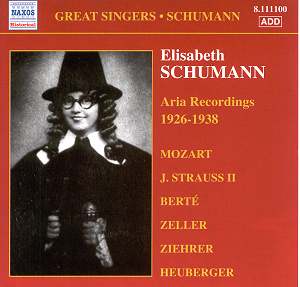

 Elisabeth
Schumann (soprano)
Elisabeth
Schumann (soprano)