Millions of people
will know of Geoffrey Burgon’s music, probably without being
aware of it. He wrote the music for two of the very finest British
television series ever made: Tinker, Tailor, Soldier, Spy
and Brideshead Revisited. His 1979 setting of the ‘Nunc
dimittis’, included here, was the evocative music that was played
over the closing titles of Tinker, Tailor. In his admirable
notes Andrew Stewart says that Burgon’s music “suggests that
[his] aesthetic compass is readily set towards the popular.”
Perhaps this should not surprise us when we learn from Mr. Stewart
that Burgon’s first love was the jazz trumpet and that when
he eventually turned to composition, under the guidance of Peter
Wishart, the seminal influences on his work included Bach, Britten
and Stravinsky. It’s certainly true that all the music included
on this disc is highly accessible but that’s not a code for
“populist”, still less does it imply any dumbing down.
The afore-mentioned
setting of the ‘Nunc dimittis’ is included here, both in its
original version and in a fairly recent revision. The revision
omits the haunting trumpet part and the singers are unaccompanied.
I haven’t seen a score but I imagine that the chorus parts largely
replicate the original organ accompaniment. I must say I strongly
prefer the original; the revised version is somehow softer in
tone. The performance of the original version is sung – very
well – by unison upper voices but this way of presenting the
piece loses something compared to the ethereal, haunting sound
of a solo treble as heard at the end of Tinker, Tailor.
I hadn’t known about Burgon’s affinity with the jazz trumpet
until I read the notes accompanying this CD. That may well explain
the use of that instrument in this and three other pieces here
recorded. However, I’ve always wondered if the opening aria
of Handel’s Birthday Ode for Queen Anne, Eternal Source
of Light Divine was a model, either conscious or unconscious,
for the ‘Nunc dimittis’.
We also get the
‘Magnificat’ that Burgon wrote as a companion piece for it.
This is written for upper voices only and features a busy organ
accompaniment. I don’t feel that the thematic material is anywhere
near as interesting as in the case of the ‘Nunc dimittis’.
Another, much earlier,
liturgical work is the Short Mass, an unaccompanied Latin
setting written for Brecon Cathedral. The writing for voices
is effective and the work makes a positive impression. There
are hints of an indebtedness to Britten’s Missa Brevis,
but the piece has its own definite character.
I was impressed
with the two pieces that Burgon wrote for Remembrance Sunday
in 2005. Death be not proud sets striking words by John
Donne and for the most part it’s a surprisingly subdued setting
of a powerful text. Come let us pity not the dead, on
the other hand, sets a poem by Drummond Allison, a young poet
killed in action in 1943 at the age of just twenty-two. As Andrew
Stewart observes, Burgon’s “economy of writing allows Allison’s
plea to pity Death but not the dead to speak from beyond the
grave.”
Another striking
work is the piece that opens the programme, At the round
earth’s imagined corners. This is another Donne setting,
for soprano solo, trumpet and organ. Catherine Hart, the soloist
here, does well in a part conceived for the voice of Felicity
Palmer, no less. Her young voice doesn’t really have the dramatic
heft and brilliance that the words and the music call for but
I like very much the purity and clarity of her singing.
This is a good time
to mention that the choir includes girl choristers, rather than
boy trebles, together with the usual male altos, tenors and
basses. Wells Cathedral has had girl choristers since 1994.
The cathedral has the luxury of eighteen each of girl choristers
and trebles, either of which groups sing with the male Vicars
Choral. On this occasion the girls are involved and very well
they sing. In fact the whole choir is on excellent form and
the frequent solos, all taken from within the choir, are, without
exception, well done. Miss Hart’s is the most frequently heard
solo voice and jolly good she is too.
Mention should also
be made of the fine organ playing of David Bednall. Burgon’s
organ writing enhances the vocal parts, never threatening to
overwhelm the singers.. As a trumpeter himself he clearly understands
that instrument and I should imagine the trumpet lines are rewarding
to play; certainly Alan Thomas makes them sound so. Indeed,
all the music presented here is well written by a composer who
has evident empathy with the human voice and who responds very
effectively to the texts that he chooses. I enjoyed everything
on the disc though, if I’m to be honest, nothing here lodges
as memorably in the brain as does the ‘Nunc dimittis’ and I
don’t think that verdict stems from much greater familiarity
with that piece.
Hyperion has done
Geoffrey Burgon proud. His music has been expertly performed by
all concerned under Matthew Owen’s expert leadership. The recorded
sound is excellent as is the booklet note. I feel as if I’ve had
a splendid and comprehensive introduction to Burgon’s choral music.
John Quinn

























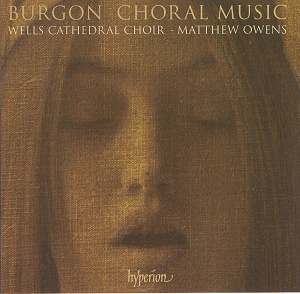

 The Choir of
Wells Cathedral/David Bednall (organ)/Alan Thomas (trumpet)/Matthew
Owens
The Choir of
Wells Cathedral/David Bednall (organ)/Alan Thomas (trumpet)/Matthew
Owens