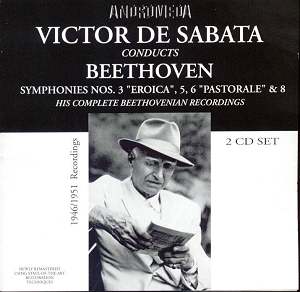
These are advertised
as de Sabata’s complete Beethoven recordings – or “His Complete
Beethovenian Recordings” as Andromeda puts it, with rather more
gravitas. This amounts to two well-filled discs’ worth containing
four symphonies. We can but hope that, even after this long
time, more performances might emerge from archives and from
private collections.
None of this of
course is new. You may have caught, with pleasure or displeasure,
transfers of the commercial Eroica in various forms –
maybe Grammophono or Iron Needle. The Fifth was on Nuovo Era’s
de Sabata edition as was the Eighth (013.616 and 013.6338).
The Pastoral was on an Italian EMI CD 081 483475-2. This
is the first time, to the best of my knowledge, that all four
have been collated in this way. For that at least de Sabata’s
many admirers will be grateful, though I’ve not been able to
audition any of the rival transfers for the purposes of A/B
comparisons.
The Eroica was
recorded in London in 1946. It and the Pastoral are the
two commercial sets; Nos.5 and 8 are derived from live performances
in New York. In many ways the Eroica is the least impressive
of the quartet. Whether conditions were gruelling or whether
he and the orchestra didn’t really get on the result is a curiously
underpowered affair – curiously un-de Sabata-like. The first
two movements have plenty of sophisticated music-making but
fail to ignite. The slow movement is unusually expansive and
tends to suffer, as does the first, from an incremental lessening
of symphonic tension. Might this have been a response to insensitive
side breaks? Probably not – nothing of the same happened the
following year in Rome, though here he was, it’s true, on home
ground. I would add that the Eroica has plenty of good
things – balance, phrasing and the like – but it’s not one of
the conductor’s more elevated documents.
The Fifth was recorded
live during one of his concerts with the New York Philharmonic.
He gave around twenty concerts with the orchestra between 1949
and 1951. This is an intensely powerful and dramatic performance
but is quite unlike, say, Toscanini’s driven drama of around
the same time. De Sabata’s means were entirely different. He
conducts with a controlled intensity and quasi-operatic sweep
that compel total concentration. He characterises paragraphs
with the highest acuity bringing new perspectives to bear, enlivening
every bar though without drawing undue attention to himself.
He thinks in long paragraphs, never forces tempi and generates
the highest excitement through sheerly musical means. The Eighth
is not an exercise in lightness; it has its strenuous and powerful
moments. De Sabata is not one to indulge an effete Allegretto
and indeed does not. He brings a balanced command of texture
and colour.
The Pastoral
was a Rome set recorded in January and February 1947. Here
one can feel the full force of a particular kind of bel canto
lyricism. Its not one that seeks to impose obviously anachronistic
precepts – rather it joyfully explores the humanity and warmth
of the music with sculpted and flowing, glowing lines. The musical
paragraphs, aided by acute rubati, flow inexorably onwards;
the scene by the brook for instance is affectionate, unfolds
naturally and with beauty. It’s a deeply satisfying performance,
one that gets close to the heart of things.
There are a few
clicks in the Pastoral and also one mangled side-break
at 4:49 in the finale. Hum and surface crackle harry the Eroica
– though the constricted sound is a bigger worry. Of course
one can imagine these things being better done. I trust they
will be. It’s only as a stopgap that I recommend this but the
interpretations themselves leave me with the greatest admiration.
Jonathan Woolf
























 London Philharmonic
Orchestra/Victor de Sabata (No.3)
London Philharmonic
Orchestra/Victor de Sabata (No.3)