Editorial Board
MusicWeb International
Founding Editor Rob Barnett Editor in Chief
John Quinn Contributing Editor Ralph Moore Webmaster
David Barker Postmaster
Jonathan Woolf MusicWeb Founder Len Mullenger
Ludwig van
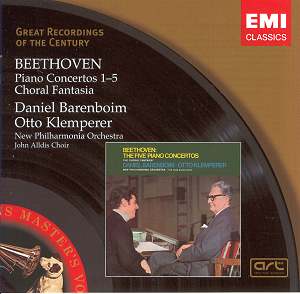
BEETHOVEN (1770-1827) CD1
Piano Concerto no. 1 in C major op. 15 (1800) [38:50]
Piano Concerto no. 2 in B flat op. 19 (1798) [30:35]
CD2
Piano Concerto no. 3 in C minor op. 37 (1803-4) [39:39]
Piano Concerto no. 4 in G major op. 58 (1805-6) [37:49]
CD3
Piano Concerto no. 5 in E flat op. 73 Emperor (1809) [43:07] Choral Fantasia in C minor for piano, chorus and orchestra
op. 80 (1808) [21:06] Daniel
Barenboim (piano)
John Alldis Choir (op. 80)
New Philharmonia Orchestra/Otto Klemperer
rec. Studio 1, Abbey Road, London, 4, 5, 9-11, 14, 28 October
1967. Stereo. ADD EMI CLASSICS
GREAT RECORDINGS OF THE CENTURY 3615252 [3
CDs: 69:25 + 77:28 + 64:13]
Some
25 years on I can still remember the mix of friendliness
and awe attendant on my first visits to my local recorded
music society – or gramophone society as it then was. After
all these people had vast collections, didn’t they ? They
had all been listening to music for years, decades even … hadn’t
they? Views and opinions rolled down from the heights like
holy writ. What ... you don’t know Klemperer’s Fidelio,
Schwarzkopf’s Four Last Songs, Furtwängler’s Tristan?
What version did you say you had of K595? Ah well, of course
nobody has quite matched the Busch Quartet.
Despite
the genuine welcome one felt … well, intimidated. Certain
artists were held in untouchable esteem, and contrary opinions
had to be strongly held to gain any respect. Most of these
giants were unsurprisingly from a former generation, although
a few such as Abbado, Barenboim, Brendel, Du Pré etc appeared
to be grudgingly admitted too. Yet I can still remember discussing
with a fellow member, whose knowledge of Klemperer seemed
encyclopaedic, the Beethoven concertos recorded with Barenboim.
I was surprised to be met with the curt rebuff, “a mismatch!” Such
was the force of this proclamation - it stuck. And so despite
listening gradually to the symphonies, the violin concerto, Missa
Solemnis and Fidelio under Klemperer’s baton,
so it remained …. until now.
Approaching
them with greater experience I would now amend my erstwhile
colleague’s assessment of a “mismatch” to one of “creative
tension”. Klemperer’s undoubtedly grand view of these works
vies with Barenboim’s freshly romantic one resulting in mutual
admiration and respect.
The
awkward, gruff, curmudgeonly Beethoven I missed - in parts
- in my recent report on Kempff’s mono set (Deutsche Grammophon,
The Rosette Collection 476 5299 - see review) is well in
evidence here. Listen for example to the finale of the fourth
concerto.
The music-making is trenchant and soloist and conductor dig
into the rhythms. The music simply has more profile. Yes
I accept that elsewhere stretches of music taken at random
can seem too slow, but this is to miss both how they fit
into the overall conception and that, in themselves, they
are full of incident and colour which keep the ear enticed.
If
I were to give some ground it would perhaps be over the B
flat concerto. Here the conception becomes a little too grand
overall, sinking just a trace under its weighty superstructure.
Yet interestingly comparing the opening of the slow movement
with Aimard and Harnoncourt (Teldec 0927 473342) I found
the latter actually felt slower, despite an overall movement
timing some 45 seconds less than the EMI. I think this boils
down to a matter of Klemperer articulating the orchestral
chords more than Harnoncourt, leading the latter to sound
more relaxed. Elsewhere I have few complaints.
Indeed
whilst listening to this set two insights into Klemperer’s
approach were called to mind. I remember the conductor being
asked about his colleague Bruno Walter and he replying -
I cannot recall the exact words - that whilst he was a very “moral” conductor,
Klemperer meanwhile was an immoral one!
On
the face of it this appears a very odd remark, but one which
makes more sense when taken within the context of further
comments by Hugh Bean, one time leader of the Philharmonia.
Bean stated that Klemperer was never concerned with “the
beauty of sound per se”, but was meticulous about its integrity,
especially balance, rhythm and clarity. I believe that what
Klemperer was driving at was that, unlike him, Walter was
a warmer-hearted individual, both in his approach to his
musicians and his outlook to music. To Walter beauty is truth;
to Klemperer truth is beauty.
Transfer
this concept to the collaboration with Barenboim, and we
find the young pianist’s “beauty” rising to the challenge
and interacting with Klemperer’s truth, creating the stimulating
result we find in these discs.
Furthermore
put into an historical perspective the match does not seem
so haphazard or unlikely. Before coming to these sessions
Barenboim had traversed the 32 Beethoven piano sonatas, also
for EMI, in a set that still receives much acclaim. Klemperer
meanwhile had tackled much of Beethoven’s orchestral music,
some of the symphonies more than once. Following an initial
and successful collaboration, on Mozart’s concerto K503,
the rest, as they say, is history. Presumably further projects
were curtailed, at least in part, due to the conductor’s
age and infirmity.
There
has been some comment in the music press at large about GROCs
- as they are affectionately called in the industry - to
the effect ... do they all really merit the appellation “great”?
In this case I’d have to concede that despite some excellently
re-mastered sound, originally masterminded by Suvi Raj Grubb
and Robert Gooch, the nay-sayers might
have
a point. Perhaps Gramophone Magazine originally came closer
to the truth in its first assessment when they reported, “I
cannot think of another cycle that so consistently rivets
the attention.”
To
conclude; do I therefore regret the missed opportunity, stretching
over a couple of decades, to acquaint myself with this set?
Yes I do. Do I think these are the “greatest” Beethoven concertos?
No, I don’t. However whilst I cannot put them forward as
a “standard recommendation”, I do believe that they have
a lot to say about this repertoire.
It’s
taken a while, but at last my attention has been riveted
too.
Ian
Bailey
























 Daniel
Barenboim (piano)
Daniel
Barenboim (piano)