Editorial Board
MusicWeb International
Founding Editor Rob Barnett Editor in Chief
John Quinn Contributing Editor Ralph Moore Webmaster
David Barker Postmaster
Jonathan Woolf MusicWeb Founder Len Mullenger
Ignacy Jan
PADEREWSKI (1860–1941)
Four Songs, Op. 7 (1882-85) [9.32] Lily of the Valley (1882) [2.01]
Six Songs, Op. 18 (1893) [15.00] Dans la forêt (1896) [1.54] Douze Mélodies sur de poesies de Catulle Mendes, Op.
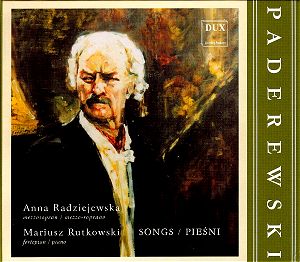
22 (1903) [30.00] Anna Radziejewska
(mezzo)
Mariusz Rutkowski (piano)
rec. S-1 Studio of Polish Radio, Warsaw, March 2007 DUX DUX0585 [58.37]
Paderewski
is best known in the West as a pianist and a composer. Ironically
he was known in his native Poland mainly as a politician,
his name very much linked to the cause of Polish nationalism.
Initially all the strands of his career ran in parallel,
but from the early part of the 20th century he
abandoned composition to concentrate on politics and pianism.
Though,
as a creative musician, he is very much associated with the
piano he also composed a significant body of songs. These
were written in the period 1882 to 1903. Initially his songs
followed the conventions of the genre in Poland, very much
in the salon tradition. The lyric, melodic form allows the
text to come over strongly and composers often chose outstanding
literary works. But by the end of his career, Paderewski
was writing far more sophisticated songs and this recital
from Polish mezzo-soprano Anna Radziejewska includes his
entire song output.
She
opens with the Four Songs, Op. 7. These were taken from his
first song cycle, setting poems by Adam Asnyk, one of the
writers associated with Polish Romanticism. Originally there
were five in the set and Radziejewska adds the dropped one, Lily
of the Valley.
These
are lively, carefree and charming songs, very much in the
lyric ballad style and Radziejewska captures their different
atmospheres nicely. She has a lovely dark, rich contralto-esque
mezzo. It is a focused voice with a nice line and she captures
the essential melancholy underlying some of the songs.
Paderewski’s
Six Songs Op. 18, set verse by Adam Mikiewicz, among the
greatest of the Polish Romantic poets. Mikiewicz’s verse
is rather more challenging than Asnyk’s and though Paderewski
does not mine any deeps, he produces songs which are attractive
and predominantly melancholy. Some, like The Piper’s Song include
lively piano material, making one aware that the composer
was also a pianist. The mazurka rhythms of My Own Sweet
Maiden echo the folk music of Paderewski’s native Poland
and in So much I’ve suffered Paderewski returns to
the folk ballad form.
In
his song, Dans la forêt Paderewski gives the French
words of Théophile Gautier a lovely atmospheric setting.
His final composition, the songs Op. 22, sets 12 poems by
Catulle Mendes. These, like the Gautier setting, use French
words.
Mendes
was married to Gautier’s daughter and his poetry often imitates
the style of other poets. Each of the poems used in these
settings is given a motto from a well known poet, hinting
at the inspiration behind the poem. These mottos are usefully
printed along with the words.
These
are darker and more complex; often dramatic, they utilise
impressive piano parts and explore far more chromaticism
than the earlier songs. Quite often, as in the first poem, Dans
la forêt, the influence of Fauré can be detected. The
style of the songs varies from the flurries of dramatic piano
notes in Ton Coeur est d’or pur through the serenade-like Naguère,
to the dark, complex L’amour fatal.
When
it comes to words we do find a slight limitation in the CD
booklet. The Polish poems are printed in Polish and English
but the French poems are printed in French and Polish only,
thus requiring a degree of expertise in French from the listener.
The
French words of these Op. 22 songs make them far more approachable
to artists than the earlier Polish songs and I would hope
that this disc might encourage other singers to take them
up. Whilst not being works of genius they are fine, soundly-crafted
settings and would respond to inclusion in well planned programmes.
Radziejewska
and her pianist, Mariusz Rutkowski do this programme ample
justice and their musicality makes the recital highly rewarding.
Radziejewska’s dark voice emphasizes the melancholy but she
also brings a welcome lightness where necessary.
This
is a lovely recital and should be of interest to everyone
with a fondness for songs.
Robert Hugill
Please support our advertisers below by clicking on the logos for further information.

























 Anna Radziejewska
(mezzo)
Anna Radziejewska
(mezzo)