Editorial Board
MusicWeb International
Founding Editor Rob Barnett Editor in Chief
John Quinn Contributing Editor Ralph Moore Webmaster
David Barker Postmaster
Jonathan Woolf MusicWeb Founder Len Mullenger
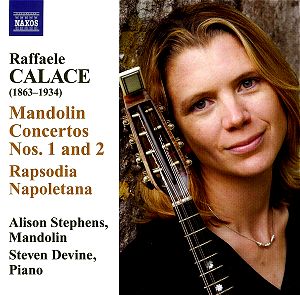
Raffaele CALACE (1863-1934)
Mandolin Concerto No.1, Op.113 [22:40]
Mandolin Concerto No.2, Op.144 [25:17]
Rapsodia napoletana, Op.66 [11:53]
Polonese, Op.36 [6:25]
Danza de nani, Op.43 [5:29] Alison Stephens
(mandolin), Steven Devine (piano)
rec. 7-9 December, 2006, The Old Granary Studio, Toft Monks,
Norfolk NAXOS 8.570434 [71:51]
Think
of the mandolin and - leaving aside Captain Corelli’s
Mandolin for the moment - one may think of a bluegrass
musician such as Bill Monroe or a Brazilian performer such
as Jacobo do Bandolim. Perhaps it triggers associations with
the mandolin orchestras of the early decades of the twentieth
century; or maybe with English folk music. For most, the
mandolin role as a classical instrument would probably come
fairly well down the list – despite the existence of Vivaldi’s
concertos for the instrument. In the classical world this
particular member of the lute family has largely been the
preserve of specialists – lovers of the instrument interested
in all its musical uses, rather than lovers of classical
music. If ever a single CD could do something to break down
widespread prejudices against the instrument, based on assumptions
that it is capable only of a very limited tonal range and
that it is essentially trivial, then this surely is it. Alison
Stephens is not only a virtuoso of the instrument, she is
also, and more importantly, a real musician. And in the works
of Raffaele Calace she is playing compositions written by
someone who had an intimate knowledge of the instrument’s
real possibilities. While there is no need to make any exaggerated
claims for Calace’s music, it has its merits – it is tuneful,
vivacious, sometimes quite poignant; at times flashy and
playful, there are also times when it explores a particularly
Italian - perhaps even a particularly Neapolitan - kind of
sentiment. The best of it has wit and grace; there is a fair
degree of musical sophistication in the way it is put together
and the ways in which its materials are developed.
Calace
was born and brought up in Naples, a city particularly important
to the history of the instrument. The beginning of the eighteenth
century saw the development there of a ten-fretted instrument
and a century or so later there emerged what is often referred
to as the Neapolitan mandolin, with its pear-shaped body,
oval sound hole, and four pairs of metal strings.
Amongst
Neapolitan makers of mandolins, one of the most significant
was the workshop of the Calace family. The workshop was established
in 1825 by Nicola Calace, who was eventually succeeded by
his sons Raffaele and Nicola, the first of these being the
composer whose work is heard here. Raffaele Calace established
an international reputation as a virtuoso performer on the
instrument; touring took him to most parts of Europe and
as far afield as Japan. The Calace workshop continues to
this day.
Calace
studied at the Regio Conservatorio di Musica in Naples and
as a composer he wrote almost two hundred pieces for the
instrument. Amongst the most substantial of his pieces are
the two concertos recorded on this disc. Each is in the conventional
three movements, but scored for mandolin and piano - presumably
for use in touring, without the need for a pick-up orchestra.
Both contain music of real charm and breathe the air of nineteenth
century Italy. So too do the three shorter pieces which close
the programme. The ‘Rhapsodia napoletana’ has delightful
fun with some of the popular Neapolitan songs of the day;
by no means all of them yet forgotten - any listener will
recognise quite a few old friends. In the process this shows
off something of the mandolin’s emotional range. The ‘Polonese’ is
full of brilliant passages, technically very demanding but
dazzling when carried off as well as it is here. In the ‘Danza
dei nani’, the nani (elves) disport themselves in
appropriately quicksilver fashion and the music exploits
the mandolin’s particular sound-world very strikingly.
Throughout
Alison Stephens plays with complete technical command and
musical intelligence. The music could scarcely have a better
advocate. Steven Devine’s work as an accompanist is exemplary.
Though describing him as an accompanist it is fair to say
that in much of this music the two instruments come close
to being equal partners and the sense of dialogue is real
and exhilarating. It is not Devine’s fault if the listener
sometimes wonders whether the modern concert grand isn’t
too large an instrument for this particular purpose. For
all the evident sensitivity of Devine’s playing, there are
moments when the mandolin comes close to being submerged;
the recording engineer seems to have resisted any temptation
to boost Stephens’ sound unnaturally by way of compensation.
I
cannot say that I picked up the CD with any expectation that
I would enjoy it as much as I did on first hearing – and
as I have continued to enjoy it on subsequent listenings.
I suspect that many other listeners who risk the relatively
small investment required for the purchase of a Naxos CD
will also be pleasantly surprised.
Oh
yes, Captain Corelli’s Mandolin. Alison Stephens played
in the theatrical version of the novel, and is also to be
heard on the soundtrack of the film.
Glyn Pursglove
Please support our advertisers below by clicking on the logos for further information.

























 Alison Stephens
(mandolin), Steven Devine (piano)
Alison Stephens
(mandolin), Steven Devine (piano)