Born Franz Wachsmann
in Königshutte, Upper Silesia,
Germany - now Chorzów, Poland
- on Christmas Eve 1906, he first worked
as a bank teller. His was an unmusical
family and his father did not believe
that a musical career would be financially
rewarding. He stuck the bank for two
years before moving to Berlin and the
serious study of music. In the 1920s
he played the piano in the Weintraub
Syncopaters, a popular jazz band of
the time. He made arrangements for them,
and this led to his orchestrating some
early German films. It was Friedrich
Hollander who gave Waxman his first
important film assignment - orchestrating
and conducting his score for the first
important German talkie: Josef von Sternberg's
The Blue Angel.
The rise of Nazism
saw Wachsmann’s emigration and by 1934,
as Franz Waxman, he was in the USA,
writing his first original score the
following year: for James Whales’ The
Bride of Frankenstein. This astonishing
piece of work contains a magnificent
long sequence for the creation of the
Bride, about which David Raksin (how
about giving us some of his music, Naxos?)
has written: "…the lady turns out
to be the wondrous Elsa Lanchester,
and…she [lets] the monster know that,
whatever his plans may be, she
has a headache. The post-Wagner, post-Strauß
(post-mortem?) effusion that accompanies
this inspired nonsense is masterful."
Raksin goes on to describe the music
as a "… coroner's version of the
Liebestod from Tristan and
Isolde". In all the scores
written in the seventy-odd years since
The Bride of Frankenstein, I
find this sequence one of the most awe-inspiring
of all music for film. It is worth mentioning
that despite the Bride’s rejection of
the Monster we must never forget that
even Monsters need love!
Following this early
success, Waxman wrote approximately
150 scores for film and television –
winning two Oscars and a Golden Globe,
and receiving another eight Oscar nominations.
There were also numerous concert works,
and, in 1947, he founded the Los Angeles
International Music Festival. This was
the scene of World and American premières
of eighty major works by composers as
diverse as Stravinsky, Walton, Vaughan
Williams, Shostakovich and Schönberg.
He died, from cancer, on 24 February
1967, in Los Angeles at a mere 60 years
of age. Despite his relatively short
Hollywood career of a little over thirty
years, only Max Steiner - who was nearly
twenty years older and wrote an almost
unbelievable amount of music for film
not to mention arrangements of musicals
- was a more prolific composer!
Objective Burma!
concerns a commando-style raid in Japanese-occupied
Burma, where the all-American team,
led by Errol Flynn, must locate and
destroy a Japanese radar station. All
goes well until the men fail to make
their rendezvous with their aeroplane
for the journey home, due to the Japanese
waiting for them at the airstrip. They
are forced to make their own way, on
foot, through enemy-occupied jungle.
Filmed in 1944 and
1945 Objective Burma! was made
using authentic World War 2 American
military materials, aircraft and gliders,
and the whole is very credible, especially
given the fact that it was shot entirely
in California! However, given the fact
that the Burmese conflict had been mainly
a British, Indian and Commonwealth affair,
the film was withdrawn from release
in the UK until 1952. An interesting,
short, article, World War II: China-Burma-India
(CBI) Theatre – April 1942 to January
1945: The Siege of Imphal-Kohima by
Lalit Pukhrambam Ph.D. can be found
at http://themanipurpage.tripod.com/history/wwII.html.
Despite historical inaccuracies, which
had nothing to do with the music, Waxman’s
score was nominated for an Academy Award
in the Best Music, Scoring of a Dramatic
or Comedy Picture section.
As in all the Marco
Polo/Naxos film score recordings the
work of John Morgan cannot be overlooked.
His fine note explains how he and the
conductor went about ensuring that the
project would be totally faithful to
the composer - and not to the film.
This meant that several sections not
used in the film itself would be restored
and heard in the context of the complete
score. And what a score it is! As you’d
expect, due to the subject matter, there
is some tub-thumping military-style
music but the score is not without its
serious moments or moments of sorrow
and regret: just listen to the tear
jerking Williams’ Death [end
of track 10]. Waxman handles a very
large orchestra with ease, using all
the colours available to him. Although
he didn’t actually write out the full
orchestral score himself, as was usual
in Hollywood, he would specify which
instruments played what in his short
score so it is Waxman’s orchestration
we are hearing. Indeed, so good is the
orchestration - mainly by Leonid Raab
working with the composer, with some
restoration by John Morgan and William
Stromberg - that I found myself simply
listening to the music as absolute music
and forgetting about any other connection
the music might have. True, it makes
a strange kind of suite when listened
to in this way but it’s still very enjoyable.
The recorded sound
is superb, capturing the large orchestra
easily and giving a good perspective
of the wide dynamic range of the music.
The excellent booklet contains separate
essays on the making of the film and
the score itself by Rudy Behlmer, a
biography of director Raoul Walsh by
Jack Smith and John Morgan’s notes on
the reconstruction of the score.
Another success for
Naxos in its Film Music Classics series.
Bob Briggs
























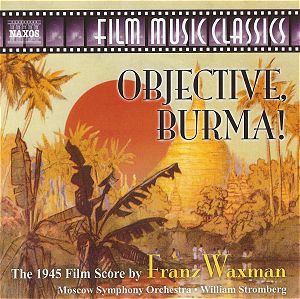

 Moscow Symphony Orchestra/William Stromberg