When
stereo recording was firmly established towards the latter half
of the 1950s the leading companies were eager to replace their
mono records. This resulted in a spate of new Rigolettos.
During less than a decade there appeared five sets – six if
we include one conducted by Nello Santi, circulated through
the Concert Hall Record Club. In roughly chronological order
they were:
Gavazzeni
(Ricordi) – Scotto, Kraus, Bastianini
Sanzogno (Decca) – Sutherland, Cioni, MacNeil
Solti (RCA) – Moffo, Kraus, Merrill
Kubelik (DG) – Scotto, Bergonzi, Fischer-Dieskau
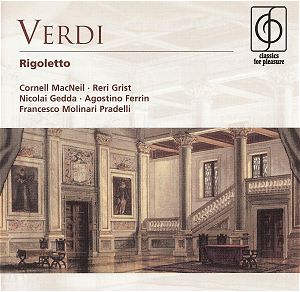
and finally, in 1967, the present set.
I
have owned the Kubelik set since it was new and learnt the opera
through it. I added the others as well as time went on. This
gave me a fairly good overview and I intend to assess all five
against a number of criteria with special focus on the set primarily
under scrutiny.
Technically
they are all good with Kubelik - recorded using La Scala forces
- the warmest and Solti the most dynamic, reflecting the respective
conductors’ readings. Molinari-Pradelli, recorded in the Opera
House in Rome has a believable theatrical atmosphere. The balance
is what one would expect from a seat in the rear half of the
stalls with a powerful but not glaring orchestra and the soloists
just behind. Reri Grist, the Gilda, has a rather small voice
and I sometimes had a feeling that she was too far away. However
her bright tones carry well out over the orchestra and also
in the ensembles.
Employing
leading Italian opera house orchestras or, as in Solti’s case,
the highly accomplished RCA Italiana Opera Orchestra, there
is no lack of authentic Verdi sound. Kubelik’s La Scala players
may be marginally more refined but Molinari-Pradelli’s Rome
musicians are not far behind and they do have a slightly meatier
sound at climaxes.
When
we go to the conductors there are more obvious differences.
Gavazzeni, Sanzogno and Molinari-Pradelli were all experienced
opera conductors and they deliver well-paced, rather traditional
– or mainstream – readings of a score they presumably knew by
heart. Of the three, Molinari-Pradelli is the one who seems
most content to let the music unfold without much intervention,
which is very often all to the good. There are places, however,
where one feels that he could have done more. Just one isolated
example: in La donna è mobile Nicolai Gedda seems to
be in exceptionally vigorous shape and he clearly wants to bring
more life to the hackneyed aria. But the conductor has no such
intention and in the first stanza Gedda is sometimes slightly
before the beat. When he reaches the second stanza he knows
that the tempo is fixed once and for all and gives a lively
and elegant reading at Molinari-Pradelli’s speed. Flexibility
indeed! The overall impression is of a competent but not particularly
inspired reading from the conductor. For a more personal touch
one has to turn to the two “star” conductors, each of them equally
at home in opera house and concert hall. Kubelik has a number
of successful opera recordings to his credit but this is his
only foray into the Italian repertoire and it may be that this
humanist wants to soften the cruel proceedings of this opera
by playing it with considerable warmth. He shapes the music
with obvious affection, not least Gilda’s scenes. The Duke stands
out as much more human than he certainly is. Solti’s approach
is, as expected, just the opposite. He strives for maximum dramatic
effect and even though he once or twice can be too hard-driven
it works. This is probably the most thrilling Rigoletto
ever recorded.
The
conductor is important in any opera performance but without
good singers and actors in the leading parts most performances
fall flat, however good the conductor. Comparing these five
casts we find at once that there is a good deal of overlapping
between the sets. Most crucial for any version of Rigoletto
is the protagonist himself. Here there are important differences.
Ettore Bastianini, the only native Italian among them, sings
his part with superb assurance and firm, dark tone. But he rarely
gets under the skin of his character. He seems distanced and
in the end one feels largely untouched by his reading. Cornell
MacNeil in his first recording is also in good voice and he
understands the predicament of the jester. He can even be a
bit over-emphatic while at other times he too seems to skim
the surface. On the Molinari-Pradelli recording his insight
has clearly deepened but instead his singing has coarsened,
he is strained and effortful. In the second act when he meets
Gilda, after she has been seduced by the Duke, he is really
good however and sings in soft and fatherly tones Ah! Piangi,
fanciulla, piangi! His reading at large is deeply involved
and one believes in him. Few baritones in the central Italian
repertoire have possessed more beautiful, manly and powerful
voices than Robert Merrill. However, as an interpreter he could
be bland, going through the motions professionally but often
leaving this reviewer untouched. Even so, the sheer greatness
of his singing was never in question. During the sessions with
Solti in Rome it seems that the maestro managed to draw the
best out of him. Reviewing the Solti set about two years ago
I wrote: “His voice is still a glorious instrument but here
he also has “face”; he is involved, he lives the part. His voice
is filled with fear when he walks home in the dark after Monterone’s
damnation; full of fatherly concern when he meets Gilda; anguished
in his plea to the courtiers in the second act aria. His wrath
at the end of the act, Si, vendetta, is tremendous. In
the last act, when the Duke is heard singing his La donna
è mobile for the third and last time and it dawns on Rigoletto
that his enemy is alive, the despair in his voice is tangible
as also is the resignation when he finds that the corpse in
the sack is Gilda.”
There
remains one Rigoletto to consider and that is Dietrich Fischer-Dieskau
on the Kubelik set. He is the odd man out. His voice has very
little of Italianate roundness and fullness and his reading
is detailed and analytical as if he were singing German Lieder,
but he goes deeper into the character than any other interpreter.
Whether this is good or bad is up to one’s personal taste. For
me this is the ultimate reading but it is definitely unidiomatic.
His
daughter Gilda is also accorded different readings. Both Gavazzeni
and Kubelik have Renata Scotto. Her involvement is never in
question but her singing leaves something to be desired. One
expects Gilda to be innocent sounding and pure, but Scotto’s
tone is frayed and especially on the Kubelik set, shrill and
squally. Joan Sutherland is of course security personified but
as an interpretation it is fairly uninteresting. Anna Moffo
for Solti isn’t particularly deep either but her creamy tones
still makes her the most beautifully sung Gilda of them all.
Reri Grist for Molinari-Pradelli has a smallish voice and the
whole reading is small-scale. She is however the one who comes
closest to the angelic quality and her Lassù in cielo
at the end of the opera is truly touching.
Of
the various Dukes of Mantua Renato Cioni on the Sanzogno set
is good but rather run-of-the-mill. Both Gavazzeni and Solti
have Alfredo Kraus, the most lyrical and elegant Duke imaginable;
with a few more years of experience he is even better for Solti,
but I know that not everyone takes positively to his rather
reedy voice. He has keen competition from Carlo Bergonzi for
Kubelik, by many, including myself, regarded as the greatest
Verdi tenor of the post-war era, and he has the very Italianate
tinge that Kraus lacks. Gedda’s voice isn’t Italianate either
but he has a vitality that matches Bergonzi’s and an elegance
that is not far behind Kraus. He is also an excellent actor
with the voice in a very nuanced reading. Gedda is over-emphatic
at times, notably so at the beginning of Ella mi fu rapita,
but in the main this is a reading worthy to be mentioned in
the same breath as those by Bergonzi and Kraus.
The
minor parts are variable but mostly very good. Ivo Vinco and
his real-life spouse Fiorenza Cossotto are Sparafucile and Maddalena
both for Gavazzeni and Kubelik. Sanzogno has a winner in Cesare
Siepi while Ezio Flagello for Solti is rather anonymous. Agostino
Ferrin for Molinari-Pradelli is a good but not exceptional Sparafucile
and Anna di Stasio’s Maddalena grows through the third act after
a rather squally beginning. There are several well-known Italian
singers in minor roles on this set and it is interesting to
hear the characteristically sonorous voice of Ruggero Raimondi
as Count Monterone. This may be his first recording. Interestingly
he auditioned for Francesco Molinari-Pradelli when he was 15
and the conductor advised him to study singing. Here he was
still only 25; forty years later he is still in excellent shape.
Just weeks ago I reviewed a Tosca DVD from last year’s Arena
di Verona Festival that is remarkable (review).
What
conclusions can be drawn from the above? Readers who want to
add a recording of 1960s vintage to their collection should
first of all consider the Solti and Kubelik versions. Since
Fischer-Dieskau’s reading of the title role is controversial
and Renata Scotto’s singing is less than ingratiating on the
Kubelik set, Solti’s version may be a safer recommendation and
then one gets the most dramatic reading in the bargain. The
Molinari-Pradelli set is not without merits with Gedda’s ardent
Duke of Mantua its finest asset but MacNeil’s Rigoletto is also
deeply involved, albeit too coarse.
Those
who don’t mind a mono recording should be aware of the Serafin
recording with Callas, Di Srefano and Tito Gobbi, available
on both EMI and Naxos. For Gedda aficionados there is on BIS
a live recording from the Stockholm Opera in 1959 in very good
sound for the period, Besides Gedda’s partly over-enthusiastic
Duke one can revel in Sixten Ehrling’s Solti-like white heat,
Hugo Hasslo’s masterly Rigoletto and, most of all, Margareta
Hallin’s unsurpassable Gilda.
Göran
Forsling