The
first movement is animated and demonstrates a strong lyrical
impulse. In addition to the composers mentioned above I’d
include Dvořák as another beneficent influence on
both the scoring and the ambience of the music. It’s fresh
and entertaining music, made even more enjoyable by the
crisp,
rhythmically vital playing that David Lloyd-Jones obtains
from the Bournemouth players. In the second movement Stanford
follows the lead given by Brahms, designating the movement
as an intermezzo. It’s here that I find Stanford’s withdrawn
motto least helpful – perhaps that’s why Richard Whitehouse
doesn’t mention it in his note for Naxos? To my ears there’s
very little evidence of strife in the music. Rather, the
music is mainly graceful and warm and the climax (around
6:30) is very brief.
The
third movement,
Andante molto moderato, is the heart
of the work. The string writing in the opening paragraphs
is quite searching and overall the music sounds “Bigger” than
anything we’ve heard in the previous two movements. About
half way through (around 6:15) a more optimistic, flowing
passage is reached in which the harp is prominent. There’s
a definite lightening of the mood and shortly afterwards
the brass enrich a rather grand climax. If indeed this movement
did treat of death in Stanford’s original scheme of things
then perhaps he moved during its course from sorrow to
acceptance? At the very end I hear patrician grief in the
music. In summary
this is an impressive, eloquent movement.
The finale is good humoured and energetic
and there’s a strong rhythmic impulse throughout most of
the movement. It’s a sunny conclusion to a most enjoyable
symphony.
The Seventh Symphony was another commissioned
work, this time for the centenary of the Philharmonic Society
of London. Richard Whitehouse comments that by the time
this symphony was penned in 1911 Stanford “had been overtaken
by Elgar and a younger generation of composers, many of whom
had been his students.” That statement is undeniably true
in respect of Elgar but I’d question the extent to which
many of what was to be a distinguished lineage of Stanford
pupils had really made their reputations secure by 1911.
Whitehouse is correct, however, to point
out the “Mendelssohnian lightness” of this symphony, which
was decidedly out of step with the more opulent orchestral
scores then being turned out by a wide variety of composers.
As Lewis Foreman avers, the Seventh is “essentially a nineteenth-century
work, a summation rather than a departure.” The first movement
is all clean lines and energy; there’s a decidedly positive
feel to the music. The second movement is designated as a
Minuet, though the tempo is that of a slow minuet. Is this
another Stanford symphonic intermezzo, even though it doesn’t
bear that title? The third movement is a set of five variations
on what Whitehouse rightly calls a “tenderly expressive” theme.
The finale, which follows without a break, strides out confidently
on full orchestra from the outset. The second subject (3:04),
led off by the violins, is more flowing but no less upbeat
in mood. The brief coda provides a suitably affirmative end
to what was Stanford’s most concise symphony, and the one
that turned out to be his last.
Both of these symphonies are very enjoyable
pieces. However, I’m bound to say that, despite listening
to them several times and despite having heard them before
in Handley’s performances, I don’t find that they truly lodge
in the memory. They sound to be expertly crafted and Stanford
unfailingly writes engaging music that is, as I say, enjoyable.
But in the last analysis perhaps they lack that last ounce
of distinctiveness and distinction that would elevate them
to the highest level in the symphonic repertoire. Nonetheless
both symphonies are very well worth while getting to know
though, regretfully, it seems unlikely that either will be
heard often in the concert hall. That makes recordings such
as these all the more valuable and vital These two symphonies
offer persuasive confirmation that symphonic music of genuine
quality was being written in England at the turn of the twentieth
century by composers other than Elgar.
Stanford is very well served by David Lloyd-Jones
and the Bournemouth orchestra. The performances are spirited
and convincing and the playing is first class throughout.
The recorded sound is excellent. The notes by Richard Whitehouse
are good but I was glad that I had access to Lewis Foreman’s
comments also to fill out the picture.
So the Naxos Stanford cycle is launched
auspiciously and I look forward keenly to further instalments,
the second being reviewed very shortly.
John
Quinn
see also review by Christopher
Howell
British Composers on Naxos page
























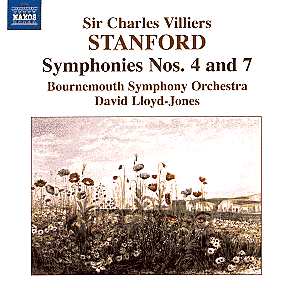

 Bournemouth Symphony Orchestra/David
Lloyd-Jones
Bournemouth Symphony Orchestra/David
Lloyd-Jones