Editorial Board
MusicWeb International
Founding Editor Rob Barnett Editor in Chief
John Quinn Contributing Editor Ralph Moore Webmaster
David Barker Postmaster
Jonathan Woolf MusicWeb Founder Len Mullenger
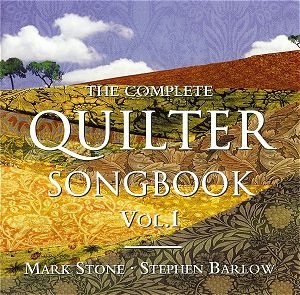
Roger QUILTER (1877-1953) The Complete Quilter Songbook Vol. 1
see end of review for full listing Mark Stone
(baritone)/Stephen Barlow (piano)
Rec. 5-6 December 2005, 3-4 July 2006, The Music Room, Champs
Hill, West Sussex
English Texts included SONY
BMG 88697 139962 [75:47 + 73:48]
The
seventy-one songs collected here represent the first volume
in a projected two-volume set of all Quilter’s songs. The
songs are not presented chronologically. Instead a different,
and interesting, approach has been taken. In her authoritative
booklet note, Quilter’s biographer, Valerie Langfield, explains
that within the overall Quilter sound he responds in different
ways to different poets and so, for example, there’s a definite “Shakespeare” sound
and a “Blake” sound. Thus the decision has been taken to
place his settings of a particular poet in close proximity
to each other. In consequence this first volume includes
18 settings by Shakespeare; 4 settings by Ernest Dowson (1867-1900);
and 8 by Shelley (1792-1822). Though several other poets
are represented in the anthology it will be seen that these
poets, and Shakespeare in particular, have the lion’s share. As
a generalisation, it seems to me that the best poetry brought
out the best music in Quilter; thus
the Shakespeare and Shelley settings strike me as the finest
songs in this set.
Roger
Quilter was essentially a miniaturist and art songs were,
by some distance, the most significant part of his creative
output. I mentioned earlier that the best words brought out
the best music in him, as is often the case with composers.
I wouldn’t say that he had the same discerning eye for a
text that, say, Gerald Finzi or Ivor Gurney possessed and,
frankly, some of the poetry included in these settings is
pretty second rate. Also Quilter’s compositional gifts were
not as pronounced as several other noted English song writers.
He doesn’t really plumb the depths in the way that Finzi,
Gurney or several others did and quite often one finds that
another composer has set the same text more effectively.
To give but just one example. Valerie Langfield avers that
Quilter’s setting of Joseph Campbell’s I will go with
my father a-ploughing (Op. 22, No 2) “has more of the
swing of a scythe about it” than Gurney’s. That may be so,
but in my view Quilter’s rather comfortable, easy-going setting
can’t hold a candle to Gurney’s more headstrong version.
But
though many of Quilter’s settings have their limitations
they are far from negligible and, though fashions change,
the best of them have retained a very rightful place in the
affections of audiences and performers. They have an easy
melodic charm and they fall gratefully on the ear. Furthermore,
they are almost invariably well written, avoiding outlandish
demands on either the singer or the pianist – though they
are not easy to perform well. Above all, they entertain
and there’s a lot to be said for that.
Groups
of Quilter’s songs crop up regularly in recitals and most
of the best known ones at least are quite well represented
on CD, though generally they appear as part of mixed programmes.
I know of relatively few discs entirely devoted to his songs
though one that came my way a few years ago was a fine one
by tenor John Mark Ainsley with Malcolm Martineau (Hyperion
CDA66878). Now baritone Mark Stone enters the lists and I
believe that he will also be the singer on the follow-up
pair of discs.
My
colleague Anne Ozorio recently reviewed favourably
a recital appearance by Stone at the Oxford Lieder Festival.
He included a Quilter group in that programme and Anne praised
in particular the fact that he “approached
the songs with simple directness, suited to their nature.” On
the evidence of what we hear on these discs I’d largely concur
with that verdict. However, Anne drew attention to Stone’s
powerful baritone and there were times when I felt that he
risked overpowering some of the songs.
However,
that last comment refers as much to tempo and style as to
strength of voice. When I heard Stone’s performance of Come
away, death (Op. 6, No 1) it sounded a bit on the heavy
side. Bring down the Ainsley version from the shelf and you
hear the difference straightaway. Of course, Ainsley possesses
the lighter voice anyway. But there’s more to it than that.
He adopts a more flowing tempo, taking 2:35 against Stone’s
3:23 and his whole touch on the song is lighter, easier,
more natural – and the same applies to Malcolm Martineau’s
accompaniment as compared with Stephen Barlow’s. I prefer
Ainsley’s approach, beside which Stone’s risks sounding a
touch lugubrious. However, I must add at once that on its
own terms Stone’s is a good performance and some collectors
may prefer a touch more vocal weight.
I
mentioned competition from other composers. For me, Gerald
Finzi’s setting of Fearno more the heat o’ the
sun is, quite simply, one of the greatest of all English
art songs. Though Quilter’s version (Op. 23, No 1) can’t
match it he still produces a very satisfying and eloquent
setting. It is in such a song that Mark Stone’s full tone
comes right into its own. In fact, he’s successful in all
five of the songs that constitute Op. 23. He’s merry and
lively in Under the Greenwood Tree and conveys the
easy charm of It was a lover and his lass engagingly.
Another
Shakespeare setting, How should I your true love know (Op.
26, No. 3), is a fine song, shot through with melancholy.
Once again, for me it’s Ainsley that best brings out the
true ambience and spirit of this song. The sense of gentle
regret he conveys is preferable to Stone’s more evidently
grief stricken approach.
I
wasn’t surprised to find Non nobis, Domine well suited
to Stone’s gifts. Kipling’s words may strike us as rather
vainglorious these days but with his fine, noble tune Quilter
lifts up the words. It sounds like a School Song from an
English Public School but, in fact, it isn’t. It was written
as a choral piece for an event called the Pageant of Parliament,
which was held in London’s Royal Albert Hall in 1934. Eleven
years later Quilter tried to repeat the trick with Hymn
for Victory. A.P. Herbert’s words read just as embarrassingly
today as do Kipling’s but, sadly, Quilter couldn’t quite
find a comparable tune to disguise the shortcomings of the
text.
Disc
Two opens with three of Quilter’s best songs, the group that
makes up Op. 3. In the Shelley setting, Love’s Philosophy,
Stone conveys the eagerness very well and I also greatly
enjoyed his tone and his fine legato in Now sleeps the
crimson petal. He also excels in Seven Elizabethan
Lyrics, the set that includes one of Quilter’s greatest
inspirations, Fair House of Joy.
In
a completely different vein is An old carol (Op. 25,
No. 3), which turns out to be Ising of a maiden.
This is a setting of endearing simplicity and both performers
respond very well. I don’t feel they’re quite as successful
with another song in the same set, Shelley’s Music when
soft voices die (Op. 25, No. 5). This song is a little
gem but Stone is too slow. Though his tone is good he doesn’t
capture the essential lightness of touch, something that
John Mark Ainsley gets just right. Stone takes 2:05 over
this miniature whereas Ainsley requires only 1:26 yet doesn’t
short change his listener.
Mark
Stones and Stephen Barlow are good advocates of Quilter’s
songs – and sometimes much more than that. I don’t think
anyone buying this set will be seriously disappointed and
I for one look forward to the companion volume in due course.
However, I think a trick has been missed here in entrusting
all the songs to one singer. There is more to be found in
these songs that a single singer can capture, I’d suggest.
One thinks of the various Hyperion anthologies of complete
songs by particular composers. So far as I can remember not
one such collection was the preserve of a single singer.
Instead different singers and different types of voice were
engaged to bring out different facets of a composer’s art.
Had a similar approach been adopted here I think the rewards
would have been even greater.
But
it would be completely wrong – and unfair – to end on a negative
note. There is a great deal to enjoy on this pair of discs.
Mark Stone possesses a good, pleasing voice, which he uses
with intelligence and good taste. Though the texts are provided
they are almost superfluous for his diction is consistently
excellent. And Stone is to be congratulated also for not
confining himself to the popular Quilter songs but for ranging
widely and giving us a survey that includes a good deal of
much less familiar material. Throughout a substantial programme
he receives excellent support from Stephen Barlow.
This
pair of discs will give a great deal of pleasure and they
should be warmly welcomed by all enthusiasts for English
song. In looking forward to the second volume can I put in
a plea that someone will give us a comparable survey of the
songs of Michael Head?
John Quinn
Full listing
A London Spring (1904) [1:35]
Four Child Songs, Op. 5 (1904/1945) [6:41]
Three Shakespeare Songs, Op. 6 [7:40]
Songs of Sorrow, Op. 10 (1904-6) [11:04]
‘Tis Saint Valentine’s Day [1:11]
Three Pastoral Songs, Op. 22 [7:01]
Five Shakespeare Songs, Op. 23 [9:50]
Two Songs, Op. 26 [5:06]
Four Shakespeare songs, Op. 30 [7:08]
Non nobis, Domine (1934) [2:41]
Come Lady-Dat [1:56]
Two Shakespeare Songs, Op. 32 [4:09]
Trollie Lollie Laughter [1:57]
Hark! Hark” the Lark [1:04]
Come Unto These Yellow Sands [2:04]
Tell Me Where Is Fancy Bred [1:58]
A Song at Parting [2:30]
Three Songs, Op. 3 [6:05]
June [1:54]
Seven Elizabethan Lyrics, Op. 12 (1908) [14:07]
Four Songs, Op. 14 [7:50]
Three Songs, Op. 15 [5:13]
Spring Is at the Door, Op, 18 (IV) [1:55]
Two September Songs, Op. 18 (V-VI) [4:08]
Six Songs, Op. 25 [12:25]
I Arise from Dreams of Thee, Op. 29 (1929) [5:08]
Music and Moonlight [2:24]
Wild Cherry [1:19]
Far, Far Away [2:20]
Drooping Wings (1942) [2:30]
Hymn for Victory (1945) [2:38]
One Word Is Too Often Profaned [1:28]
Music [2:06]
Please support our advertisers below by clicking on the logos for further information.

























 Mark Stone
(baritone)/Stephen Barlow (piano)
Mark Stone
(baritone)/Stephen Barlow (piano)