Editorial Board
MusicWeb International
Founding Editor Rob Barnett Editor in Chief
John Quinn Contributing Editor Ralph Moore Webmaster
David Barker Postmaster
Jonathan Woolf MusicWeb Founder Len Mullenger
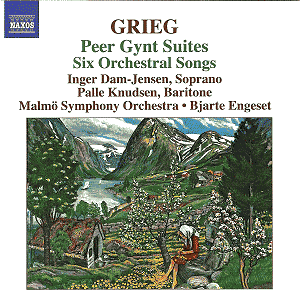
Edvard GRIEG (1843–1907)
Peer Gynt Suite No. 1, Op. 46 [14:39]
Peer Gynt Suite No. 2, Op. 55 [17:09] Det første møde (The first meeting) Op. 21, No.
1 (From Fire Digte fra “Fiskerjenten”) [3:48] Den Bergtekne (The Mountain Thrall), Op. 32 [5:59]
Six Orchestral Songs, EG 177: [24:10]
No. 1: Solveigs sang (Solveig’s Song) [4:50]
No. 2: Solveigs vuggevise (Solveig’s Cradle Song)
[3:53]
No. 3: Fra Monte Pincio (From Monte Pincio) [4:41]
No. 4: En Svane (A Swan) [2:18]
No. 5: Våren (The Last Spring) [4:14]
No. 6: Henrik Wergeland [4:14] Inger Dam-Jensen
(soprano) (op 21, songs 1-5), Palle Knudsen (baritone) (op.
32, song 6)
Malmö Symphony Orchestra/Bjarte Engeset
rec. Concert Hall of the Malmö Symphony Orchestra, Sweden,
23-24 May (suites), 29-31 May (op. 21 & 32, songs 1-5) and
25 August 2006 (song 6) NAXOS 8.570236 [65:45]
This is the fourth volume in the Naxos series of Grieg’s orchestral
music. The complete incidental music for Ibsen’s Peer
Gynt was recorded a couple of months ago and is due for
release next year (2008). The premiere of Peer Gynt was
in 1876 an event which Grieg deliberately avoided as he didn’t
trust the quality of the music! Despite his fears it was
a huge success and twelve years later Grieg finished the
first suite. It took another five years before suite No.
2 was published. Today they are among the most frequently
played works, not only amongst Grieg’s oeuvre but in the
entire orchestral repertoire. There is no shortage of recordings
but it is a special treat to have them played by one of the
foremost Norwegian conductors and a leading Scandinavian
orchestra. Bjarte Engeset is probably one of the musicians
who has penetrated Grieg’s works in the most depth. His extensive
liner-notes are characteristically all-embracing.
This music is not showy and virtuosic, as so many popular orchestral
pieces are. Grieg’s main intent was to create atmosphere
and several of the numbers are quite restrained. It has been
debated whether Morgenstemning (Morning Mood) really
fits with the scene that it illustrates, which takes place
in the Sahara. Anyway it as fine an opening of an orchestral
suite as one could wish, with the sun breaking through the
clouds at the first forte. Åses død (The Death
of Ase) is emotional and touching with its sighing ebb and
flow of dynamics. The exotic Anitras dans (Anitra’s
dance) is appropriately springy and elastic. Its rhythmic élan
recalls an incident almost sixty years ago, in 1949, when
Swedish pianist Charlie Norman recorded a boogie-woogie version.
The Grieg Foundation protested loudly and the record company
was forced to withdraw the rest of the edition, which had
already sold 10,000 copies; a lot in those days. Today nobody
would react; back then it was something of a scandal. Much
the same goes for I Dovregubbens hall (In the Hall
of the Mountain King) when it appeared in 1876. Bjarte Engeset
calls it “modernistic and innovative” and even now it has
the power to shock with its orgiastic abandon.
The second suite is no less atmospheric. Ingrids klage (Ingrid’s
lament) is a kind of counterpart to Åses død. Peer
Gynts hjemfart (Peer Gynt’s Homecoming) is stormy and
slightly reminiscent of Rimsky-Korsakov’s Scheherazade.
In the incidental music Solveigs sang is a soprano
solo but Grieg skilfully transcribed the beautiful melody
for orchestra alone. On this disc we also hear it in the
original vocal version as the first of the Six Orchestral
Songs.
Less than a year ago I reviewed a BIS disc with some Grieg
rarities – among
them the scenes from the intended opera to a libretto by
Bjørnson, Olav Tryggvason. This however was abandoned,
mainly due to the fact that Bjørnson, it seems, lost faith
in Grieg’s dramatic abilities and refused to provide any
more text. The disc was completed with lovely renderings
of the orchestral songs, sung by young Marita Solberg, whose
singing really appealed to me (see review).
On the present disc it is Danish soprano Inger Dam-Jensen – a
former Cardiff “Singer of the World” winner. Hers is also
a lyric voice but with resources to make the most of the
powerful pages. The two Solveig songs are beautifully executed. Fra
Monte Pincio is sung with textual insight and with both
lyric lightness and power. Dam-Jensen is grandly dramatic
in En Svane and invests Våren with that special
Nordic feeling that among Scandinavians has made this song
possibly the most loved musical celebration of springtime.
Both sopranos are highly accomplished and idiomatic. Picking
one in preference to the other is impossible.
The last song of the six, Henrik Wergeland is a homage
to the author (1808–1845) who also belonged to the leading circles
when a free Norway was emerging from the separation from
Denmark. It is allotted to the baritone Palle Knudsen, presumably
because someone felt the need of a more powerful, darker
interpreter. Dam-Jensen could have managed the song just
as well, since Knudsen’s is a small-scale reading; certainly
attractively sung but rather weak. The same goes for Den
Bergtekne, Grieg’s longest orchestral song. It is beautifully
lyrical but misses the intensity that singers like Knut Skram
and Håkan Hagegård invest in the song. Inger Dam-Jensen also
sings Det første mode with feeling.
The playing of the Malmö Symphony Orchestra is first class
and all through the programme one has that hard-to-define
feeling
that this is undisputedly right.

























 Inger Dam-Jensen
(soprano) (op 21, songs 1-5), Palle Knudsen (baritone) (op.
32, song 6)
Inger Dam-Jensen
(soprano) (op 21, songs 1-5), Palle Knudsen (baritone) (op.
32, song 6)