Like its fellows from the year 1725, Am
Abend aber desselbigen Sabbats, BWV 42, is a chorale cantata.
It takes the bulk of its inspiration from an existing hymn-tune
and develops the music from there. First performed on 8 April
1725, it is typical in taking the chorale theme and exploring
its musical potential before releasing it in clear identity
in the final chorale movement. Some scholars believe that Bach’s
congregation would have known these tunes well enough to join
in the when the cantata came to its close.
This cantata is exceptional for 1725, since
Bach found the associated Biblical verse, of the private appearance
of the risen Christ to the disciples, unsuitable for a choral
setting. Instead he began with a substantial da capo instrumental
movement. As ever Suzuki captures exactly the right tempo for
this, and the balance between winds, strings is perfect. Perhaps
Robin Blaze is recorded a little closely in his aria. However
he sings most expressively in this, one of the most extended
of all Bach’s da capo movements, at more than 13 minutes.
The other aria in this piece is most effectively delivered by
the bass, Dominik Wörner.
BWV 103, Ihr werdet weinen und heulen
(We shall weep and lament, but the world shall rejoice)
was written for Jubilate Sunday, 22 April 1725. There is a most
affecting opening chorus, replete with subtle woodwind counterpoints
to the string ensemble. These are beautifully balanced in the
texture by Suzuki, as structure and expressive meaning are so
subtly intertwined. Again the solo voices are on top form, with
James Gilchrist delivering his splendid aria to perfection.
From one volume to the next Suzuki assembles
an array of forces that seems perfectly judged for these cantatas,
and the SACD BIS sound helps articulate the musical delivery
so convincingly. The chorus numbers twelve, and there is always
plenty of atmosphere in the acoustic of the Kobe
Shuin Women’s University Chapel. There is no opening chorus
or sinfonia in BWV 108, Es ist euch gut, daß ich hingehe
(It is right that I go away), rather the music begins
with Dominik Wörner’s bass aria, and the instrumental ensemble
balances the voice most effectively, as Jesus sings his song
of farewell. James Gilchrist’s tenor aria is heard with a wonderful
obbligato violin, but possibly its most effective aspect as
realized here is the strong underlying pulse of the ostinato
rhythm.
In BWV 6, there is another cantata from
the closing weeks of Bach’s second year cycle, in other words
from the period around Easter. The background is another story
concerning the return of the resurrected Christ and his unexpected
appearance before (two of) the apostles. Here the musical construction
is more distinctive, perhaps, than in the other cantatas on
the disc. The opening chorus, for example, is cast in French
overture form, with a faster fugal central section at the centre.
Bach skilfully develops the two fugue subjects, and as ever
Suzuki judges the balancing and projection of the themes with
aplomb. Robin Blaze is on top form in his alto aria, combining
so imaginatively with the obbligato decoration of the oboe da
caccia. Later in the cantata the cello piccolo shares material
with the soprano, the excellent Yakari
Nonoshita, in one of Bach’s most distinctive and unusual voice-and-instrument
relationships.
The closing
chorale movements are simply delivered in all four of these
cantatas, making the musical and expressive point all the more
effectively. This is another splendid achievement by Masaaki
Suzuki and Bach Collegium Japan.
Terry Barfoot
























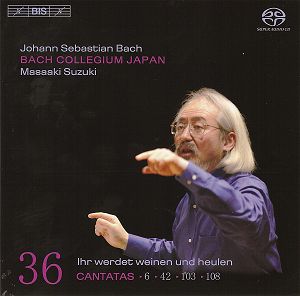

 Yakari Nonoshita
(soprano); Robin Blaze (counter-tenor); James Gilchrist (tenor); Dominik
Wörner (bass)
Yakari Nonoshita
(soprano); Robin Blaze (counter-tenor); James Gilchrist (tenor); Dominik
Wörner (bass)  [75:31]