Working
in Farringdon Records on Cheapside in London, we poor shop-floor
monkeys would occasionally be visited by a very nice Decca rep.
He handed out record tokens as a parting gift after genial Giovanni
the mad manager had put in improbably optimistic orders for
multiple copies of Schumann’s Davidsbündlertänze or some
such. The first LP I bought on the strength of this generosity
was ECM 1277, the 1984 recording of Harmonium with the
San Francisco Symphony Orchestra and Chorus conducted by Edo
de Waart. This was John Adams’s first commission during his
tenure as composer-in-residence with the San Francisco forces
from 1979 to 1985. It appeared in 1981, around the same time
as works such as Shaker Loops, and shared a similar sense
of the sonorous. It did however provide a more romantic, softer
and friendlier face for the fading fans of hard-line minimalism.
I
would be pushed to choose one performance and recording over
the other. Robert Shaw’s timings are shorter than De Waart’s,
but the massed voices and orchestra of Atlanta, all of whom
are named in the booklet, have an equal sense of scale and grandeur.
The recording is lush and gorgeous, but I have the impression
that Symphony Hall in Atlanta is a little drier as an acoustic
than the Davies Symphony Hall in San Francisco. The work has
not always been received in a positive light in live
performance, and the extended passages of atmospheric development
can appear a bit long-winded these days. This is a piece which
can stand or fall on the sense of expectancy and drama which
the conductor and musicians create. Adams’s skill in producing
grand gestures and well-orchestrated textures are thoroughly
explored here. The same goes for his ability to create new music
through a certain amount of musical ‘shopping’. There are a
few echoes of Stravinsky and others here and there, but the
biggest item for me, and one nobody seems to mention, is the
fleecing of Louis Andriessen’s De Staat for the final
movement, Wild Nights. You can’t call it plagiarism without
getting into trouble, but I don’t know any other composer who
would seriously imagine they could get away with it.
My
main reference for Rachmaninov’s The Bells has to be
a Russian one. I’ve sought out the 1985 Melodiya recording by
Dmitri Kitaenko conducting the Bolshoi Theatre Choir and Moscow
Philharmonic Symphony Orchestra which appeared in Europe on
the RCA/BMG label. Edgar Allan Poe’s text was in fact from the
outset substituted in this piece for a version by symbolist
poet Konstantin Balmont, so that singing the piece in the Russian
language ‘fits’ in many ways much better to my ears that the
American version sung on the Atlanta recording. Comparing the
two is like comparing chalk and cheese in other ways however,
with the Russian forces contrasting the grim and doom-laden
with more Respighi like colourations in the lighter movements.
The Atlanta forces sound more Hollywood than anything else in
the opening, and the gloriously plush brass and choir refuse
steadfastly to make the hairs stand on end, even when the bells
are ‘sobbing, in their throbbing, what a tale of horror dwells!’
No, there ain’t no horror here, and it all ends up sounding
rather jolly.
This
is not to say that this is a bad performance. There is plenty
of cracking playing, and while the chorus sounds a bit colourless
compared to the rough intensity of the Russian voices, they
do have plenty of dynamic unity. I’m certainly not one to claim
that only Russian musicians can perform this or any other manifestly
Russian-manufactured music. Victor Ledbetter is a powerful soloist,
as is Renée Fleming, and if Karl Dent is a little less forceful
then he certainly makes up for it in musical sensitivity and
expression. If the language is not a barrier then you will probably
end up with little to complain about with this recording. The
booklet notes have a useful and fairly detailed analysis of
the piece by Nick Jones, including numerous musical illustrations
and pointing out Rachmaninov’s allusions to other pieces. I
just found myself recognising these references more in the Russian
recording than in this one, as well as the influence it must
have had on later composers such as Shostakovich. It may be
that the Russian ‘sound’ brings more familiarity than with the
Americans, but I found myself a little frustrated by the relaxed
luxury of the whole thing. It’s all a little too well-fed and
healthy to make it really moving.
With a living American
composer and a Russian from a country on the brink of revolution
looking at each other from across the Atlantic with works of similar
scale and magnitude, this is in fact not quite the strange coupling
one might imagine. The accessibility of Adams’s writing in Harmonium
chimes in well with Rachmaninov’s The Bells, and while
there is as much to contrast as to compare, the dramatic content
of both works ultimately contains similar aims. I think I would
take de Waart’s marginally more vibrant ECM recording of the former.
Have a listen to the LSO chorus and orchestra with André Previn
on EMI for an alternative Western recording - sung in Russian
- for the Rachmaninov if you get the chance. This release also
includes a powerful recording of Prokofiev’s Ivan the Terrible.
John Adams’s Harmonium is also available on Nonesuch
with a decent coupling of the Klinghoffer Choruses if the
idea of buying a CD with only 32 minutes of music appals. If you
like the idea of having both of these pieces on one disc then
there’s plenty to enjoy with Robert Shaw, but I find The Bells
too much of a flock-lined compromise to make this a 100% recommendation,
even at budget price.
Dominy Clements






















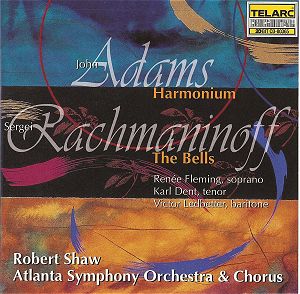

 Atlanta Symphony
Orchestra and Chorus/Robert Shaw
Atlanta Symphony
Orchestra and Chorus/Robert Shaw