Editorial Board
MusicWeb International
Founding Editor Rob Barnett Editor in Chief
John Quinn Contributing Editor Ralph Moore Webmaster
David Barker Postmaster
Jonathan Woolf MusicWeb Founder Len Mullenger
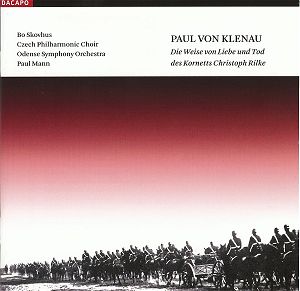
Paul von KLENAU(1883-1946) Die Weise von Liebe und Tod des Kornetts Christoph Rilke (1919) Bo Skovhus (baritone)
Czech Philharmonic Choir of Brno
Odense Symphony Orchestra/Paul Mann
rec. Carl Nielsen Hall, Odense, 28-31 August, 1-2, 4-6 September 2006
recorded in cooperation with the Danish Broadcasting Corporation DACAPO
6.220532 [71:21]
This is the third Klenau disc from
Dacapo. He was born in Copenhagen yet spent most of his life
in Germany and Austria. In Copenhagen he was a pupil of Otto
Malling but in 1902 was studying composition with Bruch in
Berlin. Later studies were conducted with Thuille in Munich
and Max von Schillings in Stuttgart. In 1913 he was appointed
principal conductor at the opera house in Freiburg. He founded
and conducted the Danish Philharmonic Society 1920-26, a
period during which he promoted the music of Arnold Schoenberg.
There was even a visit by the Master in 1923 for an all-Schoenberg
concert. After this Klenau was a conductor in Vienna and
Stuttgart. He returned to Copenhagen in 1940 and died there
in 1946.
His Third
Symphony was premiered in Strassburg with Pfitzner conducting.
The Klenau style moved from German romanticism (Strauss and
Von Schillings) toward the lyrical bejewelled expressionism
of Zemlinsky and Schreker and onwards into dodecaphonics
and then back to toanlity. Opera certainly caught his attention
and there are three twelve-tone operas: Michael Kohlhaas (1932-3), Rembrandt
van Rijn (1934-5) and finally Elisabeth von England (1939);
the latter variously re-titled in the political environment
of the time. The wonder is that such a style was acceptable
during the Nazi era although Klenau was a resourceful disputant
and managed to present the style as fully consistent with
National Socialist values and dogma. The notes point out
that during his last five or six years he discarded dodecaphonics
and concentrated on the writing of five symphonies (numbers
5 to 9) and another opera.
Die
Weise,to
words by Rilke, is for baritone, mixed choir and orchestra
and was completed in 1919. The style moves ecstatically
between the early melodic Schoenberg of Gurrelieder and
the Delius of Once I Dwelt in a Populous City.
Klenau set the whole poetic sequence but divided it into
three segments with 27 chapters, each of which is separately
tracked here. Klenau conducted the premiere in 1924 at
the Wiener Konzerthausgesellschaft.
The work
is sung in German with a fresh voiced Bo Skovhus who manages
to catch and sustain the noble innocence of the man whose
story he recounts. This is related in the third person observing
the exploits and fate of Christoph Rilke von Langenau.
The music
parallels the interwoven themes of the life of a noble hussar,
the confidences he shares with his companions, his pride
in battle, his love for his mother, his awakening to manhood,
his vulnerability, his experiences of battle and his death.
Orchestral
effects are delicately and finely judged. A defiant sprightly
military piping can be heard in tr. 8 with choir and soloist
lending a weighty threat to the proceedings. Listen to the
piano and avian woodwind underpinning in tr. 3. Things become
more barbaric and bloodier yet. In this the choral music
reminded me, in its wild massed clamour, of Havergal Brian's Siegeslied (Symphony
No. 4) (tr. 8) and The City Arming movement in Bliss's Morning
Heroes. In tr. 6 there is a rapturously dreamy colloquy
between the sighing Delian choir and Skovhus - just glorious.
The Delian references are not over for the woodwind curlicues
at the end of tr. 6 recall the music of the fountain in Delius's
music for Hassan. Just occasionally as in trs. 4 and
7 you catch echoes of Mahler but these are not numerous.
There
is a strange episode during which the Cornet (cavalry standard
bearer), on a moonlit ride, finds and
liberates
a bloodstained woman tied to a tree. The woman is represented
by the strange cries of a soprano from the choir, Hana
Skaroba. The pulse of cavalry hooves can be heard in the underpinning
ostinato in tr. 13 as the troops draw near an isolated
castle
where they relax and enjoy the gentle company of women
again. The Cornet is gently seduced by the Countess but not before
some astonishingly beautiful dreamlike music rising almost
imperceptibly to passion in tr. 17. I mentioned Schoenberg
earlier on but in this we are talking very early
Schoenberg. The music is lushly romantic in the manner
of Zemlinsky and
Schulhoff as represented by Randi Stene on that recent
Simax disc. A winding and quietly lapping woodwind figure
weaves
in and out of the second half of this work. Indeed it ushers
the work to its tranced close as, after the death of the
Cornet in battle, his elderly mother is told of his death.
I heard this hybrid SACD in standard
CD mode.
If you
like the lapidary romanticism of Korngold, Schreker, Zemlinsky
and Schulhoff with a dash of early Schoenberg and Delius
then this is most certainly for you. Quite a discovery
to set beside the less voluptuous setting by Frank Martin.

























 Bo Skovhus (baritone)
  [71:21]