Editorial Board
MusicWeb International
Founding Editor Rob Barnett Editor in Chief
John Quinn Contributing Editor Ralph Moore Webmaster
David Barker Postmaster
Jonathan Woolf MusicWeb Founder Len Mullenger
Buy
through MusicWeb
from £10.04 postage
paid. You
may prefer to pay by Sterling cheque or
Euro notes to avoid PayPal. Contact
for details
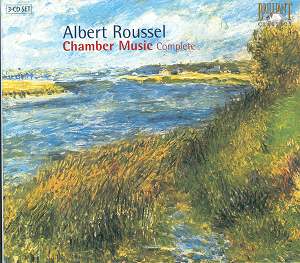
Albert
ROUSSEL(1869-1937)
Chamber Music: Complete
Piano Trio in E flat major, Op.2 (1902)
[28:08] 1
Divertissement, for wind quintet and piano,
Op.6 (1906) [6:28] 2
Sonata no.1, in D minor, for piano and
violin, Op.11 (1907-8) [32:30] 3
Impromptu, for harp solo, Op.21 (1919)
[6:48] 4
Deu poèmes de Ronsard, for flute
and soprano, Op.26 (1924) [7:49] 5
Joueurs de flûte, for flute and
piano, Op.27 (1924) [9:08] 6
Sonata no.2, for piano and violin, Op.28
(1924) [14:02] 3
Segovia, for guitar, Op.29 (1925) [3:08]
7
Sérénade, for flute, string
trio and harp, Op.30 (1925) [15:44] 8
Duo for bassoon and double bass (1925)
[4:07] 9
Aria no.2, for oboe and piano (1927-8)
[2:11] 10
Trio for flute, viola and cello, Op.40
(1929) [13:55] 11
String Quartet, Op.45 (1931-32) [19:48]
12
Andante and Scherzo, for flute and piano,
Op.51 (1934) [4:46] 6
Pipe, for piccolo and piano (1934) [0:57]
13
String Trio, Op.58 (1937) [13:31] 14
Music from Elpénor, Poème
radiophonique, for flute and string quartet,
Op.59 (1937) [8:00] 15
Andante, from an unfinished Wind Trio,
for oboe, clarinet and bassoon (1937)
[3:13] 16 1 Jet Röling (piano), Jean-Jacques
Kantorow (violin), Herre-Jan Stegenga
(cello); 2 Jet Röling
(piano), Paul Verhey (flute), Hans Roerade
(oboe), Frank van den Brink (clarinet),
Herman Jeurissen (horn), Jos de Lange
(bassoon); 3 Jean-Jacques Kantorow
(violin), Jet Röling (piano); 4
Erika Waardenburg (harp); 5
Irene Maessen (soprano), Paul Verhey (flute);
6 Paul Verhey (flute), Jet
Röling (piano); 7 Jan
Goudswaard (guitar); 8 Paul
Verhey (flute), Erika Waardenburg (harp),
Janneke van der Meer (violin), Henk Guittart
(viola), Viola de Hoog (cello); 9
Jos de Lange (bassoon), Quirijn van Regteren
Altena (double bass); 10 Hans
Roerade (oboe), Jet Röling (piano);
11 Paul Verhey (flute), Henk
Guittart (viola), Herre-Jan Stegenga (cello);
12 Schönberg Quartet:
Janneke van der Meer (violin), Wim de
Jong (violin), Henk Guittart (viola),
Viola de Hoog (cello); 13 Paul
Verhey (piccolo), Jet Röling (piano);
14 Janneke van der Meer (violin),
Henk Guittart (viola), Viola de Hoog (cello);
15 Paul Verhey (flute), Janneke
van der Meer (violin), Wim de Jong (violin),
Henk Guittart (viola), Viola de Hoog (cello);
16 Hans Roerade (oboe), Frank
van den Brink (clarinet), Jos de Lange
(bassoon)
rec. April, June, December 1994, The Old
Catholic Church, Delft
BRILLIANT CLASSICS 8413 [3 CDs: 67:43
+ 64:44 + 66:31]
This complete recording
of the chamber music of Albert Roussel
– in chronological order – was previously
issued, in the mid-1990s, on the Olympia
label (Olympia OCD 706).
The works fall fairly
naturally into divisions that correspond
to the three CDs. On the first, we have
the first three works listed above,
covering the years from 1902 to 1908;
the second CD contains works written
between 1919 and 1928; the third collects
the chamber music written in the last
eight years of Roussel’s life, between
1929 and 1937.
Roussel’s path towards
a career as a composer was a rather
unorthodox one. Roussel (who has been
orphaned very young), first received
piano lessons at the age of eleven;
an interest in music soon developed,
but on leaving school he studied at
Marine College in Brest, and went on
to become a naval officer, eventually
commanding a torpedo boat in Indochina.
His career at sea ended in 1894, when
he resigned his commission and he took
the decision to devote himself to music.
He studied in Paris, first with Eugene
Gigout and, from 1898, with Vincent
d’Indy at the Schola Cantorum; he did
so with such success that in 1902 he
was invited to teach counterpoint at
the Schola (where one of his students
was Satie). He was in the anomalous
position of being both student and Professor.
Indeed, there is, perhaps unsurprisingly,
a thoroughly academic quality to both
the Op.2 Piano Trio and the Sonata for
piano and violin (Op.11). Both have
a long-windedness that was not to remain
characteristic of Roussel, whose mature
work is more readily characterised as
terse. In these two early works, it
would be fair to say that Roussel the
composer has not yet found his own voice.
They are the product of his teaching
(whether as teacher or as taught), perfectly
‘correct’, and thoroughly committed
to the kind of cyclic procedures of
which d’Indy was an enthusiastic advocate.
They are pleasant enough – particularly
the sonata – but don’t really grip or
intrigue in any very compelling fashion.
The ‘real’ Roussel
is perhaps first discernable in the
Divertissement for piano and wind quintet.
There is more of his rhythmic quirkiness,
there are more adventurous harmonies.
Essentially a rondo, structurally speaking,
the contrasts between its rapid passages
and its rather dreamy slower sections
makes for some deliciously crisp music,
the musical equivalent of a dry white
wine. It gets an engaging performance
here, its twists and turns relished,
run round the palate as it were, but
nothing is lingered over excessively,
nothing rushed.
After these early works
Roussel’s musical attention very much
switched to orchestral writing and to
the composition of his opera-ballet
Padmâvatî, stimulated
in part by the visit he and his wife
made to India in 1909, a year after
their marriage. It was only some ten
years later that Roussel began, again,
to write chamber music. The oriental
interests which prompted the writing
of Padmâvatî are
audible in the Impromptu for harp of
1919. Roussel avoids most of the clichés
of the harp music of the time, and the
three-note motif at the beginning, as
it transmutes into the mildly hypnotic
main theme which succeeds it, has a
distinctive quality that is peculiarly
Rousselian, and also underlies most
of the succeeding sections of the Impromptu.
The two settings of
Ronsard are attractive and mildly haunting,
without perhaps being entirely satisfying
or especially memorable. Much more striking
is Joueurs de flute. Its four
short(ish) movements are dedicated to
four legendary or fictional players
of the instrument: Pan, Tityrus, Krishna
and, rather less well known, Monsieur
de la Péjaudie, hero of Henri
de Régnier’s 1920 novel La
Pécheresse. The moods and
materials of the four pieces are nicely
distinguished. ‘Pan’ (dedicated to Marcel
Moyse, later to teach James Galway)
has some lean melodic lines which gradually
evolve into fuller statement, while
never losing the dignity of Pan’s status
as a divinity; ‘Tityre’ (dedicated to
another important flautist, Gaston Blanquart)
is a short, quasi rustic dance, befitting
Tityrus’ station as a shepherd (however
poetic) in Virgil’s Eclogues.
‘Krishna’, in 7/8 and using an Indian
mode (‘Shri’), is bewitchingly sensuous
and languorous, the interplay of flute
and piano particularly lovely (‘Krishna
was dedicated to Louis Fleury, flautist
at its first performance in Paris in
1925); the brief ‘M. de la Péjaudie’
(dedicated to Philippe Gaubert) has
a rather less timeless quality, and
speaks much more directly of the early
twentieth century, not least in its
bustle and seeming uncertainty of tone
and direction. Paul Verhey and Jet Röling
give an eloquent and persuasive performance
of this excellent suite.
The second Sonata for
Piano and Violin is certainly more rewarding
than its predecessor. Its opening allegro
con moto has a sense of drama and insistent
expressiveness, while the central Andante
is quietly beautiful, fusing grace and
terseness in a manner which is the very
essence of Roussel and, perhaps also
typical, not entirely without moments
of darkness too. The Presto which closes
the Sonata is a concise dance, of sorts,
drily witty and sharp. The performing
partnership of Kantorow and Röling
works very well together, some of Kantorow’s
phrasing and variety of tone being especially
pleasing.
Roussel’s Segovia
is an attractive musical tribute to
the great guitarist, and Jan Goudswaard
conveys much of its charm, but his performance
is somewhat compromised by a less than
vivid recorded sound. A shame, especially
as the recorded sound is generally good
on these three discs. Certainly there
are no sound problems in the Op.30 Serenade.
Indeed, the recorded sound lets us hear
very well what Roussel makes of his
unusual combination of instruments.
The Serenade is one of Roussel’s
finest works. The initial allegro has
a kind of impudent and easy panache,
the instrumental colours filling in
around and behind the flute with an
almost conversational ease; the slow
movement has an air of mystery, of a
vaguely tropical (Indian?) sensuality
which seems more religious than sexual;
there is more direct eroticism in the
final movement, with its opening and
closing dance rhythms (which could have
borne a bit more incisive aggression
in the performing) framing a central
section in which all energy seems exhausted,
all senses fulfilled. As with a few
of the pieces on this set, the Serenade
perhaps doesn’t get the very best performance
it has ever had, but it gets an intelligent,
accomplished reading, well worth hearing
by those who know the work well and
admirably suited as an introduction
for those who don’t.
The Duo for bassoonand double bass is altogether
slighter, but good fun. It was written
for Koussevitzky (a virtuoso of the
double bass) on the occasion of his
being made a member of the Legion d’honneur.
It is a playful piece which enjoys the
improbable combination of instruments
and the sonorities available through
it. The Aria No.2, an arrangement
for oboe and piano, made by Arthur Hoérée,
of one of the Vocalises written by Roussel
for voice and piano, is pleasantly lyrical,
even if not a work of any great substance.
On the third CD there
are a few pieces which are, for one
reason or another, do not make especially
significant contributions to the body
of Roussel’s work. Pipe was written
as an instructional piece for the recorder
and is a pretty slight affair; Elpénor
was written as part of a radio programme,
designed to complement poems by Joseph
Weterings and heard as a suite it is
somewhat meandering, certainly by the
tight formal standards one comes to
expect from the mature Roussel. The
Andante and Scherzo for flute and piano
don’t find Roussel writing as well for
the flute as he usually does. The andante
from the Wind Trio left unfinished at
Roussel’s death is perhaps more of a
curiosity than anything else. Elsewhere
there are works of rather more gravity.
Roussel’s only String Quartet is a minor
masterpiece of concision, and gets an
excellent performance from the Schönberg
Quartet, played as it is with fine judgement
of tempo and dynamics and with real
commitment. I am surprised that we don’t
hear this quartet more often; apart
from its own intrinsic merits, its relative
brevity would surely make it useful
balance in quartet recitals built around
a couple of longer works. There are
some acerbic yet engaging passages in
the opening allegro, an attractively
worked out sonata; the adagio has real
weight and suggestiveness and the both
the scherzo of the third movement and
the partially fugal final movement are
full of compressed and thoughtful music.
Members of the Schönberg
Quartet are on hand again in a fine
account of the String Trio, the last
work Roussel completed, barely a month
before his death (he had a good deal
of ill health in the last ten years
of his life). It isn’t, I think, only
the advantage of hindsight that persuades
one of the presence of a kind of haunted
pain in much of this trio; the allegro
seems more a ghost of previous Rousselian
allegros, lacking the sheer substance
of the ‘real’ thing; the long and marvellous
central adagio is at times disturbingly
poignant, at times marked by a kind
of wistful resignation; the closing
scherzo teeters on the edge of the grotesque,
its elegance distorted into a kind of
macabre dance. The String Trio is quite
a powerful work, in a somewhat discomforting
manner, the work, surely, of a composer
who knew he hadn’t long to live. The
other work of substance on this third
disc, the 1929 Trio for flute, viola
and cello is altogether less troubled.
Its three movements are models of Roussel’s
neoclassicism, etched like figures on
a frieze, the edges clear, the statements
aphoristic. After the slightly false
start of his very early work, Roussel
developed as a composer who hardly ever
wasted a note; he says enough and no
more. His music isn’t to all tastes
and certainly it is rarely music that
invites self-indulgence on the listener’s
part, any more than it is ever self-indulgently
written.
This attractively packaged
set is a convenient assemblage of Roussel’s
work in the field of chamber music,
a sequence of works characterised by
the acute, even astringent, intelligence
that has gone into their writing and
the distinctive beauty of at least some
of the results. In some cases better
performances of individual works can
be found; but there is nothing here
that isn’t at the very least assured
and accomplished. Either as an invitation
to get to know one aspect of the work
of a composer who still seems to me
rather underrated, or as a ‘library’
set, or as a genuine source of musical
pleasure, this is a reissue much to
be welcomed.
Glyn Pursglove
Please support our advertisers below by clicking on the logos for further information.
























 for details
 1 Jet Röling (piano), Jean-Jacques
Kantorow (violin), Herre-Jan Stegenga
(cello); 2 Jet Röling
(piano), Paul Verhey (flute), Hans Roerade
(oboe), Frank van den Brink (clarinet),
Herman Jeurissen (horn), Jos de Lange
(bassoon); 3 Jean-Jacques Kantorow
(violin), Jet Röling (piano); 4
Erika Waardenburg (harp); 5
Irene Maessen (soprano), Paul Verhey (flute);
6 Paul Verhey (flute), Jet
Röling (piano); 7 Jan
Goudswaard (guitar); 8 Paul
Verhey (flute), Erika Waardenburg (harp),
Janneke van der Meer (violin), Henk Guittart
(viola), Viola de Hoog (cello); 9
Jos de Lange (bassoon), Quirijn van Regteren
Altena (double bass); 10 Hans
Roerade (oboe), Jet Röling (piano);
11 Paul Verhey (flute), Henk
Guittart (viola), Herre-Jan Stegenga (cello);
12 Schönberg Quartet:
Janneke van der Meer (violin), Wim de
Jong (violin), Henk Guittart (viola),
Viola de Hoog (cello); 13 Paul
Verhey (piccolo), Jet Röling (piano);
14 Janneke van der Meer (violin),
Henk Guittart (viola), Viola de Hoog (cello);
15 Paul Verhey (flute), Janneke
van der Meer (violin), Wim de Jong (violin),
Henk Guittart (viola), Viola de Hoog (cello);
16 Hans Roerade (oboe), Frank
van den Brink (clarinet), Jos de Lange
(bassoon)
1 Jet Röling (piano), Jean-Jacques
Kantorow (violin), Herre-Jan Stegenga
(cello); 2 Jet Röling
(piano), Paul Verhey (flute), Hans Roerade
(oboe), Frank van den Brink (clarinet),
Herman Jeurissen (horn), Jos de Lange
(bassoon); 3 Jean-Jacques Kantorow
(violin), Jet Röling (piano); 4
Erika Waardenburg (harp); 5
Irene Maessen (soprano), Paul Verhey (flute);
6 Paul Verhey (flute), Jet
Röling (piano); 7 Jan
Goudswaard (guitar); 8 Paul
Verhey (flute), Erika Waardenburg (harp),
Janneke van der Meer (violin), Henk Guittart
(viola), Viola de Hoog (cello); 9
Jos de Lange (bassoon), Quirijn van Regteren
Altena (double bass); 10 Hans
Roerade (oboe), Jet Röling (piano);
11 Paul Verhey (flute), Henk
Guittart (viola), Herre-Jan Stegenga (cello);
12 Schönberg Quartet:
Janneke van der Meer (violin), Wim de
Jong (violin), Henk Guittart (viola),
Viola de Hoog (cello); 13 Paul
Verhey (piccolo), Jet Röling (piano);
14 Janneke van der Meer (violin),
Henk Guittart (viola), Viola de Hoog (cello);
15 Paul Verhey (flute), Janneke
van der Meer (violin), Wim de Jong (violin),
Henk Guittart (viola), Viola de Hoog (cello);
16 Hans Roerade (oboe), Frank
van den Brink (clarinet), Jos de Lange
(bassoon)