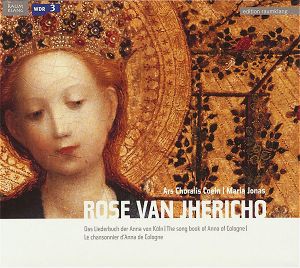
This is the kind of recording that Deutsche
Harmonia Mundi used to do so well before it became swallowed
up in multiple international take-overs: little-known music
made attractive in stylish and enjoyable performances, well
recorded in a co-production with West German Radio. Those of
an adventurous musical disposition need read no further – go
out and support Raumklang’s enterprise.
When I offered to review
this CD I had no idea who Anna von Köln was or what her songbook
consisted of. Thanks to the booklet which comes with the CD
I am now a little better informed but have still had to make
some assumptions about matters which are not covered by the
notes. The booklet is already thick enough to fit with difficulty
in its pouch within the gatefold triptych – it would probably
have been too thick to fit inside a conventional CD case – so
it is mean of me to complain that there is more that I should
have liked to have been told, but more information would have
been very welcome, for example, about how much the music needed
to be edited for these performances.
Two related movements in
late-medieval Christianity, the devotio moderna and the
Common Life combined to produce the songbook. The best-known
achievement of the devotio moderna movement was Thomas
à Kempis’s Imitation of Christ, a work which has been
translated many times in many languages. The artist Brueghel
appears to have been influenced by this movement, the aim of
which was to make religion more accessible to ordinary people,
hence the illustration of biblical or moral themes in Brueghel’s
paintings. Alongside this movement and influenced by it was
the so-called Brotherhood of the Common Life, a lay organisation
with links to the Augustinian Canons. The Brotherhood embraced
a kind of middle way between the secular and monastic states
and its members were much involved in evangelisation and good
works. It was through their good offices that Erasmus joined
the Augustinian Canons and received the education which was
to make him one of the leading lights in renaissance humanism.
Both movements flourished in the lower Rhine area, the area
with which Anna is associated, and both stressed the use of
the vernacular as a teaching instrument, hence the predominance
of texts in German here over those in Latin. Hence, too, the
use of the familiar and everyday to express profound concepts:
Laist ons syngen, track 1, depicts Jesus as an innkeeper,
serving the wine of love to intoxicate his people. That the
songbook is attributed to a woman reminds us of the place of
women in the devotio movement.
Though Erasmus was associated
with these movements, it must not be supposed that they represented
some kind of proto-protestant belief. (Indeed, Erasmus himself,
who had criticised many of the faults of medieval Catholicism
which led to Luther’s Theses, soon parted company with Luther
over the issue of Free Will.) Though emphasising Christ-centred
religion, especially concentrating on the nativity – the subject
of several of these songs – at the same time the Brotherhood
and the devotio moderna also stressed devotion and prayer
to the Virgin Mary and her mother Saint Anne and these are prominent
in the music on this CD. Most of the songs include praise of
or intercession to the Virgin or, in the case of Mater sancta,
to St Anne also. Luther himself had an abiding special regard
for St Anne, whose intervention he regarded as having saved
him from a serious illness, but after the break with Rome he
came to regard prayer to the saints as futile.
The songs present a microcosm
of late-medieval piety, with its special stress on the transitory
nature of the world and all its deceits and the uncertainty
of when death will strike. Audi tellus, track 15, presents
the familiar medieval rhetorical question Ubi sunt? –
where are those who once were great? Famous biblical and classical
personalities are named together as having passed away “according
to the law of mortals.” The theme may be morbid but the treatment
is not: Nu hoirt, track 2, is a warning about death but
the jaunty rhythm is perhaps meant to suggest the familiar late-medieval
theme of the Dance of Death. Here, for once, the prominent rhythmic
harp accompaniment is not inappropriate. Mention of the blind
leading the blind in this rhythmic context reminds us of the
Brueghel painting of the blind men reeling along the road and
about to fall into the ditch together.
A common feature of late
medieval piety encouraged the believer to identify with the
passion of Christ. The Mirror of the Life of Christ,
a text mis-attributed to St Bonaventura, was especially influential
in England in encouraging this practice, so taken to heart by
the remarkable Margery Kemp that she was often rebuked for wailing
in church as the priest consecrated the sacrament. Stetit
ihesus, track 16, provides an example of such affective
identification with the sufferings of Jesus.
The title of the CD, Rose
van Jherico, taken from track 12, emphasises the centrality
of the Virgin in this music. During the middle ages more and
more different types and titles came to be associated with Mary
and Rose of Jericho (i.e. a rose without thorns) was
one of these. Maris stella, star of the sea (track 17)
was another. So too was the identification of Mary with the
woman clothed in the sun and with the moon beneath her feet
named in Revelation, another attribution of Mary referred to
in track 12:
Die myt der sonnen
is gekleit
Tu es plena gratia
De mane onder de
voesse spreit
Aue maria.
(She is clothed with the
sun, Thou art full of grace, The moon is pread beneath her feet,
Hail Mary.)
For a list of these attributions
as used in medieval poetry, see R T Davies, Medieval English
Lyrics (London: Faber, 1963), pp.371-8.
Those fluent in modern
German will have noted from this brief quotation that late-medieval/early-modern
German is not exactly easy to follow. This is especially true
for the lower Rhine area, where a number of dialects coalesce;
even today, the dialect of Cologne, known as Kölsch, is very
hard to follow. A generally reliable modern German translation
is provided in the booklet but English and French readers have
to be content with a summary of each song. The orthography of
some of the Latin texts is also peculiar – yn for in,
for example – though some of the peculiarities may be misprints
in the booklet (facte for fac te, perhaps).
What is surprising is that
there is nothing here to suggest the kind of late-medieval music
which was developed by Luther in the well-known form of the
Lutheran unison chorale. Two of the pieces, Puer natus in
bethleem (track 7) and In dulci jubilo (track 9)
did attain rebirth at the hands of Lutheran composers, notably
Praetorius, though in forms different from those heard here:
even the macaronic (two-language) text of In dulci jubilo
was changed somewhat and shorn of its Mariolatry in the following
century.
There is a great variety
of music here. The dance-like Nu hoirt is followed by
the plainsong-like music of Te celi reginam, an elaborate
imitation of the Te Deum in honour of the Virgin Mary.
Nearly all the music is of great beauty and it is beautifully
performed, some of it in instrumental realisations, some sung
solo, the rest performed by a small choir, sometimes in a simple
form of antiphony. The vocal items are accompanied and this
accompaniment sometimes is too obtrusive, with the vocalists
set well back and the instruments seeming more forward. The
instrumental playing is beautiful in itself – the purely instrumental
tracks, 10, 14 and 19, very well performed – but Christ’s words
of comfort in O laist ons (track 13) are almost drowned
by the accompaniment of the harp and dulcimer. Elsewhere the
bells are too prominent. The acoustic sounds suitably ecclesiastical:
the recording was made at a monastery near Brühl, not far from
the home of Anna herself and of the performers.
Some of this music must
have sounded old-fashioned by 1500; some of it, indeed, sounds
like the music of Hildegard of Bingen centuries earlier. How
much this is because of the manner of the performances I am
not sure, but I note that this ensemble has performed with Sequentia
on an earlier CD and it may be that they have absorbed some
of the style with which Sequentia perform the music of Hildegard
on a number of DHM CDs. The instrumentation employed here is
very similar to that which Sequentia and other ensembles employ
in interpreting medieval music – a very different philosophy
from that of, for example, Gothic Voices, whose director Christopher
Page mostly eschews instrumental accompaniment. The booklet,
full though it is, makes no mention of the extent to which the
raw notes on the page have been edited and interpreted to produce
the sound which we hear. Are the antiphonal effects which we
hear, for example, in Audi tellus, track 15, original
or editorial? Or, again, how original is the other-worldly accompaniment
to Mit vrouden quam der engel? Or the bells in Puer
natus and Jure plaudant?
The final song, Wail
up ich moes van hinnen, track 20, rounds off the disc effectively
with a farewell to the world, a theme familiar from St Augustine’s
reminder that the earthly city is not our true abode. The music
is beautiful, as befits a song which evokes der suesser engelen
sanck, the song of sweet angels, but the notes in the booklet
admit to some doubt as to the origin of this setting: it may
just have been composed by the late eminent musicologist Barbara
Thornton. Whatever its provenance – for what it’s worth, it
sounds to me like a distant relative of a well-known farewell
song, Innsbruck ich muss dich lassen – it is beautifully
sung, with a smaller group singing the stanzas and the larger
group the refrain.
Minor criticisms apart,
this is a delightful recording. Much of the music is little short
of ethereal and the performances, from the soloists, ensemble
and instrumentalists, and the recording are very satisfying.
Brian
Wilson